
“To all Classes of the Community”: John McLeod’s Schools and the Washington Navy Yard and Capitol Hill Samplers
Jenny Garwood
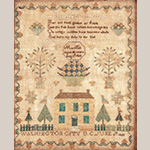
In 1846 the city of Washington mourned John McLeod, a man who for more than thirty-five years had operated a series of four successful schools that grew in both popularity and size over the course of his life. Halfway through his career, in 1822 he could accommodate around 300 boys and girls at his Central Academy and was said to have “done more by his system of education for the rising generation than any other man who ever resided among us.”[1] Two years before his death, McLeod reflected on his long and successful career stating that “It will be thirty-six years this day, the 10th of May, since I opened at the Navy Yard with only four scholars. [Since then] I have had some thousands under my care.”[2] Later in his life he boasted to have taught “more pupils than any other teacher in the Union.”[3] However, it was not … Continued
Guest Editor’s Introduction: New Discoveries: The Ever-Expanding South
A. Nicholas Powers
The American South is a dynamic, ever-expanding place. Each year, museum curators and scholars discover previously unknown objects and uncover stories that change (or in some cases reinforce) our perspectives on the lives of early Southerners and their cultural traditions. Long known for publishing groundbreaking research on the decorative, fine, folk and self-taught art, and material culture of the early South, MESDA is now providing a new platform for both emerging and established scholars. The “New Discoveries” feature of the MESDA Journal now provides museum professionals the opportunity to share short-form research notes highlighting significant new acquisitions and discoveries within their collections. Through the New Discoveries feature, the latest discoveries in southern culture will become available at the click of a button or the swipe of a screen. Lea Lane’s accompanying article exploring the significance of a rare stoneware jug by French-émigré potter Augustin Marchal is the perfect introduction for … Continued
New Discoveries: Alabama Pottery with a French Accent: MESDA’s Recently Acquired Jug by Augustin Marchal
Lea C. Lane
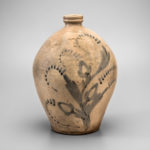
In 2022, MESDA expanded its collecting and research focus to include Alabama as our eighth state. We celebrated this long-contemplated move with the exhibition Thrown Together: Pots and People of Early Alabama in 2023. Before the exhibition opened, we were alerted to a remarkable jug coming to auction at Crocker Farm, Inc. [1] It became MESDA’s first acquisition of an Alabama object and immediately went on view alongside other ceramic treasures from the state (Figure 1 and 2).[2] The jug acquired by MESDA is attributed to the shop of Augustin Marchal (b. 1810).[3] Soft blue leaves curl up the sides of the vessel, culminating in dotted arcs that echo the overall shape of the object. It may perhaps be a representation of a cotton plant; the tulip-like shapes resemble the bolls that eventually mature into billowy puffs of fibers, and the dashed arches could arguably represent that later stage of … Continued
Lewis Clephan: Painter and Portrait Artist of Washington, DC
Carolyn J. Weekley
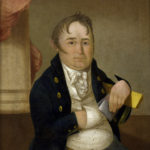
The United States’ new capital city was an odd choice for a portrait painter at the end of the eighteenth century. While Boston and New York were centers of artistic training and activity, when Washington was founded in 1790 it was sometimes referred to as the “Mud Hole” and the “Wilderness City.”[1] Washington resident Marcia Burnes Van Ness went so far as to note that the city had “trails for streets that ran between surveyor’s stakes in the tobacco fields.”[2] Adding further color to early accounts of the city, in 1834, William Dunlap, an artist and chronicler of the arts and theater, republished exaggerated remarks by one writer who had described Washington at the end of the eighteenth century as “morass and forest, the abode of reptiles, wild beasts, and savages.”[3] A developing city bustling with building activity, Washington may not have been an artist’s dream locale, but it was … Continued
© 2025 Museum of Early Southern Decorative Arts