
For generations, a garden bloomed between the pages of a notebook. Opening its marbled paper covers reveals pages of mathematical exercises, as well as a collection of more than 600 floral needlework patterns drawn by Lady Jean Skipwith during the late eighteenth and early nineteenth centuries. Born to Hugh and Jane Miller of Prince George County, Virginia, Jean spent much of her adolescence and young adulthood in Scotland. In 1788, she married her widowed brother-in-law, Sir Peyton Skipwith, and moved to Prestwould plantation in Mecklenburg County, Virginia.[1] The following year, she gave birth to her first daughter, Helen. As a girl, Helen used the notebook that would later house her mother’s needlework patterns to demonstrate her knowledge of addition, subtraction, multiplication, and division. Once completed, its pages testified to her ability to manage household accounts, convert currencies, and calculate the weight of valuable goods. The Colonial Williamsburg Foundation acquired the notebook and needlework patterns in 2002.[2] Today, these manuscripts speak to the close relationship between intellectual and creative labor in the early American South.
While none of the patterns are signed, several are cut from letters and manuscripts that were either written in Jean’s hand or refer to life at Prestwould. One pattern is cut from a list of books “to be got by Mr Cunningham” (Figure 1). This list appears to be written in Jean’s hand and likely refers to William Cunningham, who worked as her agent.[3] Her characteristic handwriting appears on another pattern “for a Toilet Cloth” (Figure 2). A large pattern in the shape of an urn (Figure 3) is cut from a letter that refers to “presents from Williamsburg,” including a “bead necklace.” Yet another pattern is cut from a letter addressed to an unknown recipient at Prestwould.
![Fig. 1 "Small list of Books to be got by Mr Cnnningham [sic]" Needlework Pattern made by Lady Jean Skipwith (1747/8–1826); Mecklenburg County, VA; 1780–1830. Ink on paper. Courtesy of The Colonial Williamsburg Foundation, Museum Purchase, acc. no. 2002–22,7.](https://www.mesdajournal.org/files/Wells_Fig_01.jpg) Figure 1 |
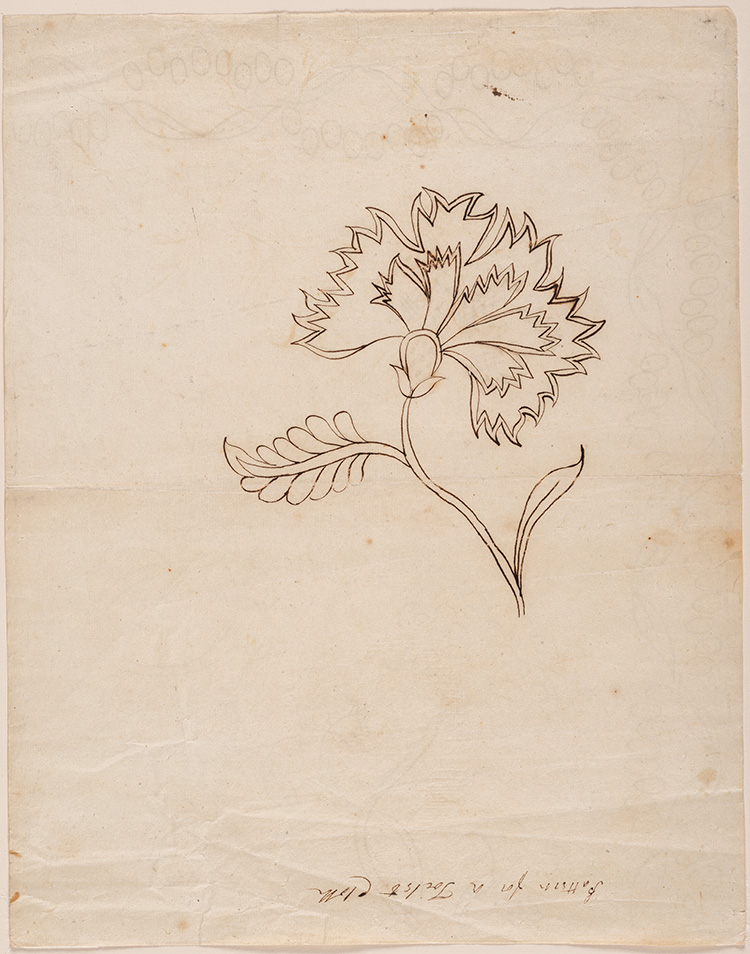 Figure 2 |
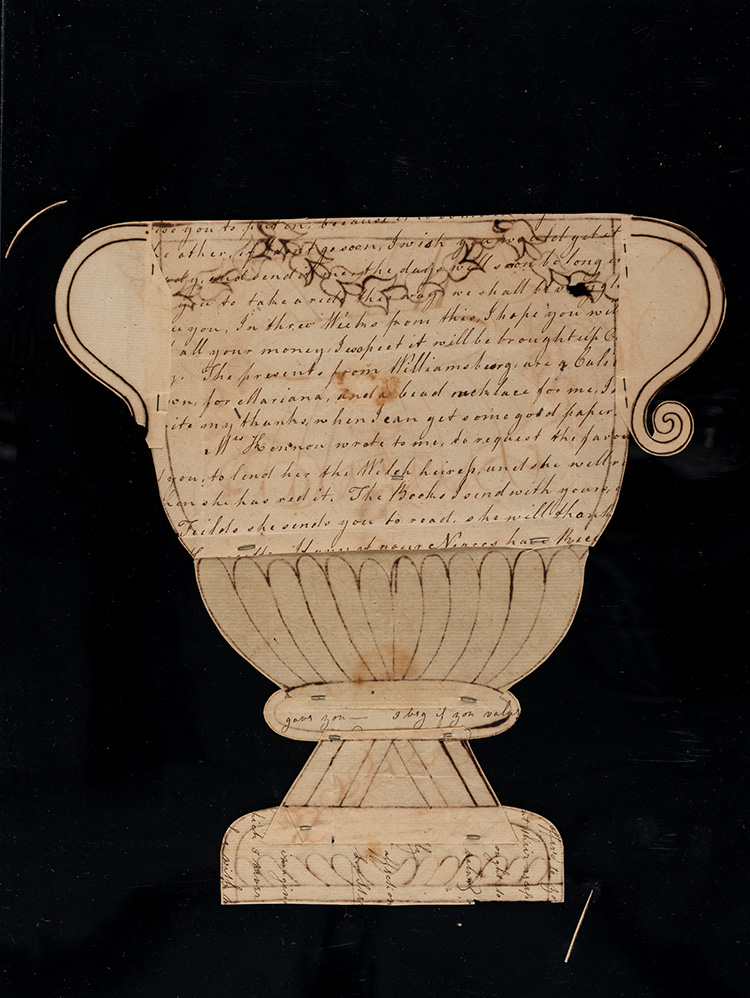 Figure 3 |
The majority of these patterns are individually cut floral sprigs that could be arranged into an endless variety of garlands and bouquets. Several large uncut patterns were likely intended to adorn the bottom of a petticoat or the edge of a coverlet; however, it is unclear how Jean used the other patterns that she drew. Except for two unadorned cotton pockets, no extant textile objects can be attributed to Jean or her daughters.[4] However, a profusion of pinholes indicates that many of the patterns were pinned to fabric, some multiple times over. These may have been used to adorn items of dress or fashionable accessories, such as handkerchiefs, workbags, or reticules. Several pattern pieces (Figure 4) retain evidence of pouncing, whereby small holes in the pattern allowed a loose powder such as charcoal to penetrate the pattern and transfer the outline onto the surface beneath. Many of the pinholes are dotted with ink, indicating that whoever used these patterns transferred the designs onto fabric with the help of an inked quill.
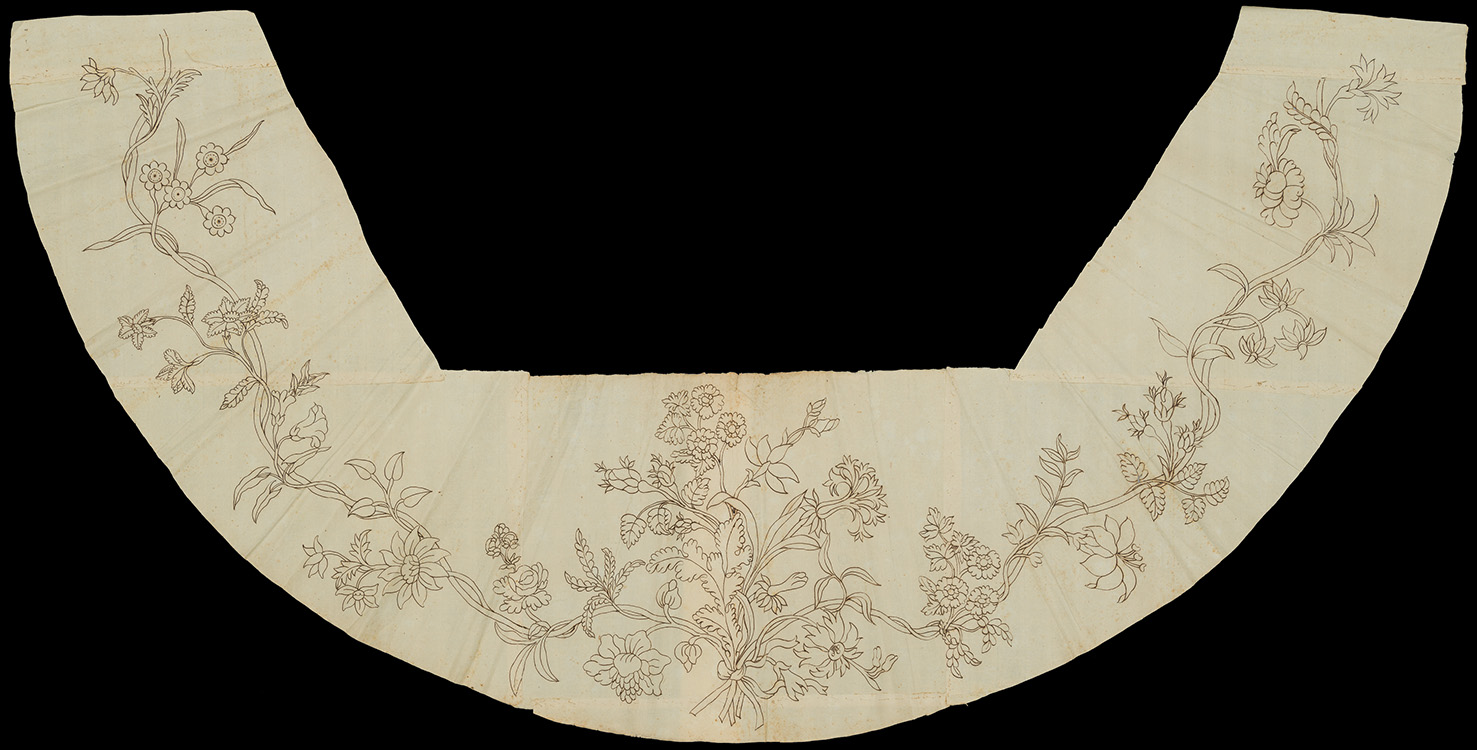 Figure 4 |
In addition to her duties as a wife and mother, Jean designed and managed an extensive garden where enslaved laborers grew a variety of fruits, flowers, and vegetables.[5] She also nurtured an assemblage of wildflowers, which she identified using Philip Miller’s Gardener’s Dictionary (1768). Her extensive personal library contained a variety of botanical texts, many of which she acquired through agents in London.[6]
Jean’s botanical notes are characterized by scientific precision. By contrast, her needlework patterns privilege aesthetics over botanical verisimilitude. Although it is possible that Jean drew inspiration from the natural world, her patterns closely resemble those published in periodicals during the late eighteenth century.[7] An uncut floral bouquet adorned with a large bow (Figure 5) loosely resembles a pattern that was originally published in the August 1782 issue of The Lady’s Magazine (Figure 6) and the November 1782 issue of The Hibernian Magazine.[8] This pattern circulated through multiple southern households during the late eighteenth century and even appears in a 1789 portrait of Mary Harvey and Sarah Champneys of Charleston, South Carolina (Figure 7). A printed pattern “for a Lady’s Work-Bag” (Figure 8) provides more concrete evidence that Jean drew inspiration from contemporary publications. This pattern closely resembles one that was published in the November 1779 issue of The Lady’s Magazine; it is possible that it was published by a competing publication that made small alterations to claim ownership over the design.[9]
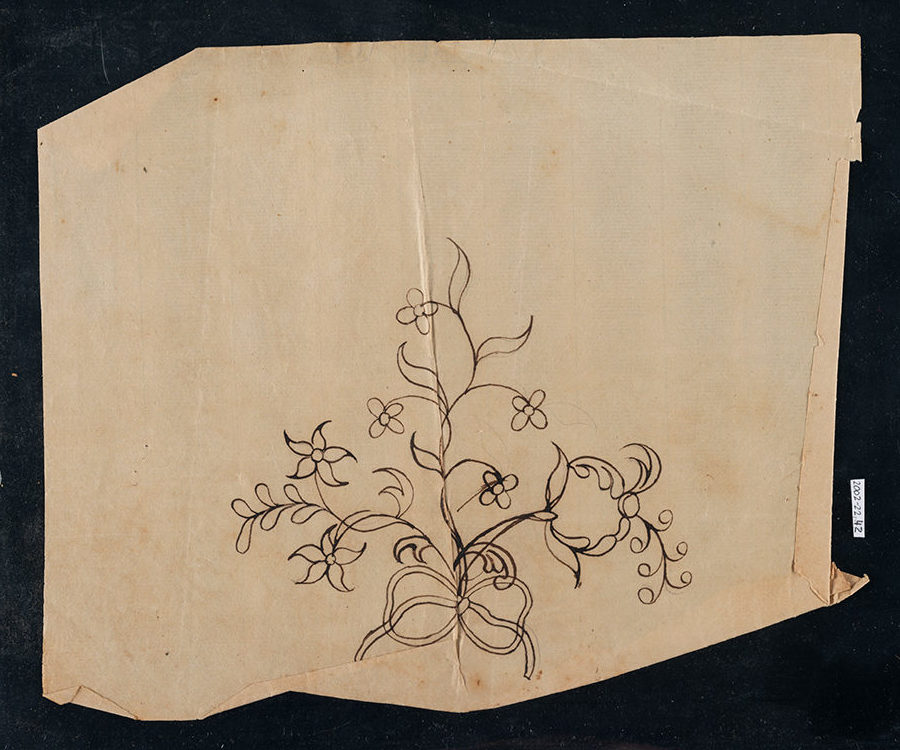 Figure 5 |
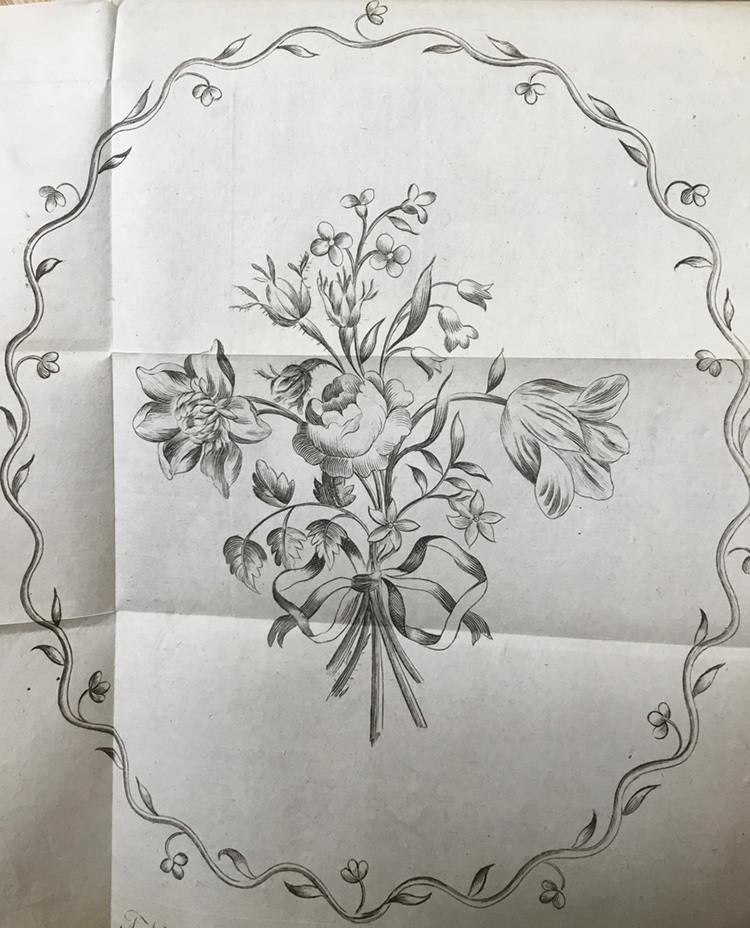 Figure 6 |
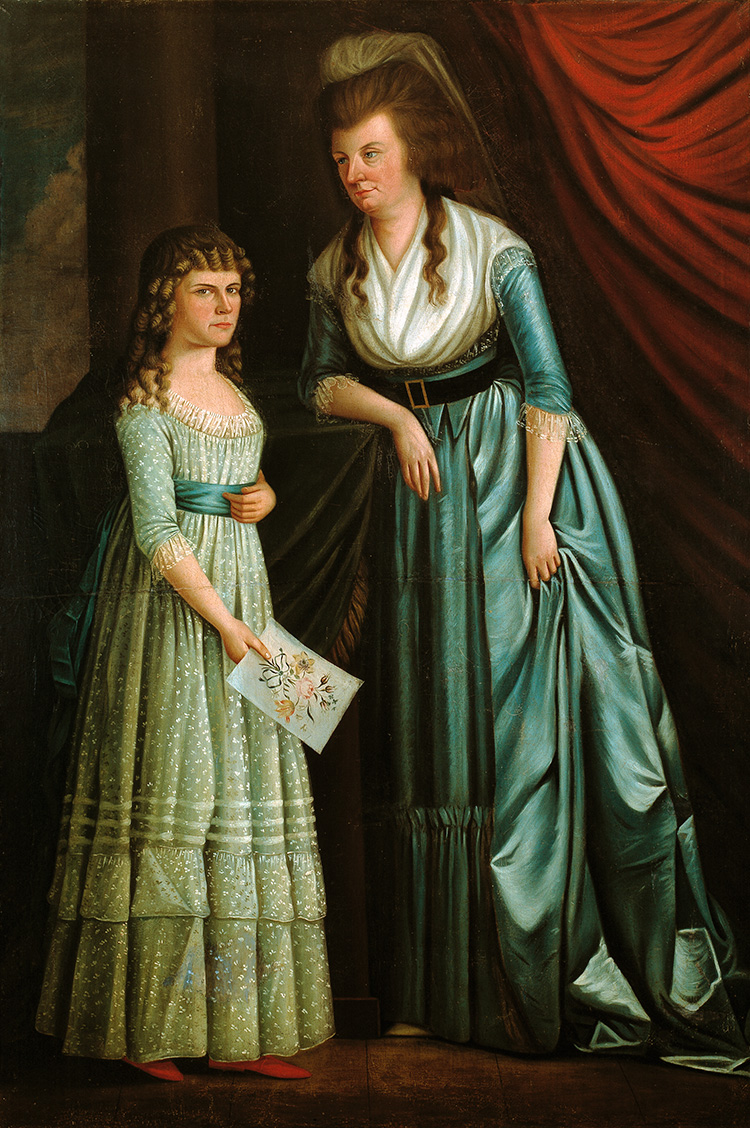 Figure 7 |
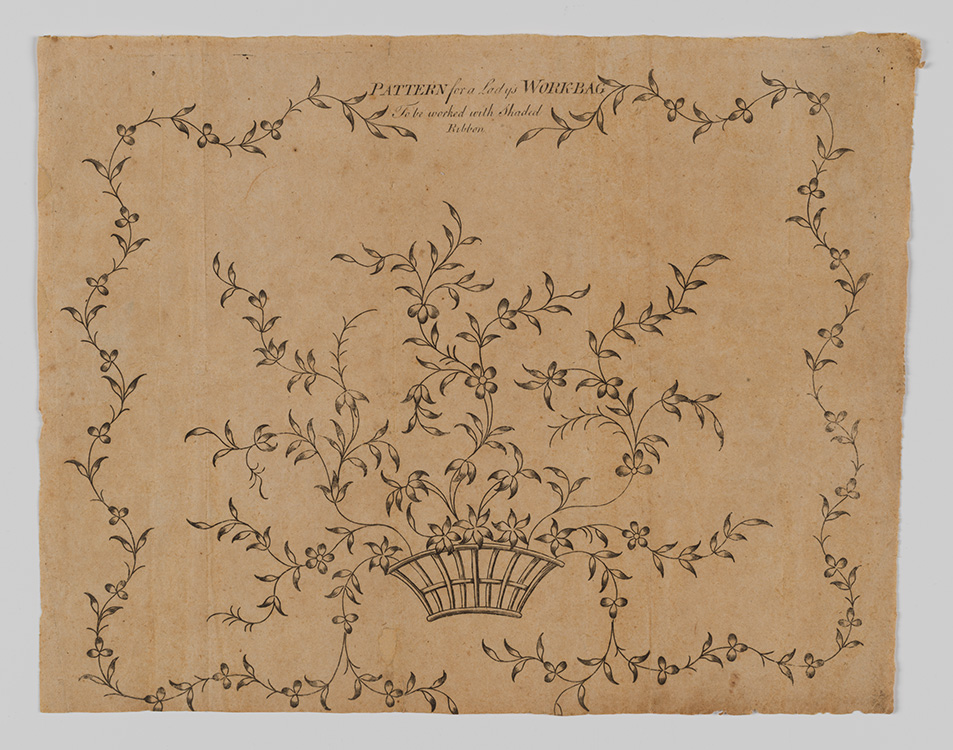 Figure 8 |
As Jean collected seeds and plant cuttings for her garden, she also gathered paper flowers that she would one day “plant” upon a fabric ground. The connection between embroidery and cultivation was already well-established by the time Jean drew her patterns. Floral motifs had characterized embroidery patterns for centuries, so much so that during the seventeenth and eighteenth centuries, garden designers mimicked embroidery patterns in their work, planting gardens that came to be known as parterres de broiderie.[10] Beyond floral motifs, the physical process of embroidering a pattern onto fabric mimicked the motions of planting. As women drove their needles into the “ground,” they planted a seed and watched as the product of their labor grew before their eyes. In an essay on needlework published in 1714, Joseph Addison mused that women must take great delight in “transplanting the beauties of nature into their own dress” and “walking among the shades and groves planted by themselves.”[11] In his 1755 dictionary, Samuel Johnson defines the term “embroidery” as “figures raised upon a ground.” In order to produce these figures, a woman would need to “work” the fabric with needle and thread. For the definition of “work,” he included several connotations including “labour” and “flowers or embroidery of the needle.”[12]
Today, these patterns provide insight into the creative labor undertaken by women in the early American South. As women drew, arranged, and transferred paper patterns onto fabric, they demonstrated their artistic skill. Furthermore, these patterns affirm that southern women drew inspiration from patterns published in British periodicals and thereby underscore the importance of understanding southern needlework within a transatlantic context. Finally, these patterns contribute to our understanding of the woman who created them. For Jean, botany was both a scientific and artistic pursuit; while the plants that she assembled at Prestwould might no longer exist, her paper garden remains.
Emily Wells is a Ph.D. candidate in the History Department at William & Mary. She can be reached at [email protected].
[1] Lisa Ann Flick, “Stretching the Bounds: Lady Jean Skipwith, Mistress of Prestwould, 1748-1826” (M.A. thesis, College of William & Mary, 1987); Patricia O. LaLand, “Lady Jean Skipwith,” Early American Life 33, no. 2 (April 2002): 54–59.
[2] In 2019, I helped to catalog and rehouse these patterns under the direction of Kimberly Smith Ivey, former Senior Curator of Textiles at the Colonial Williamsburg Foundation.
[3] Jean Skipwith requested The Novice of St. Dominick and The Wild Irish Girl: A National Tale, novels written by Sydney Owenson and published in 1806.
[4] Pockets with Extra Tape, ca. 1800, Manuscripts Artifact Collection, William & Mary Special Collections Research Center.
[5] Peggy Cornett, “In the Company of Gardeners: The Flower Diaries of Jefferson, Skipwith, and Faris,” Twinleaf (2000), not paginated; Rudy J. Favretti, “Prestwould Gardens,” The Magazine ANTIQUES 147, no. 1 (January 1995): 170–173; Holly Gruntner, “Lists and Linnaean Taxonomy in Jean Skipwith’s Papers,” William & Mary Special Collections Blog. Online: https://libraries.wm.edu/blog/special-collections/lists-and-linnaean-taxonomy-jean-skipwiths-papers (accessed 25 March, 2021); Ann Leighton, “‘To Be Got When I Can,’” in American Gardens in the Eighteenth Century: “For Use or for Delight” (Amherst: University of Massachusetts Press, 1986), 271–291. Jean Skipwith’s garden notes can be found in the Skipwith Family Papers (mss. 65 Sk3), Special Collections Research Center, College of William & Mary.
[6] Mildred K. Abraham, “The Library of Lady Jean Skipwith: A Book Collection from the Age of Jefferson,” The Virginia Magazine of History and Biography 91, no. 3 (July 1983): 296–347.
[7] Jennie Batchelor, “The Art of Georgian Embroidery Design,” Piecework (Fall 2025): 51–55; Jennie Batchelor, “Georgian Embroidery Patterns in the Lady’s Magazine (1770-1819),” Textile History 53, no. 2 (November 2022): 171–195; Davida Tenenbaum Deutsch, “Needlework Patterns and their Use in America,” The Magazine ANTIQUES 139, no. 2 (February 1991): 368–381.
[8] See also A New Fancy Pattern; from The Hibernian Magazine, or Compendium of Entertaining Knowledge (November 1782), The Charleston Museum, acc. no. 1926.60; Needlework Picture, Charleston, South Carolina, The Charleston Museum, acc. no. 1936.91.
[9] Jennie Batchelor, email message to author, 21 May 2020. It is possible that this pattern is the “Pattern for a Lady’s Work Bag” that was published in the December 1779 issue of The Hibernian Magazine.
[10] Thomasina Beck, Gardening with Silk and Gold: A History of Gardens in Embroidery (Newton Abbot, Devon: David & Charles, 1997), 64–79.
[11] Joseph Addison, ed., The Spectator, v. 8 (London, 1714), 186.
[12] Samuel Johnson, A Dictionary of the English Language (London, 1755), 688, 2297.