
In 1970, the Museum of Early Southern Decorative Arts (MESDA) acquired a walnut side chair (Figure 1) with a single-sentence provenance: “Original property of Zachariah Johnstone—brought by Zachariah Johnstone from Augusta Co., Virginia, to his new house, Providence Hill, in Stonebridge [sic] County near Lexington.”[1] This line is more than a lead for mapping the chair’s life onto Johnston’s biography. It suggests how, for decades, the chair has been understood as both a piece of eighteenth-century furniture and an object of memory, its meaning distilled into its association with a single prominent owner.
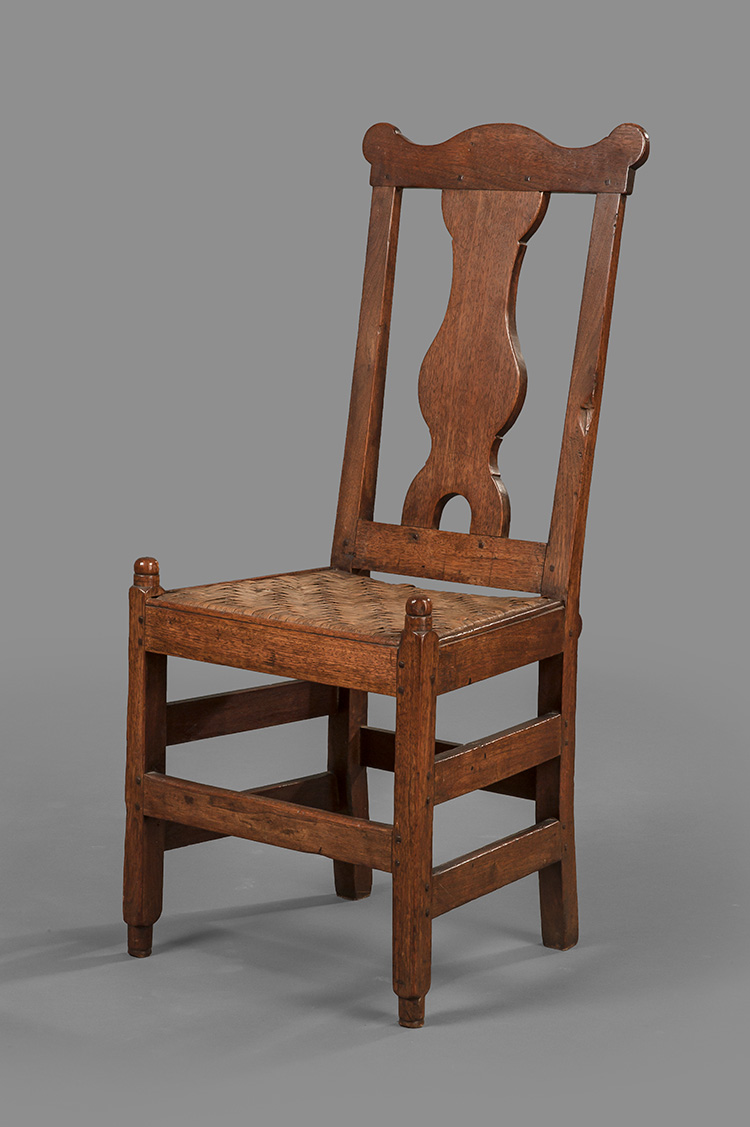 Figure 1 |
Zechariah Johnston, as he more often spelled his name, was born to Scotch-Irish parents and was baptized in 1742 in Augusta County, Virginia.[2] Today he is best known as a Presbyterian advocate for religious freedom in the Virginia House of Delegates.[3] He is also remembered as a Revolutionary War militia captain and a decisive pro-Constitution voice at Virginia’s 1788 Ratification Convention. In the 1790s, as his political career and plantation lands grew, Johnston commissioned a new home called “Stone House” in Rockbridge County.[4] The chair likely moved with him and became one of “6 walnut chairs” listed on his probate inventory in 1801.[5]
Pinpointing when this chair became associated with Johnston is challenging. The chair seems to have remained in situ in Johnston’s Rockbridge house, stewarded by his descendants, until the mid-twentieth century.[6] Perhaps the chair survived so well because family members protected it as a relic of a beloved relative and, later, a prestigious ancestor.[7] Family memory may have started accumulating around the chair as early as the 1790s, when Johnston chose to retain this older, somewhat conservatively styled chair to furnish his new build. The chair first may have been used at Old Stone Fort (earlier than and different from “Stone House” listed above), the frontier house that his father William Johnston (ca. 1715–1769) built after immigrating from Ireland.[8] If so, the chair might have imported cultural traces from Johnston’s early life in Augusta to his new home in Rockbridge. Perhaps the chair’s style connected Johnston to his parents’ Scotch-Irish origins, as several armchairs owned by other Scotch-Irish families in the Valley share a boxy base of double stretchers and sturdy mortise-and-tenon joinery. For example, similar features characterize an armchair (Figure 2) also at MESDA that descended in the family of William Lam, who arrived in Augusta around the same time as William Johnston.[9]
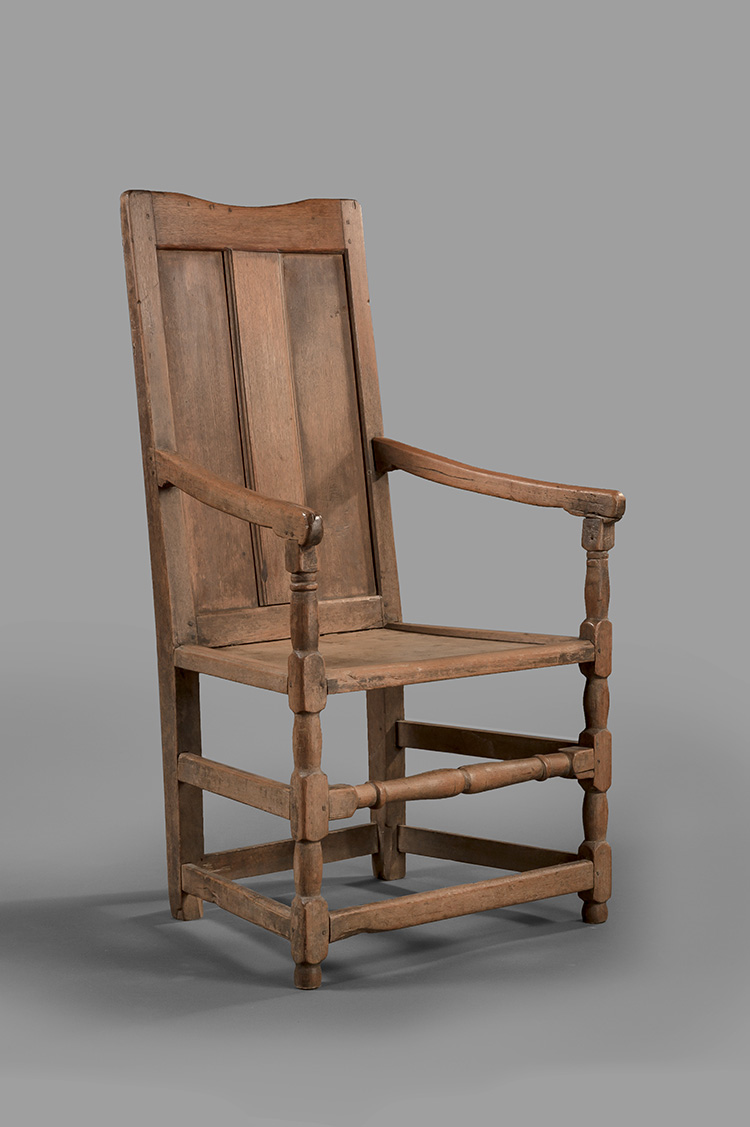 Figure 2 |
Alternatively, the chair’s mnemonic function may have developed later, with descendants assigning new meaning to a stored-away eighteenth-century chair by linking it to a prominent ancestor from the same period. Whether the chair’s associations with Johnston’s memory are long-standing or recent, they are inextricable from the chair’s material persistence. Indeed, the chair’s materiality has invited these memories. The chair’s boldest features are through tenons formed where the seat rails push through the stiles, terminating in half-moon forms (Figure 3). The construction transforms a structural element into an ornamental feature, though the finishing is imprecise—the splat and ears are adorned in visible compass marks. The deep marks suggest that the maker may have approached chairmaking from the vantage of a house joiner.[10] Taken together, these signs of facture contribute to a sense of the chair as experimental in its making and transparent in its structure. The through tenons offer behind-the-scenes access to the joint, much as the compass marks reenact the maker’s design process.
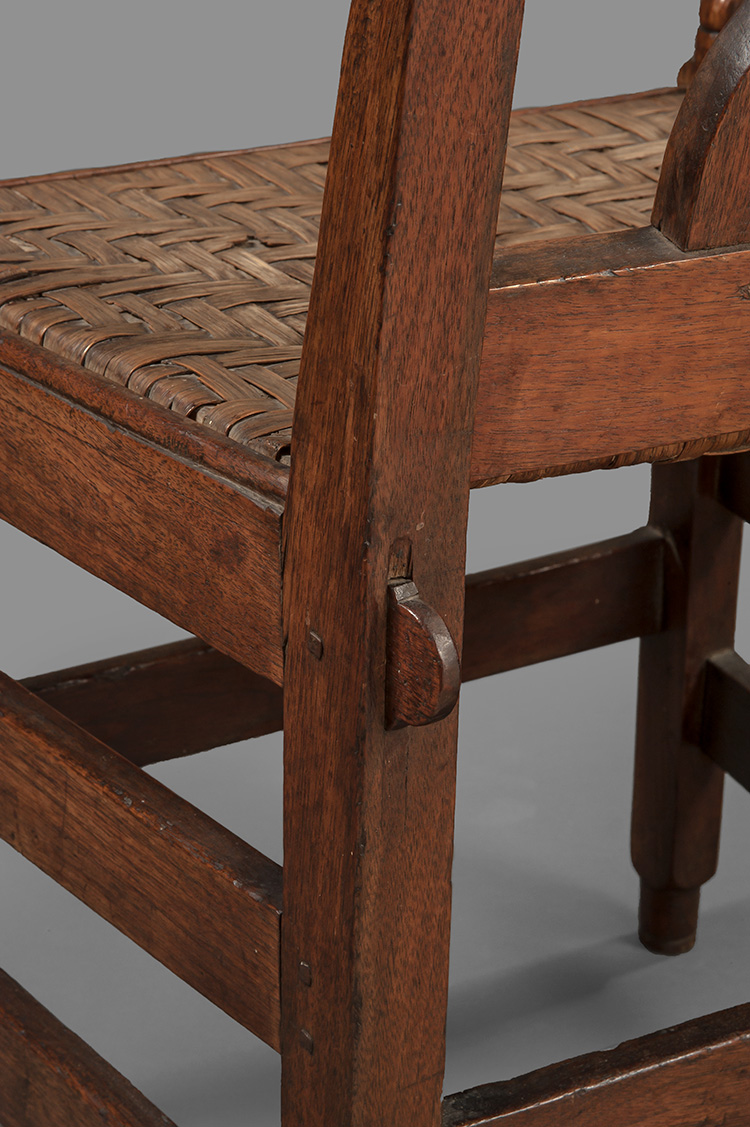 Figure 3 |
Understood as vernacular and transparent, overtly visible joints became a visual language for narratives of Johnston’s life that took shape around the time that this chair came to MESDA. Johnston’s descendants Matthew White Paxton Sr. (1898–1987) and Matthew White Paxton Jr. (1927–2023) defined his legacy through house tours and local history publications in the 1950s and 1960s.[11] Paxton Sr. lectured about Johnston as a “plain, uneducated farmer” who represented his community in the House of Delegates with “simple and unadorned” speeches.[12] The rhetoric used to describe Johnston rhymes with the aesthetics of the chair: “sturdy,” “rugged,” “strenuous,” “plain,” “unadorned.”[13] In fact, a biography of Johnston in 1972 was illustrated almost exclusively with photographs of the wood pegs used in Johnston’s home, suggesting that exposed pegs and joints without nails could visualize Johnston’s “sterling honesty” and authenticity as a “frontiersman” (Figure 4).[14] Perhaps the chair’s prominent through tenons functioned for twentieth-century viewers like these photographs of pegs in Johnston’s house joinery, as signs of rugged and honest construction.
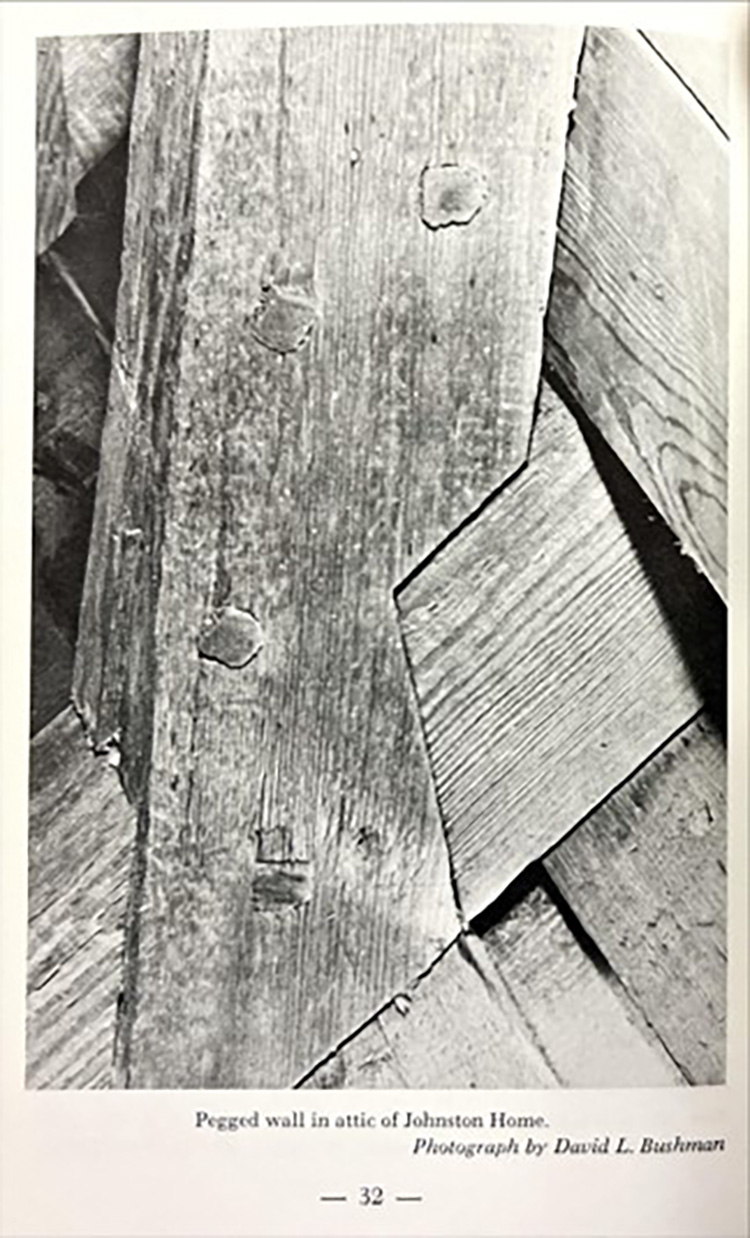 Figure 4 |
This commemorative portrait of Johnston linked his Revolutionary military service, advocacy for religious liberty, and support for constitutional ratification to a concept of plain-spoken backcountry self-sufficiency. Such a figure embodied Revolutionary ideals not through the national prominence of Jefferson or Madison but through a close relationship to the Valley. Johnston’s biographies transposed regional values into national founding narratives and converted exposed joinery into a kind of structural honesty that seemed to verify political integrity.
With Johnston’s political legacy translated into the vocabulary of early American woodworking, the chair may have seemed even more tightly joined to Johnston by 1970. Revisiting the chair in the years since, however, has revealed how much that single line—“Original property of Zachariah Johnstone”—obscures other individuals. Firstly, the “plain farmer” identity conjured by mid-twentieth-century biographers minimizes the reality that Johnston held large, dispersed tracts of land.[15] Enslaved and free people working this land produced the wealth that enabled Johnston to build Stone House and his descendants to preserve its contents.[16] Secondly, that the chair came to MESDA with only Johnston’s name attached to it underscores how little is known about the maker. Scholars including Johanna Brown, Jeffrey S. Evans, and the late John Bivins have compared it to a group of Moravian-made chairs on loan to MESDA, suggesting a culturally Germanic maker (Figure 5).[17] Yet while through tenons are frequently associated with Germanic construction techniques, rounded versions appear in Irish and Welsh joinery traditions.[18] As German and Scotch-Irish makers worked alongside each other in the Upper Shenandoah Valley, such tenons may have moved fluidly across communities.
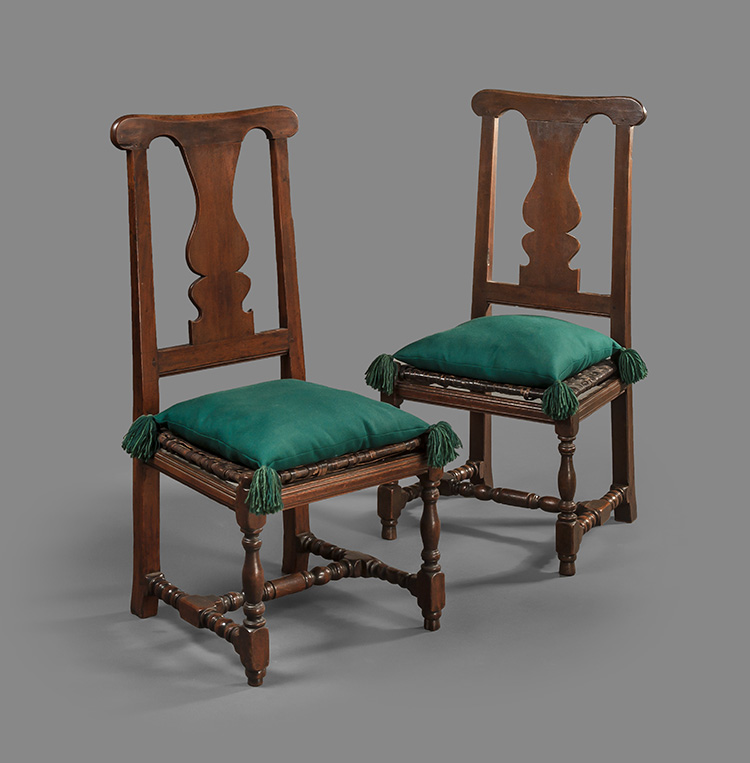 Figure 5 |
This chair’s through tenons also moved across time: by the twentieth century, they absorbed shifting familial and political memories. In the process, a once-ordinary piece of seating furniture became entangled with the memory of a Revolutionary veteran and founding-era legislator. Traversing the two centuries between 1770 and 1970, the chair invites future research into the eighteenth-century makers and meanings of its puzzling through tenons, even as its visible joints have already shaped its layered commemorative afterlives.
Ella Nowicki is the Windgate Curatorial Fellow at Crystal Bridges Museum of American Art. She can be reached at [email protected].
[1] Victor G. Herring III recorded this history from Jack Roberson, a dealer in Lexington, Virginia, who sold the chair to Herring. Invoice from Victor G. Herring III to MESDA, 20 January 1970. Johnston’s new house was in Rockbridge County, not the non-existent Stonebridge County, and has been more commonly referred to as Stone House.
[2] Johnston was baptized Presbyterian at Tinkling Spring Church near Fishersville, Virginia. Howard McKnight Wilson, The Tinkling Spring, Headwater of Freedom (Richmond, VA: Garrett and Nassie, Inc., 1954), 476.
[3] Johnston spoke in favor of the 1786 Act for Establishing Religious Freedom in Virginia, establishing a connection to Thomas Jefferson that Johnston’s descendants emphasized. Thomas E. Buckley, “Church-State Settlement in Virginia: The Presbyterian Contribution,” Journal of Presbyterian History 54, no. 1 (Spring 1976): 114–115. See also endnote 11.
[4] Johnston’s move to Rockbridge took place between 1792 and 1797, with Stone House completed in 1797 by the builder John Spear. M. W. Paxton, Jr. (with assistance of Nat Neblatt, ed. Druscilla J. Null), “HABS No. VA–899 – Stone House: Photographs, Written Historical and Descriptive Data” (Washington, DC: Historic American Buildings Survey, National Park Service, prepared 1969, published 1983).
[5] Probate inventory of Zechariah Johnston’s estate, 3 June 1801, Will Book 2 (1797–1806), Rockbridge County, Virginia, 243–244.
[6] Matthew Paxton Jr. owned Stone House at the time of its Historic American Buildings Survey report in 1969.
[7] While some relic furniture relies on memories encoded in raw materials like wood from significant trees, Ruthie Dibble demonstrates that some furniture derived relic-like power from its proximity to memorable owners and even from form, with particular types of joinery functioning as a “historical sign” for the early American past. R. Ruthie Dibble, “The Hands that Rocked the Cradle: Interpretations in the Life of an Object,” in American Furniture, ed. Luke Beckerdite (Milwaukee, WI: The Chipstone Foundation, 2012); Rodris Roth, “Pieces of History: Relic Furniture of the Nineteenth Century,” The Magazine ANTIQUES 101 (May 1972): 874–878.
[8] Howard McKnight Wilson, “Zechariah Johnston: A Virginia Champion of Freedom,” Augusta Historical Bulletin 8, no. 1 (Spring 1972): 29. For Old Stone Fort, also called The Barrens, see Beverly Mano Survey, History Museum Photograph Collection, O. Winston Link Museum: History Museum of Western Virginia (accession number 1990.69.1148c), https://hswv.pastperfectonline.com/photo/512FC147-1E5F-4347-87B4-991694311460 (accessed 17 November 2025).
[9] Another armchair (Augusta or Rockbridge County, 1740–1770, MESDA acc. no. 2026) descended in the Lam family who arrived in Augusta in the 1740s. This chair also has double stretchers, though more delicately turned elements. The Colonial Williamsburg Foundation owns a walnut panel-back armchair (Rockbridge County, 1750–1765, acc. no. 1964–489) that descended in the Scotch-Irish Gilmore family. As with Johnston’s chair, the seat rails are tenoned through the rear stiles. Other joined walnut chairs with similar double stretchers include an armchair at MESDA (Valley of Virginia, 1740–1770, acc. no. 2024.15) and an armchair in a private collection (Valley of Virginia, 1700–1740, MESDA Object Database 3507.1). The latter, like Johnston’s chair, was purchased by the Lexington dealer Jack Roberson. For more on this Augusta-Rockbridge group, see Jeffrey S. Evans, Come In and Have a Seat: Vernacular Chairs of the Shenandoah Valley (Winchester, VA: Museum of the Shenandoah Valley, 2010), 75.
[10] Evans attributes walnut joined chairs in Rockbridge and Augusta to “multiple-trade craftsmen” who executed house joinery as well as furniture. Evans, Come In and Have a Seat, 4–11.
[11] The Paxtons advertised public tours of the home of “frontiersman Zachariah Johnston who was…Jefferson’s friend.” See “Lexington Homes to Open Saturday,” The Progress-Index, Petersburg, Virginia, 6 October 1968, 1; Matthew W. Paxton Sr., “Zachariah Johnston of Augusta and Rockbridge and His Times,” Proceedings of the Rockbridge Historical Society 5 (1961): 61–69. Through the 1950s, Stone House and its furniture was stewarded by Ann and Susan Johnstone, also descendants of Zechariah. See “Historical Society to Hear Paper on Zachariah Johnston,” Rockbridge County News, 17 July 1958.
[12] Paxton, “Zachariah Johnston of Augusta and Rockbridge and His Times,” 66. Paxton quotes the phrase “plain, uneducated farmer” from William C. Alexander, “Zachariah Johnston,” The Princeton Magazine 1 (1850): 367, and quotes “simple and unadorned logic” from Hugh Blair Grigsby in an uncited article in the Washington College Historical Papers.
[13] Paxton begins his article in praise of the “sturdy, rugged men and women” who settled Augusta County. Paxton, “Zachariah Johnston of Augusta and Rockbridge and His Times,” 62, 66.
[14] Wilson, “Zechariah Johnston: A Virginia Champion of Freedom,” 32, 34, 36. The photographs in the article depict Johnston’s house Old Stone Fort in Augusta.
[15] Johnston owned at least 1,400 acres in Rockbridge and willed a plantation in Augusta County to his sons Zechariah and Alexander, also providing instructions for distributing his 5,000 acres of land in Kentucky, some purchased and some acquired through military land grants. Will of Zechariah Johnston, 25 September 1799, Will Book 2 (1797–1806), Rockbridge County, Virginia, 191–196.
[16] Johnston’s probate inventory lists the following enslaved individuals: Bob, Matt, Nany, Belly, Patt, and children Frank and Milly Childs.
[17] John Bivins and Paula Welshimer, Moravian Decorative Arts in North Carolina: Introduction to the Old Salem Collection (Winston-Salem, NC: Old Salem, Incorporated, 1981), 21; Johanna Brown, “A Southern Backcountry Perspective,” Antiques & Fine Art 7, no. 4 (7th Anniversary Issue, 2007): 259; Evans, Come In and Have a Seat, 75, 81 (note 4). Scholars have also gestured beyond German influence. Evans situates the chair between German and Scotch-Irish coordinates. John Bivins and Forsyth Alexander characterize it as a “Backcountry blend of national styles,” with the splat and crest compared to eighteenth-century British designs derived from fifteenth-century Chinese influence. See John Bivins and Forsyth Alexander, The Regional Arts of the Early South: A Sampling from the Collection of the Museum of Early Southern Decorative Arts (Winston-Salem and Chapel Hill, NC: Museum of Early Southern Decorative Arts, distributed by the University of North Carolina Press, 1991), 126, pl. 18.
[18] Benno M. Forman, “German Influences in Pennsylvania Furniture,” in Arts of the Pennsylvania Germans, ed. Scott T. Swank (New York: W.W. Norton and Winterthur Museum, 1983), 125–128, 138, 169. Irish Sligo chairs are studded with rounded through-tenons. Claudia Kinmonth, Irish Country Furniture and Furnishings, 1700-200 (Cork, Ireland: Cork University Press, 2020), 90–96. Similar half-moon tenons animate a seventeenth-century Welsh chest illustrated in Richard Bebb, Welsh Furniture, 1250–1950: A Cultural History of Craftsmanship and Design, (Carmarthenshire, UK: Saer Books, 2007), 2: 3, pl. 598.