
Pennsylvania, 1770.
One crisp fall morning, James Read strolled into his study at his house in Reading. Refreshed from a swim in the Schuylkill River (his habit when the weather was fine), he picked up a thin package that had recently arrived from Philadelphia. Carefully unwrapping the brown paper, he held a small book with paper-on-board bindings. He sat down at his desk and pored over its pages, immersed in the text. His excitement grew and he grabbed a pencil, underlining phrases as he went and writing in the margins: silk. SILK. SILK. As the morning grew bright and the household buzzed around him, he sat back in his chair with satisfaction. He closed the book, then reopened it and flipped to the title page. He reached across his desk for his quill, dipped it in ink, and wrote in the corner of the page James Read’s of Reading on Schuylkill, adding the date—1770—within the flourishes under his name (Figure 1 and 2). This book, he decided, would join his collection.
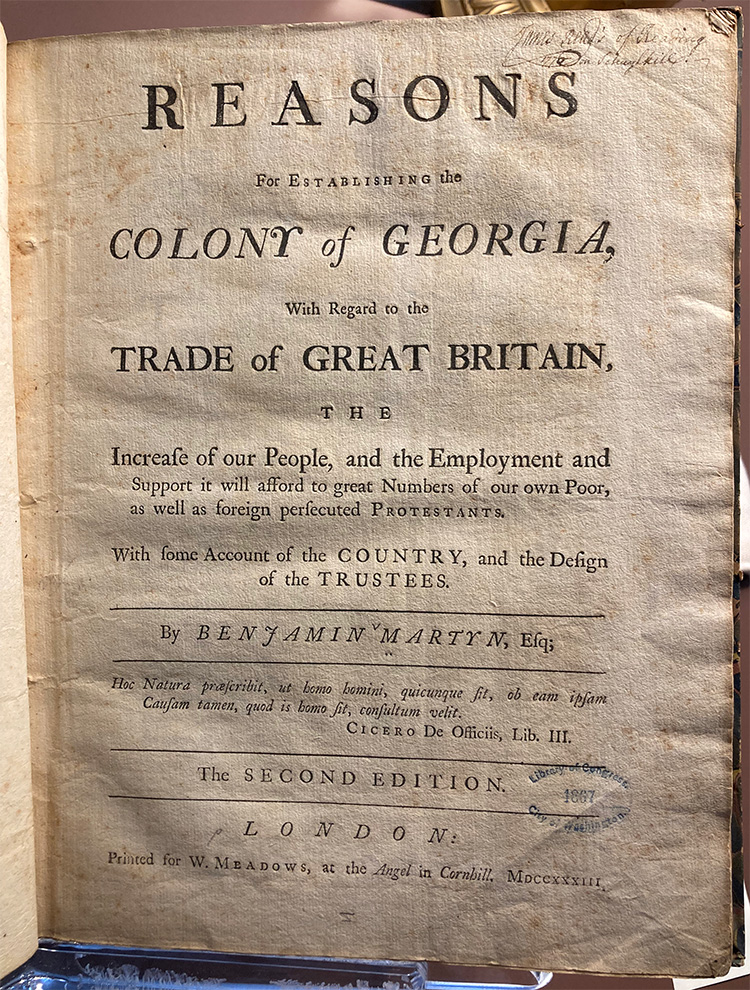 Figure 1 |
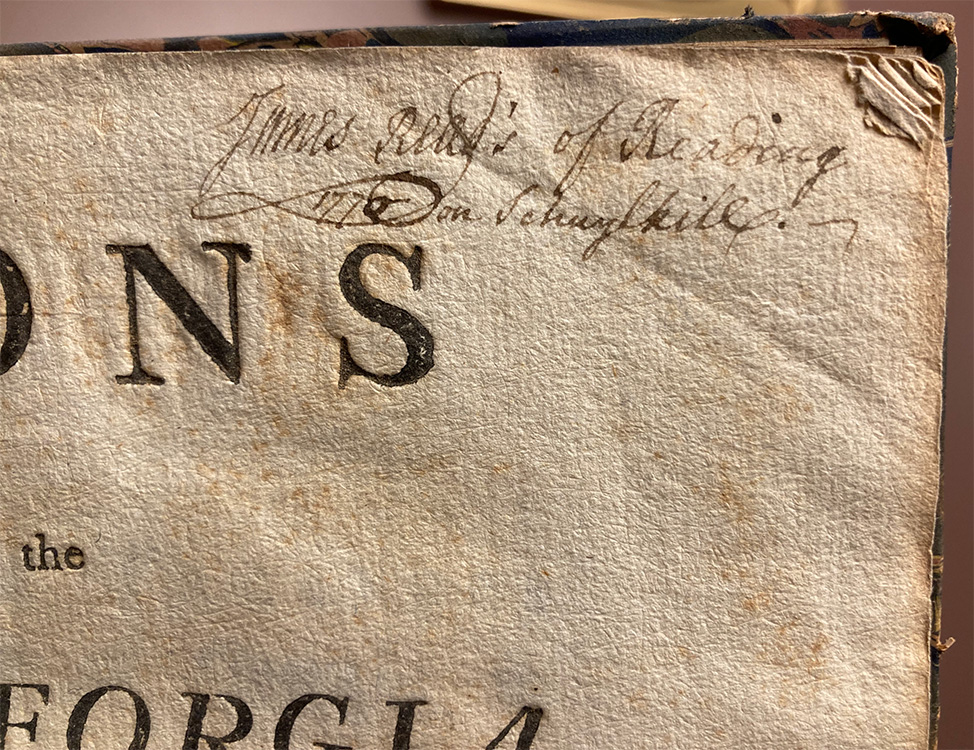 Figure 2 |
The book that Read perused that day was not a fresh volume from his brother-in-law’s Philadelphia printing shop but a much older treatise published in London nearly forty years before. Its edges were already darkened with smudges left by prior readers, its pages creased and dog-eared. It was not an adventure story, nor a history of the world, and not even a law treatise which a lawyer like Read might find instructive (although perhaps not so early in the morning). No, this book was a rare and outdated essay that described an aspirational and idealistic plan for a new colony called Georgia. Titled Reasons for Establishing the Colony of Georgia, this text was exactly as its name suggests: a compelling argument to justify a grand (and flawed) attempt to establish another British colony in the New World. Its pages outlined the potential opportunities in Georgia, from raw silk production—a resource desperately needed to support English weavers—to gainful employment for England’s poor and destitute.
Short in length and straightforward in argument, Reasons is now considered to be a foundational document in the history of the Colony (and now the State) of Georgia. Published in three limited print runs in England in 1733, copies quickly made their way around the western world and joined the libraries of English and American elites. One hundred years later, Reasons was republished in the 1840s by the newly formed Georgia Historical Society in Savannah as their first project to make Georgia’s important colonial historical documents available to the public.[1] In the late 1860s following the American Civil War, two copies were deposited within the Library of Congress in Washington, DC, as part of an effort to collect important books related to American history. One of these copies is the book that James Read annotated that morning in 1770. Today, original printings of Reasons are prized items in research libraries around the world—one such version is currently a promised gift to the Thomas A. Gray Rare Book and Manuscript Collection at the Museum of Early Southern Decorative Arts in Winston-Salem, North Carolina.[2]
Despite its modern scholarly significance and appeal as a rare manuscript, Reasons seems an odd choice for a country lawyer living on Pennsylvania’s frontier on the eve of the American Revolution. What might Read have been looking for within the pages of a worn, outdated book about the founding of Georgia, a far-off southern colony that was nearing forty years old? Well-connected and well-read, Read was a former bookseller and prided himself on his voracious reading habit and extensive book collection, a rarity at this time when books were expensive commodities. However, books were also important tools that Read regularly referenced and annotated, items to be used rather than displayed. He believed in the educational and civic value of literature and helped to establish the first public lending library in Reading in 1763, likely donating books from his personal collection for circulation.[3] While the contents of his library are not known, one book—Reasons for Establishing the Colony of Georgia—has been identified as once belonging to him through his bold signature on the title page. Located at the Library of Congress, Read’s copy of Reasons includes notations and marginalia that provide a glimpse into Read’s life and the pre-Revolutionary world in which he lived. Through a close reading of the scribbles and underlining preserved within this book, this article maps James Read’s encounters with southern colonies and western frontiers and examines the various threads that link Read to a network of global trade and learning, from booksellers to silk merchants, to founding fathers and forgotten ones.
REASONS FOR PRODUCING REASONS
The treatise that Read acquired in 1770 had a long history of its own before it reached Read’s hands. Nearly forty years before, Reasons had been printed and bound at a printing house called The Angel in Cornhill, London’s bustling print district. The text was written by Benjamin Martyn, a young man who held the position of secretary for a venture to establish a new colony called Georgia, managed by a group of Englishmen who called themselves the Georgia Trustees. Reasons for Establishing the Colony of Georgia summarized the Trustees’ plans for the colony, including the exciting economic opportunities of silk production and the social benefits of relocating many of England’s poor to southern North America.[4] At the moment that Reasons was being printed, a group of 114 settlers led by General James Oglethorpe, one of the Georgia Trustees and later known as the founder of Savannah, were already en route to Georgia aboard the Anne on a journey that would take several months. As Martyn, the Trustees, and the English public eagerly waited for news of the settlers to reach London (the first letters from the colony would not arrive until late spring), the publication of Reasons would have served as a testament to the hopeful future of the project.
As one of the important surviving records of Georgia’s colonial period, Reasons is a curious object. It is a thin book, only forty pages long with well-sized leaves (a bit bigger than standard paperback today) and large, legible type. It is printed on handmade laid paper with a unicorn watermark folded within the crease of the bindings (visible only when backlit).[5] Not surprising given its age, many versions have been altered over the last few hundred years—the copy in the MESDA Rare Book Library has been rebound and, at some point in its history, the pages were cropped to remove centuries of dirt. As a result, some of the letters along the top and bottom of the pages are cut off. Others, like Read’s copy at the Library of Congress, were rebound but retain their original edges, now darkened and wrinkled by years of wear. Reasons also includes a frontispiece that previously appeared in an earlier Trustees publication in 1732, and a map of southern North America. The inclusion of these features may have helped readers to imagine the new colony, a place that few Britons had ever visited, and its spatial relationship to established towns like Charleston (then Charles Town), South Carolina, and St. Augustine, Florida. However, these illustrations were also intended to paint a specific picture of the colony, one of unlimited opportunity that was in many ways at odds with reality.
Map of Georgia
This early map of the southeastern coast of North America (Figure 3) is thought to be one of the first maps with the new territory of “Georgia” labeled. As such, it would have provided a useful geographic context for readers. Noted geographer and Georgia scholar Louis de Vorsey has identified this map as a close copy of a circa 1708 map prepared by Thomas Naire, a trader and Indian agent in the Carolinas, but modified to make the region more appealing to investors and potential settlers.[6] Importantly, notations in Naire’s map about the locations of Native American, French, and Spanish settlements were removed to make the landscape seem empty and open for colonization.[7] Additionally, the Spanish stronghold in St. Augustine (now Florida) was moved further south to increase the visual distance between English and Spanish settlements and lessen the perceived threat of Spanish attack.[8] While it is not known who modified the map—whether Oglethorpe, Martyn, or someone else involved in the Georgia project—these updates suggest an intentional effort to promote the landscape as available for settlement rather than the reality: a land with long-established inhabitants and complex territorial claims.
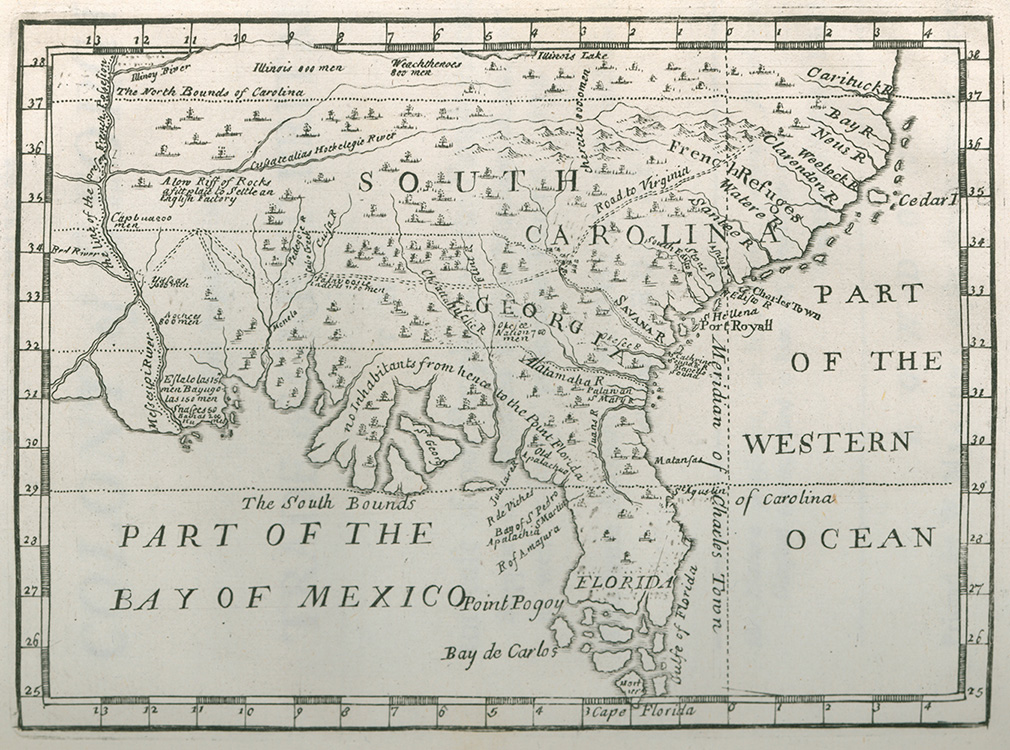 Figure 3 |
Frontispiece Image
While the map introduced a sense of spatial distance along the North American coast and the new site of Georgia, a frontispiece engraving (Figure 4) by English artist John Pine provided the first visual representation of the imagined territory. Pine was a skilled illustrator best known for his work in Robinson Crusoe (1719) and later as a royal chief engraver of the seals, a position he held from 1743-1756.[9] Having never visited Georgia, Pine relied on descriptions of the colonial landscape from books and illustrations to create an image of a vast new territory with ample natural resources and infinite land for settlement. He depicted settlers in the foreground clearing the landscape and constructing houses, and in the background, a vast city laid out in rows of mile-long squares. His image has since become a celebrated representation of early colonial Georgia and its first city, Savannah, although few details reflect the realities of the place—from the mountainous topography and tropical vegetation to the sprawling urban metropolis. Instead, Pine’s image appears more as a generic visualization of an ideal southern American colony rather than one grounded in fact.
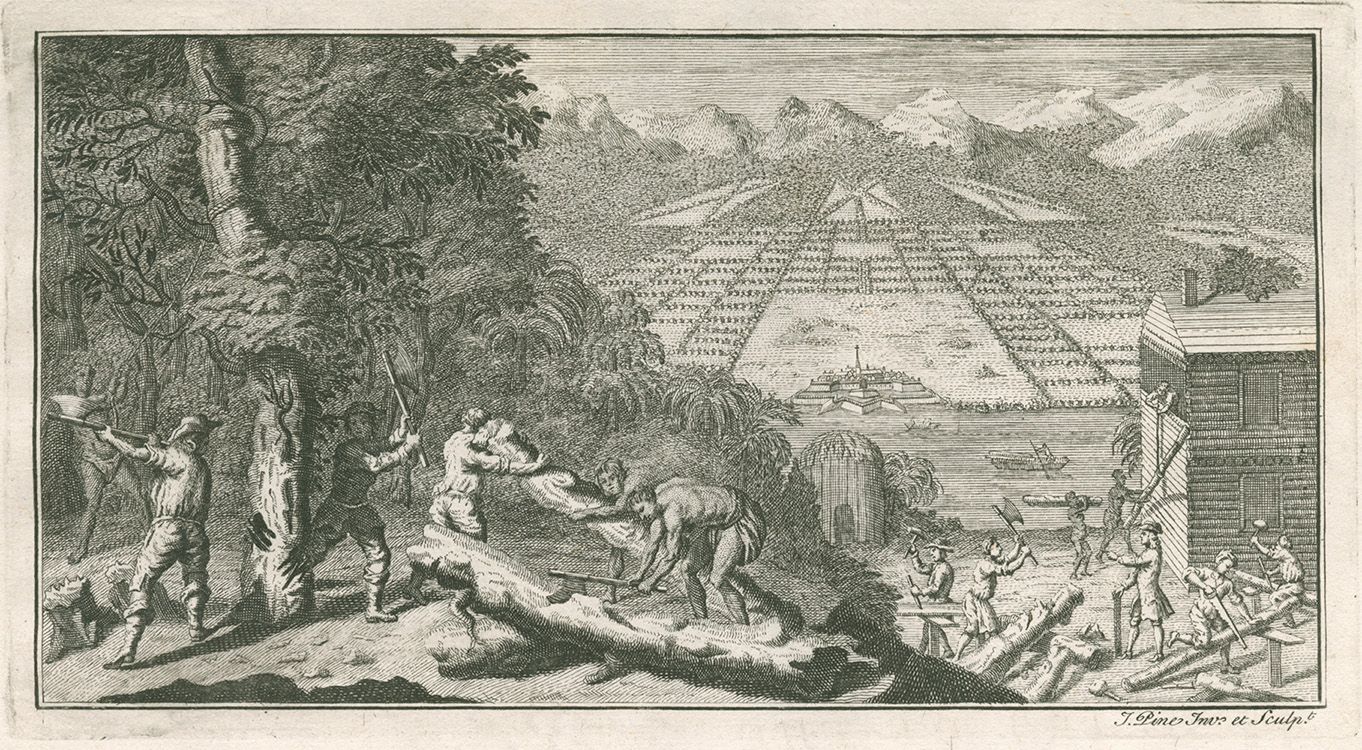 Figure 4 |
Distribution
While we cannot know where Martyn’s text went once it was published, it is very likely that the Trustees (there were twenty-one, including members of England’s nobility) received the first copies. Reasons was also distributed to members of Parliament to gain political and financial support for the project. The book must have been popular, as it was republished twice more in the spring and summer of 1733.[10] These later printings may have been intended for the wider public and included an appendix with a special update: letters from General James Oglethorpe written in Georgia in February 1733, the first accounts from the colony. Several copies of Reasons even made their way across the Atlantic to important colonial figures in the Americas. According to the Georgia Historical Society, which republished Reasons alongside other important Georgia colonial-era documents in 1840, the book in their collection could be traced back directly to “Jonathan Belcher, Esq., Governor of Massachusetts, probably presented by General Oglethorpe himself, with whom he corresponded.”[11] This potential direct link to Savannah’s founder is worthy of its own article as the book passed through many hands to reach the Society’s shelves in 1840, just as James Read’s copy would have done seventy years earlier.[12]
ESTABLISHING A COLONY CALLED GEORGIA
To understand why such a book as Reasons was produced and how it came to be a prized possession for historic and modern book collectors alike requires a step back into the early colonial history of this country. Georgia, the youngest of America’s thirteen colonies, came into being only forty-three years before the Declaration of Independence and more than fifty years after the establishment of Britain’s last American colony, Pennsylvania, in 1682. Yet at the time of her founding, England’s thirst for raw materials, land, and territorial dominance over its enemies, France and Spain, was unquenchable. At home, England also faced a growing social crisis as large numbers of the British population fell into poverty due to war, religious conflict, and a lack of abundant natural resources to provide steady employment and produce quality goods for export. A new colony would allow England’s poor and religious refugees to be resettled while providing English factories with raw materials to lessen their dependence on international trade.[13] This is the crux of Martyn’s treatise on Georgia, although he was far from the first to develop these ideas.
In the first decades of the eighteenth century, multiple proposals were put forward for new colonies in the North (near present-day Canada and Maine) and along the western frontiers of Virginia, Maryland, and Massachusetts.[14] Most were intended as military settlements to defend established towns from French, Spanish, and Native American groups, as well as pirates on the high seas.[15] Many of these proposals also adopted the name Georgia in honor of the English monarch George I (ruled 1714-1727) and later his son George II (ruled 1727-1760).[16] Proposed governance systems ranged from royal colonies controlled by the Crown to a novel Trustee system led by a group of individuals acting (ideally) from charitable rather than monetary interests. However, due to territorial disputes among Britain’s American colonies and a lack of investment and interest in England, none of these projects came to fruition.
The Margrave of Azilia
While prior colonial proposals had focused largely on northern and western territories, one plan called for a new settlement just south of South Carolina and its thriving port of Charles Town. On 19 June 1717, British speculator Sir Robert Montgomery secured a land grant from South Carolina for territory between the Altamaha (sometimes spelled Allatamaha) and Savannah Rivers to establish a new settlement.[17] The same year, he published a treatise entitled A discourse concerning the design’d establishment of a new colony to the south of Carolina, in the most delightful country of the universe. This short pamphlet, probably distributed in a limited capacity to interested investors, outlined his plans for an agricultural and military colony called the Margravate of Azilia to be managed by a group of trustees. However, Montgomery’s grant required that Azilia be populated within three years and he failed to stir up enough interest to send settlers to the territory. His grant was revoked in 1720 and the land was returned to South Carolina.[18]
Despite Montgomery’s unsuccessful venture, his treatise on Azilia served as an early document promoting settlement on the site that would become Georgia. His descriptions of the site’s virtues—its ample natural resources, strategic trading location, and beautiful environment—were intended to inspire investment and encourage settlers to come forward, much like Martyn’s treatise fifteen years later.[19] To promote his ideas further, Montgomery published an urban plan of his imagined settlement, consisting of mile-long squares with civic spaces, parks, fortifications, agricultural landscapes, and residential areas.[20] Unlike the decentralized and remote plantations in Virginia and South Carolina that were often targeted in attacks by Spanish and Indigenous groups, Montgomery’s plan was made up of ordered, fortified networks that could be perpetually expanded to protect settlers as the colony grew in size: “The first Lines drawn will be in just Proportion to the Number of Men they enclose; As the Inhabitants encrease [sic], New Lines will be made to enclose them also, so that all the People will be always safe within a well defended Line of Circumvallation.”[21] This geometric settlement took inspiration from earlier military architecture, adapted to support the agricultural and manufacturing activities that were vital to American colonial life and the English economy.
Montgomery’s plan of Azilia (Figure 5) and John Pine’s illustration published in Reasons are curious objects to compare. The neat, ordered plats shown in Pine’s design share many similarities with the famous plan for the city of Savannah laid out by General Oglethorpe in 1733 or 1734, with its impressive civic and commercial squares with central gardens. However, Pine’s image, first published in 1732, predates the implementation of the Oglethorpe plan by a couple of years. Pine also represents these urban squares at a massive scale, miles long rather than the comfortable city blocks found in Savannah today.[22] As a result, it seems that Montgomery’s Margravate of Azilia may have heavily influenced Pine’s illustration of Georgia, and probably Oglethorpe’s plan for Savannah as well.
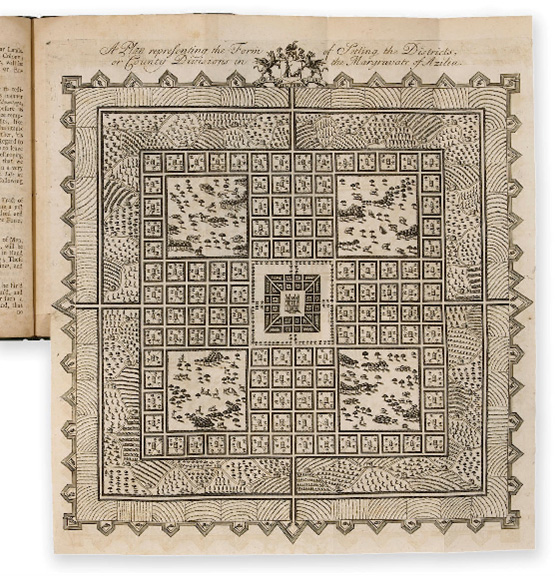 Figure 5 |
‘The Most Delightful Country of the Universe’
While Montgomery was not able to realize his vision, elements of Azilia reappeared a few years later when Georgia was chartered in 1731. Like Azilia, Georgia was located in the same southern territory granted by South Carolina and it was managed by a group of trustees based in England. As Montgomery had before, the Georgia Trustees imagined that Georgia would have a Mediterranean climate perfect for many of the goods that England relied upon but could not produce: indigo, cochineal, olives, and wines, to name a few.[23] However, their biggest focus was on sericulture, the raising of silkworms for silk production, which served as a central theme in Reasons.
Since the sixteenth century, England had been a major center for textile manufacturing, including silk. However, the cold and rainy climate made local raw silk production unfeasible, and English manufacturers had to import silk threads from Turkey, Levant, Italy, India, and China.[24] Facing steep competition from France and Italy, which boasted some of the finest silk factories in the world, England instituted protectionist trade policies like tariffs to bar imports of manufactured silk goods to bolster domestic silk weaving.[25] In the seventeenth and eighteenth centuries, Britain increasingly turned to its American colonies to provide raw materials for silk production. Virginia, Maryland, and the Carolinas were sent silkworms and settlers were encouraged to plant mulberry trees in the hopes that a silk industry would take root. However, silk production was notoriously difficult. Silkworms were high maintenance and required continuous feeding in the form of mulberry leaves.[26] Once the worms formed cocoons made of silk thread, the cocoons had to be roasted or boiled to kill the worms, preventing them from damaging the silk when they hatched and enabling the removal of the gum that held the threads together. Cocoons were then reeled, the process of carefully untangling the threads of the cocoons, some of which could be more than 100 meters in length, to produce a thread that could be used for weaving cloth.[27] The entire process required almost constant attention over two or three months and skilled labor to properly reel the threads without damaging them. Yields were small: 2,500 silkworms could yield about one pound of raw silk, enough for a shirt or part of a dress, to be shipped to England for textile production.[28] Compared to other cash crops like cotton and tobacco that thrived in the colonies and did not require such specialized industry, sericulture was simply too difficult for the average colonist looking to make his or her fortune.
However, with its warm climate and the ample labor expected to be provided by England’s resettled poor, Georgia offered England a chance to try at silk again.[29] Early promotional literature around the Georgia project emphasized the opportunities of silk production while minimizing the labor and resources involved. In Reasons, Benjamin Martyn estimated that each worm would “spin 3000 Yards of Silk” and a silk industry in Georgia could provide employment for 20,000 people.[30] He optimistically wrote: “The Work of making Raw Silk is easy, the Silk Worms will multiply prodigiously in such a Country as Georgia… a sufficient Quantity of Silk might soon be raised to supply all Europe, if there were Hands enough properly instructed to carry on the Work.”[31] So closely linked were the colony and sericulture in the British imagination that Georgia’s first three colonial seals used for official documents all included references to raw silk production.[32]
Among the first 114 settlers of Georgia sailing on the Anne in the winter of 1733, when Reasons was first published, were several individuals with experience in weaving and silk throwing and one “Italian Silk Man,” Paul Amantis, who “understands the Nature & Production of Raw Silk.”[33] Italian silk was some of the best in the world and the Georgia Trustees were eager to replicate it in the new colony. Unfortunately, Paul proved to be an “idle troublesome fellow” and relocated to Charleston within a few months of arrival, where he soon died. His brother, Nicolas, replaced him later in 1733 and brought as his servants two additional silk experts, Jacob Camuse and his wife Jane Mary, from the Piedmont region of Italy famous for its silk production.[34] By 1735, the Camuses had taken over the silk business on behalf of the Trustees and were training other settlers in the trade. While production never reached the levels that the Trustees had hoped for, Georgia and silk would be forever linked in the pre-Revolutionary world.
JAMES READ, READER.
James Read was just fifteen and living more than 700 miles away in a large house on High Street (now Market Street) in the bustling city of Philadelphia when Oglethorpe landed in Savannah in 1733.[35] His family were some of the earliest settlers of Pennsylvania and were deeply involved in trade and politics, holding prominent positions in the Pennsylvania colony.[36] Read’s father, Charles Read, was a merchant and kept a store where he sold specialty imports from Europe including patterned cloth, ground cocoa , chocolate, and books.[37] Unlike most children his age at this time, Read grew up surrounded by books—in his father’s library and shop, and in his uncle’s 3,000-volume library, an enormous collection at a time when books were expensive commodities imported from Europe.[38] In 1733, he also took over his elder brother’s shares in the new Library Company of Philadelphia when Charles, Jr., traveled to England for his education.[39] Founded by Benjamin Franklin in 1731, the Library Company was a novel subscription library where, for a modest annual fee, members could borrow from a collection of books donated by members and supporters. Dues also funded the acquisition of the latest English publications on science, history, and literature.[40] Early members of the Library Company were primarily young men with some education who worked in professions as lawyers, doctors, or artisans, with the Library providing important access to knowledge at a time when few households could afford more than a couple of books.[41] As a subscriber, James Read would have joined a growing network of learned young men seeking further knowledge, perhaps even notating their thoughts within the pages of the books that they shared.
In January 1737, James Read’s father died without a will and left James and his elder brother, Charles, Jr., with an estate deeply in debt. Part of their inheritance, their father’s considerable private library, had also been left in disarray as Charles, Sr., had been “wont to lend books widely, but not always discreetly.”[42] Given both the value of the collection and the brothers’ love of reading, James and Charles ran advertisements in The Pennsylvania Gazette to try to locate the missing books:
“Whereas the Library late of Charles Read, Esq., is very much despers’d, and many Sets of Books broken, particularly the Spectator, Tatler, Guardian, Conquest of Mexico, Athenian Oracle, &c. and some whole Sets lent out, together with several valuable Treatises. These are therefore to desire those who have any Books lately belonging to the said Charles Read, that (in order to prevent the Expense of repairing the Library aforesaid) they would generously and gratefully return them.”[43]
It is not known how many books the brothers were able to recover or how the library was divided between them. However, by the age of twenty, Read probably had a sizable library of his own, along with a comprehensive understanding of the value—academic, social, and economic—of books.
In addition to tracking down lost volumes, young James took over running his father’s shop alongside his stepmother, Sarah Harwood Read. To reduce expenses, the pair downsized and moved to a building on Market Street next door to Read’s cousin, Benjamin Franklin, who ran a printing shop and post office and sold various other goods.[44] By this time, Franklin was already owner of The Pennsylvania Gazette and Post-master, a well-known figure throughout the colony and beyond. As family, the Reads and the Franklins had done business with each other for many years: the Reads advertised in The Gazette and purchased books from Franklin, and Franklin purchased paper and other goods from the Reads.[45] James Read, whom Franklin called “Cousin Jemmy,” grew close to his cousin and they often collaborated on publishing projects and exchanged books for themselves and their customers.[46]
Little is known about Read’s early years working in the shop next door to Benjamin Franklin. However, we might expect that Read was kept well-informed on current events, including the new colony of Georgia, through his cousin’s newspaper. Accounts of Georgia were printed in The Pennsylvania Gazette as early as May 1733, republished from the South-Carolina Gazette and other newspapers as word traveled north up the coastline.[47] The Library Company of Philadelphia’s growing collection also included many of the latest English publications and, as of an inventory recorded in 1741, held three hundred and seventy-five texts including a copy of Benjamin Martyn’s Reasons for Establishing the Colony of Georgia.[48] It is quite possible that Read’s first encounter with this text occurred when the book was a new publication circulating around the Library. For a teenager, these exciting accounts of far-away adventures may have sparked a deep interest in the colony that persevered throughout Read’s life.
JAMES READ, BOOKSELLER.
Despite a growing number of printers like Franklin operating in the colonies, most books came to the Americas through trans-Atlantic trade networks. Around 1739 or 1740, Read embarked on his first trip to England to develop contacts to support his bookselling business in Philadelphia. There, he developed a friendship with William Strahan, a young Scottish printer working in the London book trade. Just three years older than Read, Strahan was a rising star and would soon work with philosophers David Hume and Adam Smith and later as the Chief Publisher of Samuel Johnson’s Dictionary (1755). As a result of his acquaintance with Read, Strahan expanded his business into American markets in the early 1740s selling books to Read, Franklin, and others. Read and Strahan corresponded regularly after Read returned to Philadelphia, and Strahan entrusted Read with finding a position for his protégé, David Hall, a fellow Scotsman looking for work in the colonies. In an act of friendship, Read introduced Hall to his cousin Franklin and Hall became Franklin’s business partner and later owner of The Pennsylvania Gazette. Also through Read, Strahan developed a professional correspondence and close friendship with Franklin and they regularly exchanged letters for almost fifty years.
By the mid-1740s, both Read and Franklin were receiving frequent shipments of books from Strahan, which they passed on to customers and, in some instances, kept for themselves. A line from one of Franklin’s letters to Strahan dated 25 September 1746 illustrates the close ties between the three men: “I shall as you desire deliver one of Ainsworth’s Dictionaries to Mr. Read. You will please to take the Charge of it, off my Account in your Book, and add it to his.”[49] James Read continued to operate his bookshop adjacent to Franklin’s business and often advertised in The Pennsylvania Gazette using Franklin’s shop as a landmark: “Books to be sold by JAMES READ, next Door to the Post-Office, Philadelphia.”[50] Read was at this time also pursuing a second career in law and courting Susanna (Sukie) Leacock, whom he married in 1745. David Hall, now working for Franklin, was courting Susanna’s sister, Mary, and the two men became brothers-in-law upon Hall’s marriage in 1748.
Surviving correspondence between Read and Strahan from this period reveals a friendly, if occasionally unequal, relationship. In a letter dated 1 July 1744 referring to a large order of books that Read had requested of Strahan, Read writes: “I received my books &c. per Capt. Hargrave and am very well satisfy’d with them. They were very little damaged, a few only of the least valuable having been wet. I thank you heartily for the troubles you took to procure such as were difficult to be got… I am already too much in your debt for favours I do not deserve. I cannot but blush when I receive so many books not charged in my acct. for which I have it not in my power to make any returns, but my grateful acknowledgement.”[51] This letter seems to suggest that Strahan often went to great lengths to fill Read’s orders and may have waived payments or provided a substantial discount to Read, a testament to their transcontinental friendship. In the same letter, Read describes the difficulties in getting payments across the Atlantic and thanks Strahan for his understanding: “You are too good in your caution not to put myself to any inconvenience in my payment which you see, I do not.”[52]
Read’s cavalier attitude towards repayment captured in this letter reveals deeper issues that persisted throughout his life. Historian J. Bennett Nolan, who published a book in the 1930s about Read’s relationship with Strahan, suggests that Read faced lifelong financial troubles: “…his private affairs were ever in a state of confusion. [Read] appears never to have been out of debt and, as he once remarked to Franklin, the Sheriff was always tapping on his shoulder.”[53] In addition to debt, Read struggled with addictions to alcohol and tobacco, which he documented in his letters and diaries. He appears to have often found relief in books, which helped to distract him from his vices.[54] However, these challenges, as well as the close quarters that Read and his growing family now shared with Benjamin Franklin, David Hall, and their wives on Market Street, strained Read’s relationships. As he grew his businesses, he also increasingly found himself competing with Franklin for customers and they sometimes pursued the same public offices in Philadelphia.[55]
Sometime around 1744 or 1745, Read made a purchase that would upend his partnership with Strahan. For the promised sum of 132 pounds sterling, Read acquired a large parcel of books from Strahan — and then never sent payment.[56] Strahan would spend the next forty years trying to settle the bill, even giving Franklin power of attorney to collect the debt and threatening Read, though unsuccessfully, with imprisonment.[57] In a letter to Strahan dated 29 April 1749, Franklin wrote about the “Affair with Mr. Read” and remarked that Read “has many good Qualities for which I love him; but I believe he is as you say, sometimes a little crazy.”[58] In a somber letter to David Hall in February 1750, Strahan warned of Read: “when a Man is disposed to make People his Enemies, no wonder if he find it difficult to succeed in the World.”[59]
JAMES READ, BOOK COLLECTOR.
Facing increasing competition in Philadelphia in the book trade, legal profession, and politics, and having lost his primary English partner in Strahan, Read made a bold decision. According to Franklin, Read had “left off Bookselling” by October 1748 (possibly selling his shop to David Hall).[60] In 1750, he had accepted the positions of Prothonotary, Register of Wills, Clerk of Quarter Sessions, and Justice of the Peace in Berks County, a new settlement on the western edge of the Pennsylvania frontier with the town of Reading as the county seat.[61] Like the settlers who first landed in Georgia in 1733, Read was relocating to the edge of the British Empire to help establish law and order in a new colonial landscape. The move to the remote Reading appears to have been at least partially motivated by an effort to reduce his expenses and live more frugally, as Read wrote to his older brother, Charles: “I am inflexibly determined to sacrifice every other inclination to that of discharging what I owe. I think I am come now to a cool maturity of life. I intend to keep a very exact account of the profits of my offices and of all my disbursements. I can certainly live at Reading at a little more than half of what it costs me [in Philadelphia].”[62]
Reading seems to have suited Read, who settled his family in a house with a large garden overlooking the Schuylkill River. Regardless of his promises to live modestly, he constructed a library addition to his home for his book collection. In a letter to his friend Edward Shippen IV, Read wrote: “In this same study I propose to be every morning in the year at five o’clock and there remain until noon, unless called to my office or to breakfast, endeavouring [sic] to improve my understanding and subdue my passions and appetites to reason and religion.”[63] Read continued to grow his library and “kept in touch with the latest publications, not only in London but in Paris, Edinburgh, Leyden and Dublin… no one ever bought books with more discrimination or read them with greater appreciation.”[64] Thanks to his close relationships with Franklin and Hall, he continued to receive books, often at little or no cost.[65]
It is in this study nearly twenty years later in 1770 that Read consumed the latest news from The Pennsylvania Gazette, now published by David Hall. Read read about the increasing restrictions that the British government placed on goods throughout the American colonies, from Georgia to New Hampshire, like the 1765 Stamp Act which taxed all printed materials and the 1767 Townshend Acts which taxed imported products such as paper and tea. He may have learned with horror the atrocities of the Boston Massacre, occurring in March of 1770, and the escalating tensions between the colonies and England. Sitting in this study, Read also would have been aware of new developments in an industry that had long captured the imaginations of many colonists and Englishmen, including the Georgia Trustees: silk. Led by his cousin Franklin and many of his acquaintances in publishing, trade, and law, an emerging Philadelphia-based silk industry presented an opportunity to make the city a part of a global luxury textile market.
JAMES READ, SILK MAN?
Despite substantial British investment, particularly in southern colonies like Georgia, silk production in the Americas in the mid-eighteenth century remained limited. In addition to subsidies, Parliament issued the Silk Act of 1749: An Act for encouraging the Growth and Culture of Raw Silk in His Majesty’s Colonies or Plantations in America, followed by the Silk Act of 1769: An Act for further encouraging the Growth and Culture of Raw Silk in His Majesty’s Colonies or Plantations in America. A wave of publications exploring the economic and social opportunities of silk production also helped to bolster renewed interest in the industry in the colonies. In Philadelphia, the American Philosophical Society, an intellectual and scientific organization (which counted Franklin among its founders), took up the subject under its ‘Committee for American Improvement’.[66] By early 1770, the Society was soliciting information through The Pennsylvania Gazette:
“THE AMERICAN PHILOSOPHICAL SOCIETY having it under their Consideration, to promote the Culture of Silk in this Province, their Committee for American Improvements request such Persons as have had any Experience in raising Silk Worms, to send an Account, to either of the Subscribers, Secretaries of the Society, of the Quantity of raw Silk or Balls, they have raised in any Year, particularly during the last, with any other Hints they may think useful, towards promoting the Design.”[67]
To support this project, the American Philosophical Society established a sub-committee, the ‘Society for Promoting the Cultivation of Silk,’ colloquially called the Silk Society. One of their first actions was to publish a book in April 1770 with guidance on silk production for their members and the interested public: Directions for the Breeding and Management of Silk-Worms.[68] In addition to detailed instructions on how to raise silkworms, the book outlined the Society’s plans for a public filature, a type of factory, in Philadelphia to reel the silk into skeins, as well as subsidies to encourage farmers to plant mulberry trees and raise silkworms.[69] Once reeled, skeins of raw silk could be sent abroad to England or manufactured locally, providing exciting new business opportunities to colonists throughout the region. The text also contains several references to Georgia silk production and some of the techniques developed with the colony’s climate and resources, clearly a source of inspiration for the Society. To initiate their project, the authors planned to “write immediately to Georgia and Carolina for a quantity of the silk moths eggs, to distribute to such persons as may undertake to propagate silk-worms.”[70]
The idea of a silk industry appears to have been met with public interest and by summer 1770, the Silk Society had opened the filature on Seventh Street in Philadelphia and was advertising in The Pennsylvania Gazette: “ALL Persons, who have COCOONS, which they are desirous of having wound, are requested to bring them to the FILATURE…”[71] The Society was also proud to announce that “the Managers have procured a Person from Georgia, who is skilled in the Business, and will proceed to reel the SILK, with all Expedition.”[72] While the name of this silk expert is not known, the emphasis on their Georgia origins and the repeated references to Georgia in the Society’s publication suggest the southern colony’s dealings in sericulture were not only well-known but lauded as far north as Pennsylvania—a tantalizing link to Martyn’s Reasons and the legacy of the Georgia project within the colonies.
REASONS FOR READING REASONS
James Read appears to have followed these developments in silk production closely. He continued to receive The Philadelphia Gazette and would have seen the regular announcements by the American Philosophical Society. His name appears in the Society’s 1770 publication on “A LIST of the SUBSCRIBERS for promoting the CULTURE OF SILK,” as he contributed two pounds sterling to help fund the publication of the book and received a copy for his collection.[73] It is also around this time that Read wrote his name in his copy of Reasons for Establishing the Colony of Georgia, and the notations within the book, as well as its content, suggest that its acquisition may have been related to its thorough discussion of the silk industry proposed for Georgia. Sentences about benefits of silk production are underlined in brown pencil, while one word appears in the margins over and over: silk (Figure 6). Perhaps, reading the Society’s publication and seeing references to Georgia silk production, Read sought out other books on the topic—among them, Reasons. Perhaps he recalled the book from his youth, a potential encounter as a young subscriber to the Library Company of Philadelphia, and wanted to read it again. Or potentially, it was a book that he had inherited from his father or received from William Strahan, which he found on his shelf and dusted off in curiosity. Whatever the reason, silk, that most delicate of all fibers, appears to be the thread that links James Read’s 1770 inscription and marginalia to Benjamin Martyn’s 1733 book about Georgia. Why else might a former bookseller, living on the outskirts of the Pennsylvania territory in pre-Revolutionary America, be interested in a forty-year-old treatise about a proposed plan for a distant southern colony?
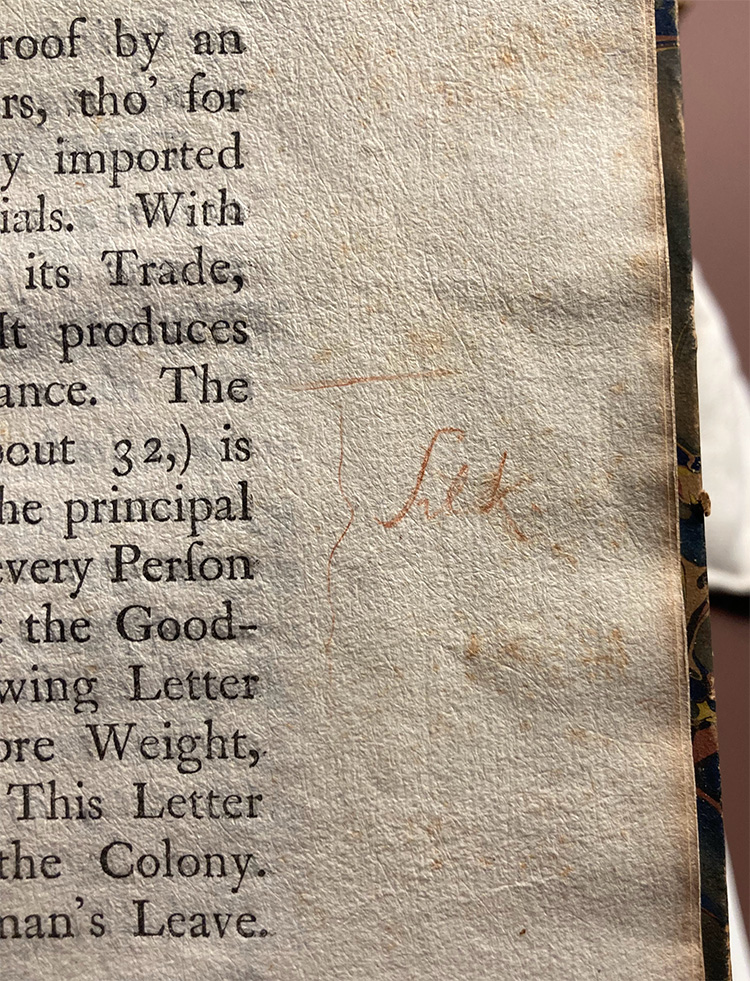 Figure 6 |
In addition to his literary pursuits, Read dabbled extensively in horticulture. He and his brother, who owned a large plantation in New Jersey, exchanged letters on agriculture as well as seeds and samples of plants throughout their lives.[74] Since his youth, Read had corresponded with and followed the studies of English botanist Peter Collinson, even naming his only son Collinson after the scholar.[75] Peter Collinson was deeply interested in silk production and collected many books on the topic—he also helped acquire books for the Library Company of Philadelphia.[76] James Read was also connected with the Bartrams, a family of naturalists and early members of the American Philosophical Society. Moses Bartram had conducted experiments on American silk worms collected along the Schuylkill River (perhaps not far from Read’s home) and helped to lead the Society’s silk initiatives.[77] His brother, William, traveled extensively throughout the southern colonies in the 1760s and 1770s and published an account of his experiences in 1791.[78] As a result of his extensive kinship and friendship networks, Read was well-positioned not only to learn about sericulture from its leading supporters and scholars, but also to experiment with mulberry trees and silkworms in his own sizable garden. He may have even received seeds or seedlings collected in the colonies and abroad from his correspondents, as Collinson and the Bartrams were known to send samples in their post.
Another piece of circumstantial evidence helps support theories that Read was involved in the early silk trade and relied on books like Reasons to guide him. After nearly thirty years of non-payment for his debt to Strahan, Read suddenly sent the English publisher the large sum of sixty pounds (roughly half of what he owed) in 1771.[79] Where he came across such a sum is not known, but it is possible that Read found the early years of the Philadelphia silk project to be quite lucrative given the ample subsidies and benefits provided by the Silk Society. Read even appears to have been optimistic of paying the full amount, as he agreed to a bond for the remaining funds in 1773. However, the colonies’ foray into the American Revolution and the resulting decline in silk production in Philadelphia meant that Read never sent over the remaining funds.[80] When Strahan died in 1785, Read still owed him more than seventy pounds for the books he had purchased forty years before.[81]
JAMES READ, LIBRARIAN.
Just after the conclusion of the Seven Years War in 1763, six men met at Widow Drury’s Tavern in Reading, Pennsylvania. They came to discuss the founding of a subscription library where, for a fee of $2 per year or 5 cents a day, anyone could borrow books and gain access to knowledge.[82] Likely modeled on Franklin’s Library Company of Philadelphia founded thirty years before, this library would bring literature and education to a remote corner of the Pennsylvania territory. One of the founders put in charge of acquiring books for the new library was none other than James Read, a former subscriber to the Library Company himself.[83] Today, this library still operates as the Reading Public Library and is the sixth oldest library in the United States (although not in continuous operation since 1763).
That James Read would be instrumental in the creation of a new library within a decade of moving to Reading perhaps comes as no surprise given his literary connections and interests. His motivation may also have been due to brotherly competition, as his elder brother Charles had helped to establish a similar subscription library in his home of Burlington, New Jersey in 1757. It seems that the Read brothers, like their father before them, were civic-minded and saw books as important resources that should be made accessible to the public, if not for free, then for a small fee. Many of the books that Charles donated to the library were from his own collection, including older pre-1740s volumes that could have belonged to his father decades before.[84] Following in his brother’s footsteps, Read might have also provided books from his own overflowing shelves to expand the Reading Library’s offerings, in addition to using his publishing network to acquire new texts. Perhaps, having read Reasons, Read chose to give it to the library so others might learn about the origins of the Georgia project and its grand silk ambitions—a story that few Pennsylvanians probably knew.
Read’s involvement in the early Reading Library may also help explain why this copy of Reasons includes his full name, date, and location written so decisively on the title page: James Read’s of Reading on Schuylkill 1770. Reasons belonged to his collection and even as he lent books to the library for circulation among subscribers, he retained ownership of them. His experience reconciling his father’s library—tracking down missing volumes lent to family acquaintances who had never returned them—may have prompted him to be more careful with his own valuable collection. The act of permanently adding his name and other identifying information in ink to the title page, and not a page that might be easily removed such as an end page, would have ensured that Read’s copy could not be misplaced or confused with another. This book undisputedly belonged to him. His declaration would also have helped Read to locate and reclaim his books if the library ever ceased lending or if he stepped back from his role as a subscriber and founder. In the end, Reasons likely returned to Read just a few years later as the library closed in 1774 in the lead-up to the American Revolution.[85] We do not know what this book experienced in the almost 100 years between Read’s inscription in 1770 and its induction into the Library of Congress in 1867 but based on the wear and marginalia, Reasons appears to have passed through many hands and engaged many eager readers during its time in circulation and beyond.
CONCLUSION: JAMES READ’S LEGACY
In his 1939 book on the life of James Read and his relationship with William Strahan, J. Bennet Nolan writes stingingly about Read’s legacy:
“No one remembers poor Jimmy Read now, and he rests in an unmarked grave in the yard of historic Christ Church in Philadelphia… Nevertheless, he once loomed large in the colonial and Revolutionary history of this province… With his talents and family connections he should have taken high place amongst the founders of our nation; that he did not do so may be ascribed to his own foibles and omissions.”[86]
Nolan’s criticism of Read is that, unlike his more famous family members, his name has not stood the test of time. His faults were well-known by his peers and he openly struggled with alcoholism and debt—although Franklin, Hall, and Strahan were certainly not without flaws themselves. At a time when men like Franklin were able to transcend life and become established figures in our history books, James Read has instead faded from memory.
Ironically, Nolan’s sometimes scathing account is one of the few published resources available on Read’s life. But a different story is told not through primary or secondary documentary materials but through the very objects that Read once owned and used. The simple act of signing his copy of Benjamin Martyn’s 1733 book Reasons for establishing the Colony of Georgia has left open a portal into Read’s life in the year 1770—and through it, to otherwise unimaginable connections between a Pennsylvania lawyer, a burgeoning southern colony, the complex and sometimes lucrative trade in raw silk, and a new public library.
This story came from one book, from the underlining and scribblings of an old man more than two hundred and fifty years ago. A flourish of the pen might be easy to overlook or ignore: I almost did when I first saw Read’s marginalia and his bold signature on the title page. Certainly, his loud claim to ownership might be seen as self-important—Nolan would be the first to agree. But in an age where few people were literate and even fewer could afford to own books, Read was acquiring texts to absorb knowledge of the world. His act of self-memorialization on the title page of Reasons may actually relate to his role within the early Reading library: as a former bookseller, he was in charge of acquiring books for the new library. With his connections to the publishing industry and book trade and his large personal library, Read was well-placed to make literature available to others on the Pennsylvania frontier. Through the distribution of books like Reasons, he could introduce the growing town of Reading to a southern colonial project not unlike their own—the establishment of Savannah in 1733 at the edge of British North America and the goods like silk that took a central place in Georgia’s early colonial industry and identity. His signature on the title page protected his investment while also ensuring that these books could be circulated to others in his community. The dirtied pages and stained sheets may allude to the countless hands that handled Reasons through the Reading Library, with frontier farmers learning about the economics of silk as they prepared to grow their own mulberry trees and raise their own silkworms, inspired by the Georgia colonists that came before them. In this way, it seems only fitting that I discovered Read’s story through a book, and it is through his contributions to collecting and sharing books that his story lives on.
Emelia Lehmann is Boston-based cultural heritage professional and a former Presidential Management Fellow and Historical Architect with the National Park Service. She completed the 2023 MESDA Summer Institute as the Mills Lane Architectural Fellow. She can be contacted at [email protected].
[1] “Introduction” in Collections of the Georgia Historical Society, VOL. I., ed. Georgia Historical Society (Freeman and Bolles, 1840), v and xii.
[2] This book was the subject of my 2023 MESDA Summer Institute project, where I explored the publication history of Reasons and provided a detailed analysis of its frontis image created by engraver John Pine. I came across Read’s copy at the Library of Congress while conducting additional research, and my curiosity about his signature inspired this spin-off essay.
[3] Nathaniel A. Thomas, “The History of the Reading Public Library,” Berks Community Television, Virtual Lecture, 15 January 2013, Video, 01:10 to 01:20, https://archive.org/details/The_history_of_the_Reading_Public_Library.
[4] Reasons followed a short four-page treatise published in 1732 (and attributed to Martyn) titled Some Account of the Design of the Trustees for Establishing the Colony of Georgia in America. This publication contained a brief summary of the intended project and was most likely intended to garner early investments and spread the word about the project. Benjamin Martyn, Some account of the designs of the Trustees for establishing the colony of Georgia in America (London: 1732), Internet Archive.
[5] This watermark was observed on the two copies of the book at the Library of Congress and on the copy held by MESDA.
[6] De Vorsey attributed the changes to Oglethorpe and Martyn, although the map does not list a maker or contributors. Louis de Vorsey, “Maps in Colonial Promotion: James Edward Oglethorpe’s Use of Maps in ‘Selling’ the Georgia Scheme,” Imago Mundi no. 38 (1986): 35–45, http://www.jstor.org/stable/1150866.
[7] Omissions within the new Georgia territory near the Savannah River included at least three indigenous communities listed as having 150 men or more. A counter-argument to de Vorsey’s claims might be that these settlements had changed or moved in the twenty-five years since Naire’s map was produced, although further research would be needed to confirm.
[8] de Vorsey, “Maps in Colonial Promotion,” 35-39.
[9] Pine was also a Freemason (as were many of the Georgia Trustees) and some historical accounts suggest that he may have been a person of color. As Royal Chief Engraver, he was involved in the Georgia project again in 1754 when he was asked to redesign the Georgia colonial seal. Ben Marsh, “The Meanings of Georgia’s Eighteenth-Century Great Seals,” The Georgia Historical Quarterly 96, no. 2 (2012): 216-218, http://www.jstor.org/stable/23622209.
[10] Today, the second printing is referred to by scholars as the First Edition Second Printing (the ‘preferred’ edition) while the third printing is the Second Edition, so listed on the title page.
[11] Georgia Historical Society, “Introduction,” vii. Jonathon Belcher, who served as the Governor of Massachusetts Bay and New Hampshire (1730-1741) and Governor of New Jersey (1747-1757), was involved in colonial politics and expansion. He corresponded with Oglethorpe and the two men may have even met in London during one of Belcher’s visits.
[12] The Society includes this provenance in their 1840 volume on Georgia History: “On his leaving Massachusetts for New Jersey, the Governor [Belcher] gave [Reasons], with other books to Thaddeus Mason, Esq., who had been his private Secretary; and from him it descended to his grandson, the Rev. Thaddeus Mason Harris, D.D., and by him was furnished to the shelves of the Library of the Historical Society of Georgia.” Georgia Historical Society, “Introduction,” vii. This story helps to explain how a British book about a southern colony owned by a Massachusetts governor might have come into the possession of the Georgia Historical Society in Savannah.
[13] Trevor R. Reese, Colonial Georgia: A Study in British Imperial Policy in the Eighteenth Century (Athens: University of Georgia Press, 1963), 1-17.
[14] Milton Ready, “The Georgia Concept: An Eighteenth Century Experiment in Colonization,” The Georgia Historical Quarterly 55, no. 2 (1971): 157–172, http://www.jstor.org/stable/40579271; Colonial Society of Massachusetts, “The Proposed Colony of Georgia in New England, 1713-1733,” in April Meeting, 1939, Vol 34: Transactions, 1937-1942, https://www.colonialsociety.org/node/622.
[15] Ready, “The Georgia Concept: An Eighteenth Century Experiment in Colonization,” 157–172.
[16] These included a proposed settlement named Georgia near present-day Maine, and a ‘Province of Georgia’ west of Virginia’s Blue Ridge Mountains. Ready, “The Georgia Concept: An Eighteenth Century Experiment in Colonization,” 157–172.
[17] Robert Montgomery, A discourse concerning the design’d establishment of a new colony to the south of Carolina, in the most delightful country of the universe (London, 1717), 3 & 5, HathiTrust.
[18] Montgomery died in 1731 just a few months before King George II granted the charter for Georgia.
[19] Montgomery, A discourse, 6-7. Montgomery never visited Georgia and based his descriptions on other firsthand accounts with his own embellishments.
[20] A margravate, ruled by a margrave, was a term used within the Holy Roman Empire to refer to a border territory that typically provided defense for the interior. Montgomery’s design for Azilia was highly militaristic, a clear response to accounts of the dangers of this area from both Spanish and native threats.
[21] Montgomery, A discourse, 8.
[22] Additionally, almost nothing in Pine’s work reflects the text of Reasons, such as Martyn’s focus on silk production. Instead, Pine depicts settlers clearing and preparing trees for use in construction and, perhaps, potash production. Potash was an important ingredient in fertilizer, soap, and glass and in his treatise, Montgomery had suggested potash might be Azilia’s key cash crop. One could therefore interpret Pine’s image more as an illustration of Montgomery’s proposed colony rather than the Trustees’ plan for Georgia.
[23] Benjamin Martyn, Reasons for establishing the colony of Georgia, with regard to the trade of Great Britain, the increase of our people, and the employment and support it will afford to great numbers of our own poor, as well as foreign persecuted Protestants (London: W. Meadows, 1733), 13.
[24] Gerald B. Hertz, “The English Silk Industry in the Eighteenth Century,” The English Historical Review, Volume XXIV, Issue XCVI (October 1909), 711, https://doi.org/10.1093/ehr/XXIV.XCVI.710.
[25] Hertz, “The English Silk Industry in the Eighteenth Century,” 711-712.
[26] Many imported silkworms did not take to the native mulberry trees growing in the colonies, requiring colonists to plant imported mulberry trees. Lee Pelham Copper, “Silk Production in the Seventeenth Century,” Historic Jamestowne, Colonial National Historical Park, National Park Service, 1996. Online: https://home.nps.gov/jame/learn/historyculture/silk-production-in-the-seventeenth-century.htm (accessed 8 June 2025).
[27] Biddle Sawyer Silks, “How is Silk Made? A Step by step guide.” Online: https://biddlesawyersilks.com/how-is-silk-made-a-step-by-step-guide/ (accessed 8 June 2025).
[28] Biddle Sawyer Silks, “How is Silk Made?”
[29] Hertz, The English Silk Industry in the Eighteenth Century, 716.
[30] Martyn, Reasons for establishing the colony of Georgia, 10-11.
[31] Martyn, Reasons for establishing the colony of Georgia, 10-11.
[32] The colony of Georgia had three official seals in the years before the American Revolution. The first (1733-1754) was used during the Trustee period and on one side featured a silkworm and cocoon on a mulberry leaf. The second (1754-1767) was introduced when Georgia became a Royal Colony and included a female figure offering a skein of silk to the monarch, George II. This seal was replaced in 1767 with a similar scene depicting the new monarch, George III, and remained in use until 1777. Marsh, “The Meanings of Georgia’s Eighteenth-Century Great Seals,” 199-200, 210-211 & 221-223.
[33] E. Merton Coulter and Albert B. Saye, eds., A List of the Early Settlers of Georgia (Athens: The University of Georgia Press, 2009), 1.
[34] Coulter and Saye, A List of the Early Settlers of Georgia, 2 & 8.
[35] James Read is not to be confused with Colonel James Read (1743-1822), a Revolutionary War hero who likewise resided in Philadelphia for part of his life and interacted with many of the same popular figures.
[36] James Read’s father, Charles Read, had been Mayor of Philadelphia from 1726-1727. His uncle, James Logan, was also Mayor (1722-1723), as well as Chief Justice of Pennsylvania (1731-1739), acting Governor (1736-1738), and Colonial Secretary to William Penn during his youth.
[37] Carl Raymond Woodward, Ploughs and politicks; Charles Read of New Jersey and his Notes on Agriculture, 1715-1774 (New Brunswick, NJ: Rutgers University Press, 1941), 25-26, HathiTrust.
[38] Most people at this time could not read, much less purchase a book which might have cost as much as a month’s wages for the average laborer. Printing within the colonies was also extremely limited, so many books were imported from abroad.
[39] Charles, Jr., was one of the original subscribers to the library in 1731. Woodward suggests that Charles Read Sr. probably sponsored his son’s involvement, as Charles Jr. was just sixteen at the time. Woodward, Ploughs and politicks, 29. James Logan, James Read’s uncle, was also very involved in the Library Company and donated many books during his lifetime, as well as his 3,000 volume collection after his death. The Library Company of Philadelphia, “James Logan,” Online: https://librarycompany.org/jameslogan/ (accessed 15 May 2025).
[40] J.A. Leo Lemay, “Chapter 4: The Library Company of Philadelphia,” in The Life of Benjamin Franklin, Volume 2: Printer and Publisher, 1730-1747 (Philadelphia: University of Pennsylvania Press, 2006), 100. This was in contrast to the academic libraries in the colonies, such as Yale and Harvard, which focused more on theological books and books in foreign languages. Franklin imagined the Library Company as a place to exchange new and relevant information, not to learn ancient philosophies.
[41] Lemay, “Chapter 4: The Library Company of Philadelphia,” 95-97.
[42] Woodward, Ploughs and politicks, 34.
[43] The Pennsylvania Gazette, Philadelphia, 4-11 August 1737, quoted in Woodward, Ploughs and politicks, 34-35.
[44] Franklin married Deborah Read in 1730; her mother, Sarah Read, was a cousin of James’s father, Charles. James Read’s step-mother was also named Sarah (Harwood) Read, leading to some confusion in the deeds and documents relating to both households. In his correspondence, Franklin used notations to denote Sarah Read, neighbor, and Sarah Read, mother.
[45] Woodward, Ploughs and politicks, 29-30.
[46] J. Bennett Nolan, Printer Strahan’s book account: a colonial controversy (Reading, PA: The Bar of Berks County, 1939), 3-4, HathiTrust.
[47] “Containing the freshest Advices Foreign and Domestick. From May 17. to May 24. 1733,” The Pennsylvania Gazette, 17 May 1733, Newspaper.com. These accounts were first published in the South-Carolina Gazette on 31 March and were received in Philadelphia by May (nearly six weeks later), illustrating the pace at which news traveled around the American colonies.
[48] Edwin Wolf, ed., A Catalogue of books belong to the Library Company of Philadelphia: a facsimile of the edition of 1741 (Philadelphia: Library Company of Philadelphia, 1956), vi-viii & 16, Internet Archive. The Library Company of Philadelphia now holds three copies of Reasons in their collection, including one previously belonging to celebrated English botanist Peter Collinson.
[49] Benjamin Franklin, “Letter from Benjamin Franklin to William Strahan,” 25 September 1746, in Benjamin Franklin Papers, Yale University Libraries, https://franklinpapers.org/framedVolumes.jsp.
[50] “Books to be sold…,” The Pennsylvania Gazette, Philadelphia, 12 April 1745, Page 2, Newspapers.com.
[51] James Read, “Letter from James Read to William Strahan,” 1 July 1744, in The John Bigelow Papers, Union College Schaffer Library Special Collections, https://arches.union.edu/do/fe393a92-1eb4-4f09-95db-51cf7002ad72#mode/2up.
[52] “Read to Strahan,” 1 July 1744.
[53] Nolan, Printer Strahan’s book account, viii.
[54] In a diary entry dated December 1787, when Read was in his late 60s, he wrote: “Having soon after rising been confronted with a strong inclination for a drink of rum and water, I resisted it to my great satisfaction and read several chapters of an excellent little book entitled Miroir de la Perfection Chretienne. I pray God that my soul may profit thereby.” Read quoted in Nolan, Printer Strahan’s book account, 122.
[55] In 1749, Read attempted to compete with Franklin for the position of Clerk of the Assembly. Franklin won the position and described the situation to Strahan in a letter, noting that he was hurt by Read’s actions and, for a time, the two men “were not on Speaking Terms.” Benjamin Franklin, “Letter from Benjamin Franklin to William Strahan,” 29 April 1749, in Benjamin Franklin Papers, Yale University Libraries, https://franklinpapers.org/framedVolumes.jsp.
[56] Adjusted for inflation, 132 pounds sterling would equal almost $30,000 in 2025 dollars. For comparison, Franklin regularly ordered large quantities of books from Strahan that totaled closer to 60 or 70 pounds sterling.
[57] William Strahan, “Letter from William Strahan to Benjamin Franklin, Power of Attorney,” 2 September 1748, in Benjamin Franklin Papers, Yale University Libraries, https://franklinpapers.org/framedVolumes.jsp.
[58] “Franklin to Strahan,” 29 April 1749.
[59] “Letter from William Strahan to David Hall,” 13 February 1750, quoted in Nolan, Printer Strahan’s book account, 44.
[60] Benjamin Franklin, “Letter from Benjamin Franklin to William Strahan,” 19 October 1748, in Benjamin Franklin Papers, Yale University Libraries, https://franklinpapers.org/framedVolumes.jsp.
[61] The name Reading has nothing to do with the Read family, although the coincidence is remarkable.
[62] Read quoted in Nolan, Printer Strahan’s book account, 60.
[63] Read quoted in Nolan, Printer Strahan’s book account, 64. Nolan described Read’s study as ‘pretentious’ and suggested that some of the books might have been those sent by Straham in 1745 for which Read never paid.
[64] Nolan, Printer Strahan’s book account, 52.
[65] Nolan, Printer Strahan’s book account, 63-64.
[66] The Pennsylvania Gazette, Philadelphia, 6 June 1765, Page 1, Newspapers.com.
[67] The Pennsylvania Gazette, Philadelphia, 11 January 1770, Page 3, Newspapers.com.
[68] The treatises were sent to the Society by Benjamin Franklin (then the American Philosophical Society President), who was at that time in England. A letter of his to Dr. Evans, Vice-President of the Society, was included in the publication and emphasized the benefits and opportunities of sericulture in Pennsylvania. Abbé Pierre-Augustin Boissier de Sauvages and Samuel Pullein, Directions for the Breeding and Management of Silk-worms: Extracted from the Treatises of the Abbé Boissier de Sauvages, and Pullein, with a Preface, Giving Some Account of the Rise and Progress of the Scheme for Encouraging the Culture of Silk, in Pennsylvania, and the Adjacent Colonies (Philadelphia: Joseph Crukshank and Isaac Collins, Publishers, 1770), iv-v.
[69] The Society offered to reel silk provided by farmers in Pennsylvania, Delaware, Maryland, and New Jersey, extending the prospect of silk production throughout the region.
[70] de Sauvages and Pullein, Directions for the Breeding and Management of Silk-worms, vii.
[71] The Pennsylvania Gazette, Philadelphia, 30 August 1770, Page 3, Newspapers.com.
[72] The Pennsylvania Gazette, Philadelphia, 30 August 1770, Page 3, Newspapers.com.
[73] de Sauvages and Pullein, Directions for the Breeding and Management of Silk-worms, xi, xiv.
[74] Woodward, Ploughs and Politicks, 83.
[75] Woodward, Ploughs and Politicks, 43.
[76] National Gallery of Art, “History of Early American Landscape Design: Peter Collinson.” Online: https://heald.nga.gov/mediawiki/index.php/Peter_Collinson (accessed 8 June 2025).
[77] His observations were published by the American Philosophical Society after his death: Moses Bartram, “Observations on the native silk-worms of North America, by the late Mr. Moses Bartram from the Transactions of the American Philosophical Society,” in The Literary Magazine and British Review for 1793, Vol. X (London, 1793).
[78] American Philosophical Society Members Biography, “William Bartram.” Online: https://membib.amphilsoc.org/member/pub/108 (accessed 27 December 2025).
[79] Nolan, Printer Strahan’s book account, 83-84.
[80] Strahan’s relationship with his two of his biggest supporters in the American book market, and in his dealings with Read, had also changed. David Hall, his former protege and Read’s brother-in-law, died in 1772. Franklin, critical of British taxation—especially on paper goods via the Townshend Act—was highly critical of Strahan’s involvement in British Parliament, although the two continued to correspond until the end of Strahan’s life.
[81] Read tried to restart his correspondence with Strahan around the same time. In a letter to Strahan in 1785, he writes: “Be pleased to address me, dear Sir, as James Read of Reading, now of Philadelphia. I thank God I have no ill will to any man, much less to a man whom I knew so long ago as 15 March 1740.” However, Historian J. Bennett Nolan writes that the letter was returned unopened with a notation written on it by Read that Strahan had died before the letter reached him. J. Bennett Nolan, The foundation of the town of Reading in Pennsylvania (Reading, PA: School District of Reading, Pennsylvania, 1929), 189.
[82] Olivia Sostak, “Reading Public Library,” Clio: Your Guide to History. Online: https://theclio.com/entry/39011 (last updated 3 May 2017).
[83] Thomas, “The History of the Reading Public Library,” 01:10.
[84] Woodward, Ploughs and Politicks, 47-48.
[85] Sostack, “Reading Public Library.”
[86] Nolan, Printer Strahan’s book account, vii-viii