
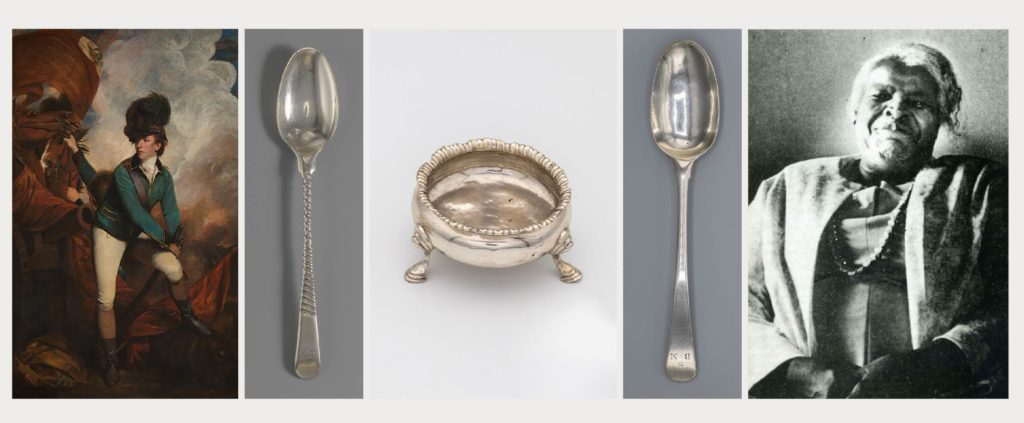
On the morning of 4 June 1781, the American Revolution came thundering up the hillside to Monticello’s doorstep. The hooves of a mounted group of British Dragoons, many of whom were Loyalist soldiers from Pennsylvania and New York, pounded up the dirt roads, led by Captain Kenneth McLeod. His mission: to capture Virginia Governor Thomas Jefferson and other members of the Virginia legislature. He nearly succeeded.
Thomas Jefferson carefully recorded his memories of the events of June 1781. According to Jefferson, the Virginia General Assembly had reconvened in Charlottesville in May due to aggressive British military activity around Richmond. Jefferson was in residence at Monticello with his wife and two daughters. Speaker of the House Benjamin Harrison, Speaker of the Senate Archibald Cary, and legislator Thomas Nelson Jr., accompanied by their enslaved attendants, also lodged at Monticello. None of them knew that Lieutenant Colonel Banastre Tarleton, commander of the British Legion, was riding quickly to Charlottesville with about 250 mounted troops. After receiving Jack Jouett’s warning of a British regiment’s imminent approach, the delegates departed Monticello seeking shelter and security in Charlottesville. The assembly eventually adjourned to Staunton, about forty miles west. Martha Jefferson and her daughters fled the plantation in a carriage. Lieutenant Christopher Hudson, a neighbor of Thomas Jefferson’s, arrived at Monticello with an urgent warning that the British were climbing the hill. Jefferson left home on horseback just in front of the troops, so close that he was compelled to avoid open roads, instead riding through the woods to thwart detection and capture. He rejoined his family and found eventual refuge at Poplar Forest, his plantation in Bedford County. It is a thrilling, dramatic story about escape and equanimity in the face of danger that became one of the foundational narratives of life at Monticello during the American Revolution.[1]
In his recollections, written and revised over the following decades, Thomas Jefferson, intentionally or not, disregarded pieces of the story. He named Jack Jouett and Christopher Hudson as the men who brought warnings about the British arrival. He described his family’s departure from Monticello but never named the enslaved people who packed Martha Jefferson’s carriage or who drove it away. He did not identify the enslaved person who prepared his horse for rapid departure. He did not discuss the conduct of the British soldiers during their time at Monticello, how they comported themselves among the stores of wine, sugar, and other foodstuffs stored at the plantation. He did not explain what happened to valuable household objects like silver during the occupation. In later correspondence, Jefferson claimed that British troops did not damage the house or plantation at all, an experience vastly different from that of many of his neighbors and peers in Virginia.[2]
Luckily, Thomas Jefferson’s recollections are not the only sources for the events of 4 June 1781. Rich resources, including journal entries, published references, recollections, generations of oral histories, and pieces of silver, document the stories and perpetuate the memories associated with the events of 4 June.[3] White descendants of Jefferson and descendants of at least three families who were enslaved at Monticello have preserved the story of the British raid in variations that give the story drama, tension, and life. Most versions of the story include details about a group of silver tablewares hidden by members of the enslaved community in the uncertain moments as Jefferson departed and British troops advanced toward the house. While Jefferson centered his recollections around himself and his actions, the families’ stories placed people and objects at the center of a sometimes conflicting tale about independence, authority, loyalty, agency, and pride. While different families focus on various aspects of the story, all who tell it are creating worth and claiming status through association with the silver and the events around it.[4]
The idea of objects as “memory bridges,” connectors between memories that shape identity, is a useful framework for this work, especially when used in conjunction with the oral and written traditions preserved across generations. Monticello historian Lucia Stanton calls these traditions “inherited memories” that connect objects, events, and the people who remember them.[5] The beauty of the memory bridge concept is the flexibility and variety it allows for the diverse ways that objects, memories, and identities interrelate and can be traced. A silver teaspoon, found on the ground at Monticello in the 1960s, taken, preserved, and returned to the Thomas Jefferson Foundation in 2017 is but one example of an inherited memory. Other pieces of silver, marked by a new owner to establish a connection between Thomas Jefferson and the new owner’s ancestors, are another. The published story of Martin Hemings, the enslaved man who acted as the butler of Monticello during the June 1781 raid, responding to the threat of a British soldier demanding information with the icy words, “Fire away, then,” is yet another inherited memory, one which inspired the title of the article. Oral traditions passed down through generations about an ancestor’s heroism in the face of violence and uncertainty are another still. [6] The varied stories told about the 4 June raid, the silver that survived it, and the people who defied the British to save a Jefferson family asset, even as they themselves were defined as assets under the inhumanity of enslavement, became embedded with meanings that shift in focus and resonance depending on whose memories shaped the storytelling. The variations reveal the complex coexisting realities and experiences of people living through the American Revolution and shaping the earliest years of the nation.
The morning of 4 June was not the only time Thomas Jefferson and his family fled their residence in the face of British approach. It happened first about six months earlier, in January 1781, when the family left the governor’s residence in Richmond in haste. Both incidents would soon become political ammunition for Jefferson’s opponents who questioned his honor and accused him of weakness and poor judgement in his role as governor. These attacks were fierce and unrelenting, first surfacing just after his term as governor ended. Political foes levied these accusations against him again in the 1790s, during his presidency, and even into his retirement years (1809–1826). Jefferson spent the rest of his life trying to explain and justify his actions and decisions in the face of British aggression in January and June 1781. The generations of descendants who preserved and celebrated memories of the actions of those who conducted the family’s plans for departure, the management of household affairs, and the careful stewardship of valuable material goods approached the story from a perspective distinct from Jefferson’s. One of the most remarkable aspects of the story is how widely shared it is between Jefferson’s recognized white descendants and those descended from families who were enslaved at Monticello.
Silver at Monticello
What are the silver objects at the center of the shared stories about the events of 4 June 1781? Where did they come from, and how were the objects acquired? A close examination of their makers, marks, and provenance helps identify the silver that was present in the Jefferson household and later became associated with the story of how the enslaved people who remained at Monticello hid it from British troops during the raid. These surviving pieces became the material links to the event, remembered across generations by descendants of both the slaveholding and enslaved families.
Thomas Jefferson’s father, Peter Jefferson, died in 1757 at Shadwell, the plantation he settled in Albemarle County, Virginia. His probate inventory included considerable household silver consisting of eighteen tablespoons, a soup spoon, a punch ladle, two salts, ten teaspoons, small utensils, a silver coffee pot, teapot, and milk pot. The coffee and tea wares were the most highly valued objects in Jefferson’s inventory, except for beds and bed hangings and the human property who labored for Jefferson and his family. Jefferson also owned silver personal items, including a “silver Hilted sword” and a “Do [ditto, or “silver hilted”] cutlass,” a silver watch, and a pair of silver spurs.[7]
Peter Jefferson left all his household furniture to the use and discretion of his widow, Jane Jefferson, except for a cherry desk and bookcase, his books, and his surveying and measuring instruments. He set these aside for his elder son, Thomas. Since Thomas Jefferson was a minor when his father died, all these items remained at Shadwell, in use by Jane Jefferson and her children.[8] Tragically, the great house at Shadwell burned on 1 February 1770, consuming most of the furniture and household items there.[9] Archaeological excavations at Shadwell have recovered fragments that relate to the objects on the probate inventory: examples of Delftware plates and Chinese export porcelain saucers, stemware, pieces of bone-handled forks and knives, furniture hardware, measuring devices, clothing accessories like buttons and buckles, and a single silver teaspoon.[10]
The Shadwell teaspoon (Figure 1) is an example of the popular Hanoverian pattern, with its upturned terminal and extended drop where the stem meets the bowl. Marks indicate an English spoon, but they are heavily eroded and illegible. Nevertheless, the recovery of the single Shadwell teaspoon reinforces the information from Peter Jefferson’s probate inventory: that silver was present at Shadwell, that Jane Jefferson and her children continued using it along with additional flatware and ceramics listed in the inventory after his death, and that these same objects were either distributed among her daughters Mary, Martha, and Lucy when they married in the 1760s or lost in the 1770 fire. When Thomas Jefferson married Martha Wayles Skelton on 1 January 1772, the couple began married life with scant, if any, silver from his childhood home.[11]
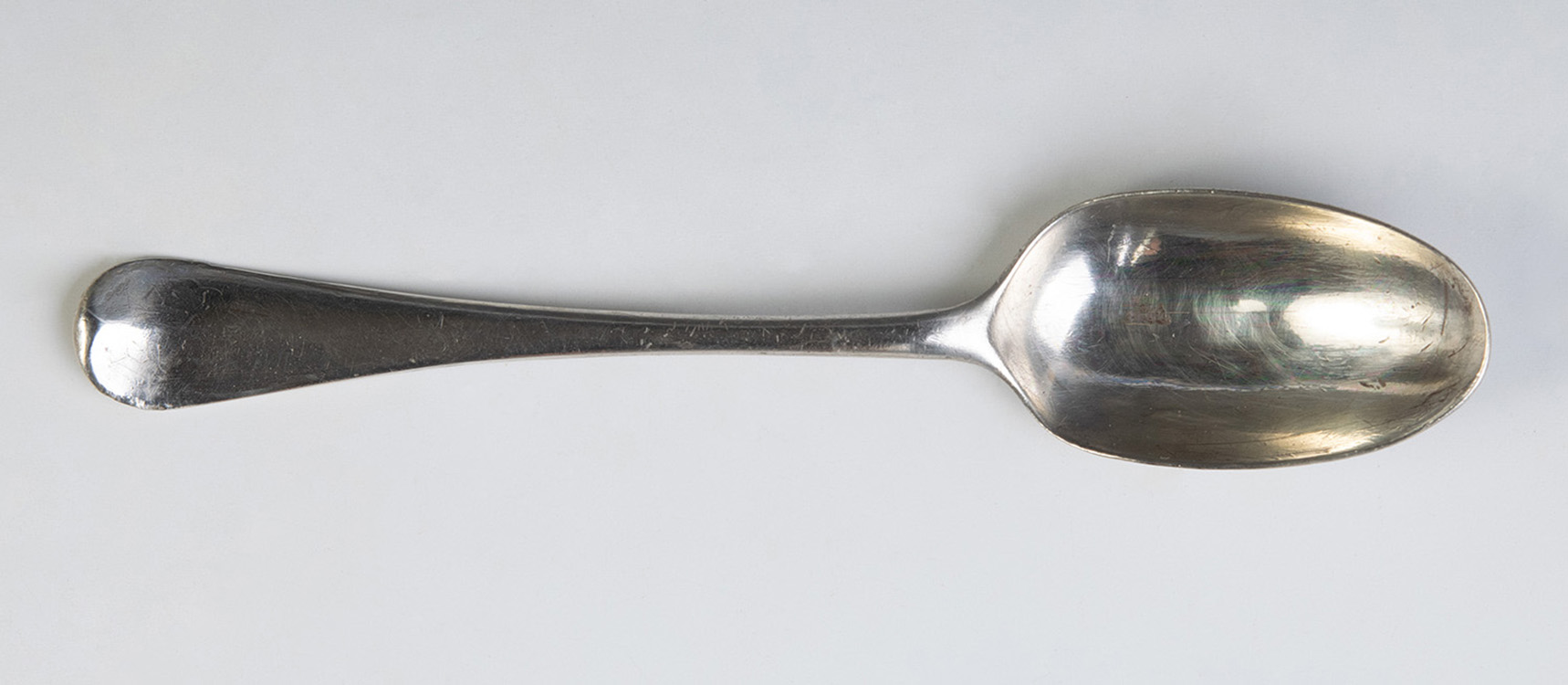 Figure 1 |
If Thomas Jefferson was silver poor at the time of his marriage, his new wife was not. Martha Wayles Skelton was a widow; in 1766, she married planter Bathurst Skelton. Over the course of their two-year marriage, which ended with his death in 1768, the Skeltons purchased silver utensils from England. A record associated with Skelton’s probate (Figure 2) indicates that Martha Jefferson had a “silvertop” cruet and stand, a ladle, twelve tablespoons, twelve teaspoons, a pair of tongs, and four salts with shovels and glass inserts, all of which she brought with her to Albemarle County upon her second marriage.[12] These items laid the foundations for the newlywed Jeffersons’ silver holdings.
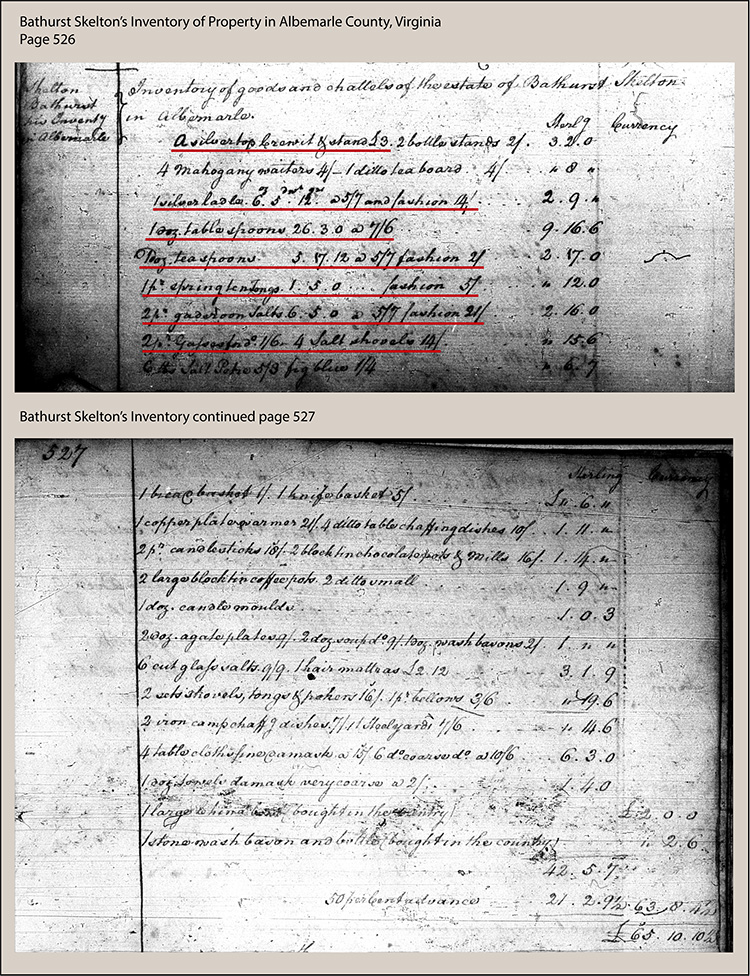 Figure 2 |
Twelve items that originated in the Skelton household are today in the Thomas Jefferson Foundation’s collection: a ladle, two salt cellars, two salt spoons, two tablespoons, and five teaspoons. Another tablespoon is in the collection of the White House Historical Association. Close reading of the silver marks across all the pieces reveals details about the Skeltons’ purchasing habits and preferences.
The large and weighty ladle (Figure 3) is an example of the Onslow pattern, with its distinctive downturned flaring scroll at the terminal. The ladle bears the smallworker mark of London silversmith James Tookey (1717–1767) and a 1766/67 date letter (Figure 4).[13] The ladle features the initials “S/B M” inscribed in a triangular composition near the top of the shaft just under the flaring scroll (Figure 5), although it is significantly worn. The initials belonged to Bathurst and Martha Skelton.
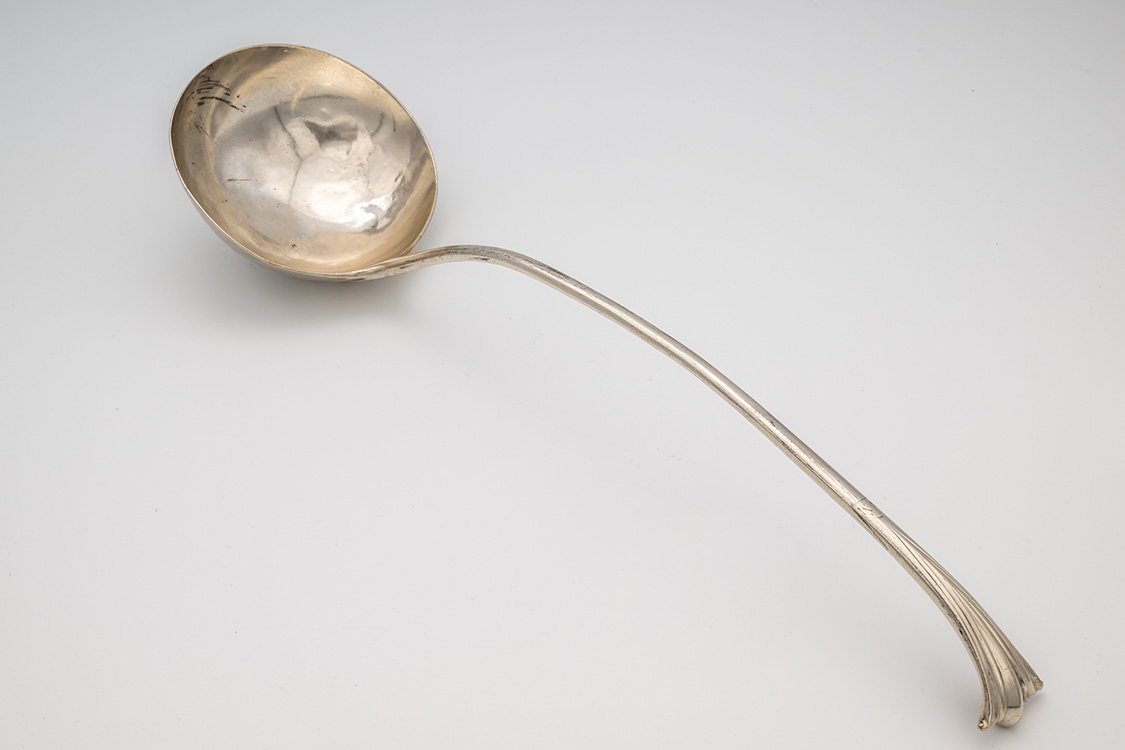 Figure 3 |
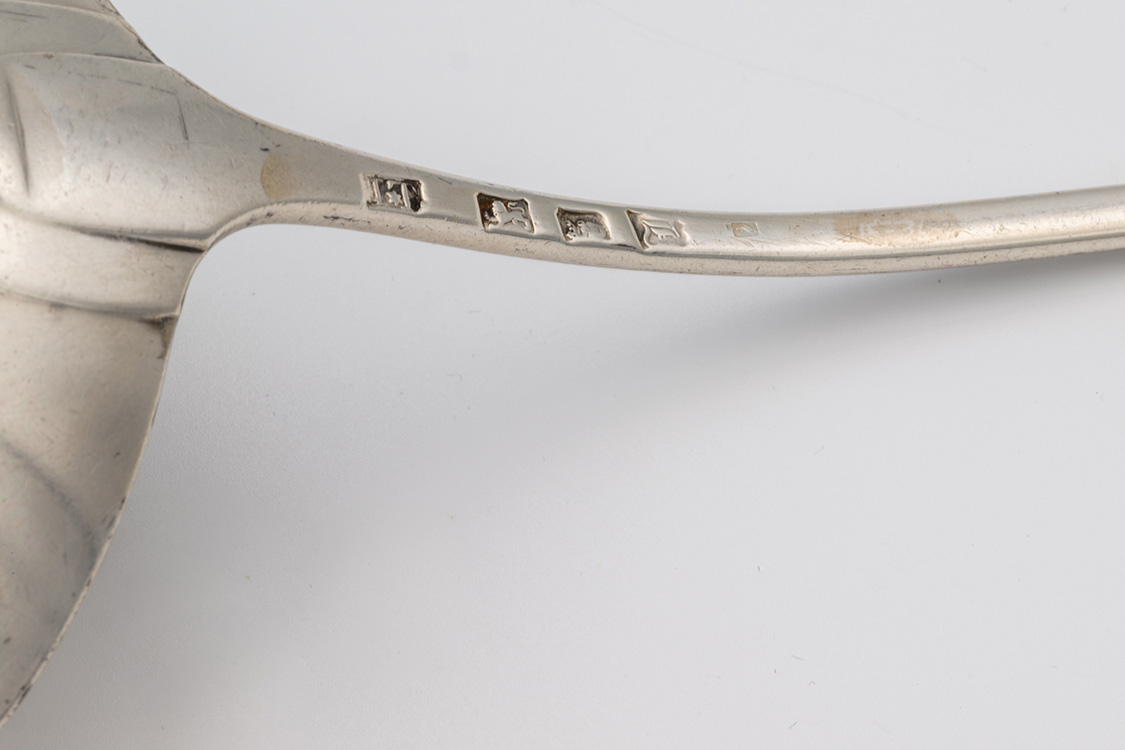 Figure 4 |
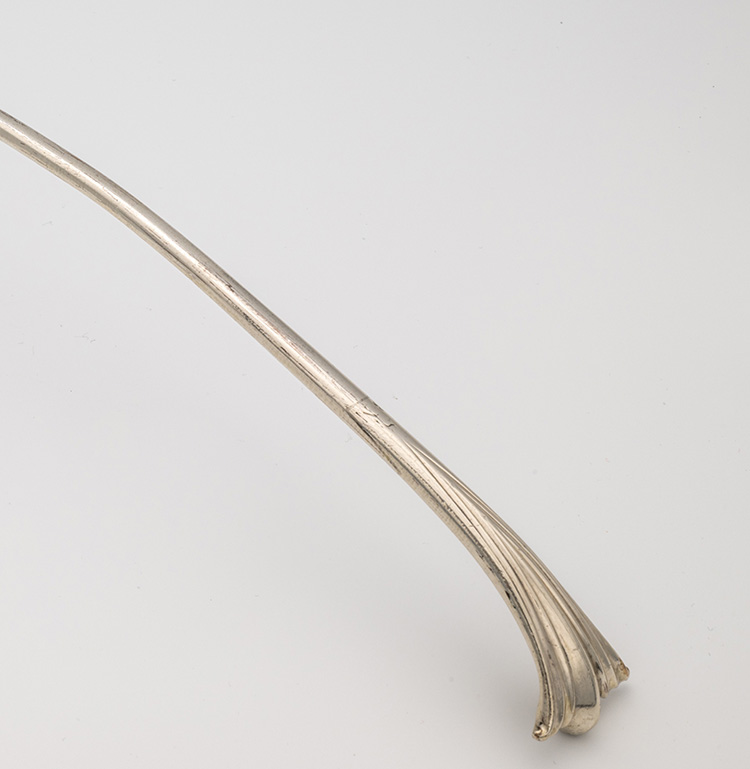 Figure 5 |
James Tookey also made the set of teaspoons with twisted stems decorated with spiral gadrooning and slightly downtipped terminals (Figure 6); five of these survive at Monticello. Tookey’s smallworker mark, “I * T,” appears on the underside of the handle (Figure 7), but no other marks are present. The spoons have the initials “S/B M” in a triangular composition with a four-pointed diamond at the center engraved on the top of the terminal (Figure 8).
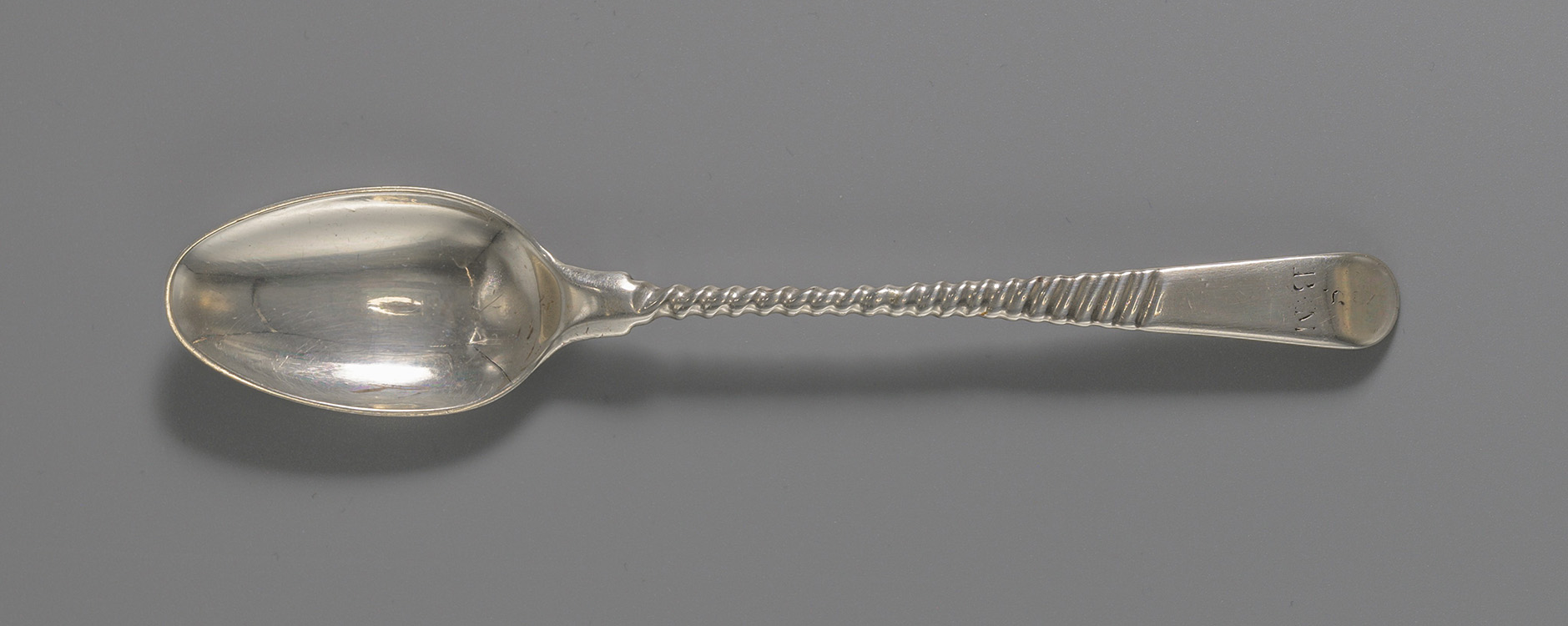 Figure 6 |
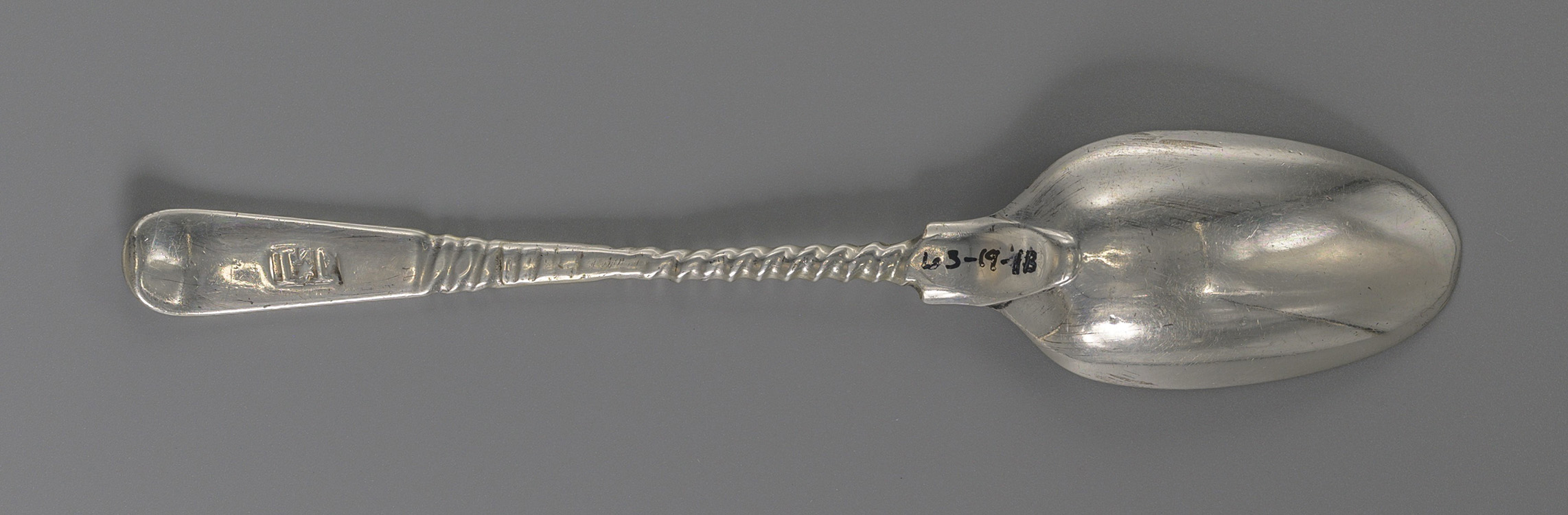 Figure 7 |
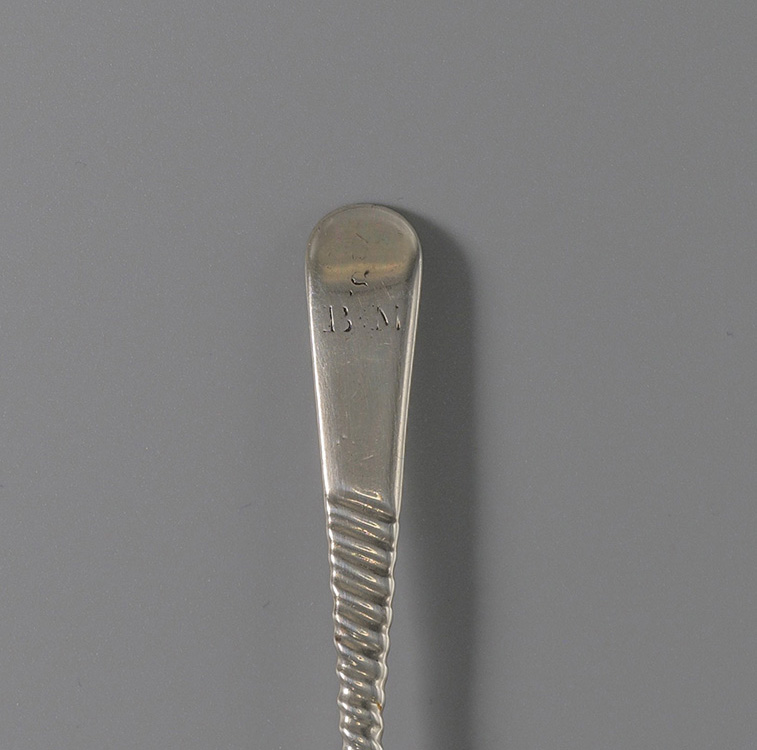 Figure 8 |
The pair of circular tripod salts with gadrooned and scalloped rims (Figure 9) carry the “E M” mark of London smallworker Elizabeth Muns and the date letter for 1768/69.[14] The salt cellars have the same set of “S/B M” initials with the four-pointed diamond engraved on the underside of the vessels (Figure 10) that appear on the teaspoons and the ladle. The engraving-style of the initials appears appropriate to the 1760s, especially in contrast to an extensive inscription outlining the history of the salt cellars’ ownership placed in the late nineteenth century. The ladle has a similar provenance as the salt cellars and an almost verbatim copy of the inscription on the underside of its bowl.
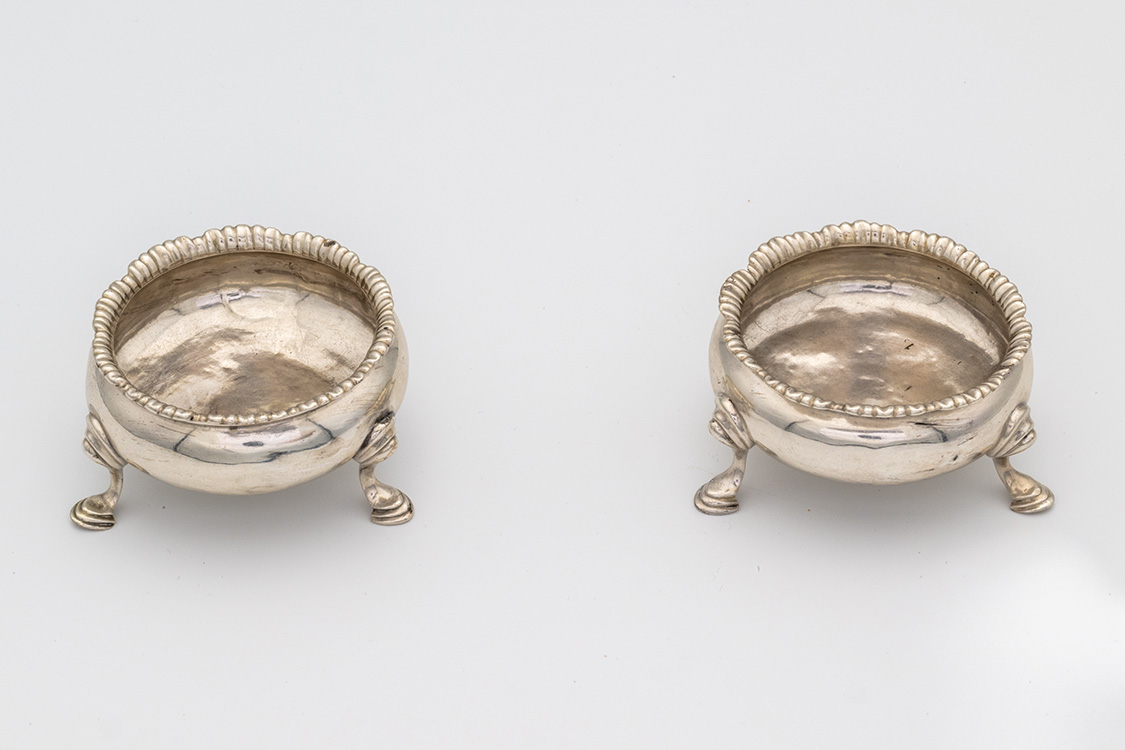 Figure 9 |
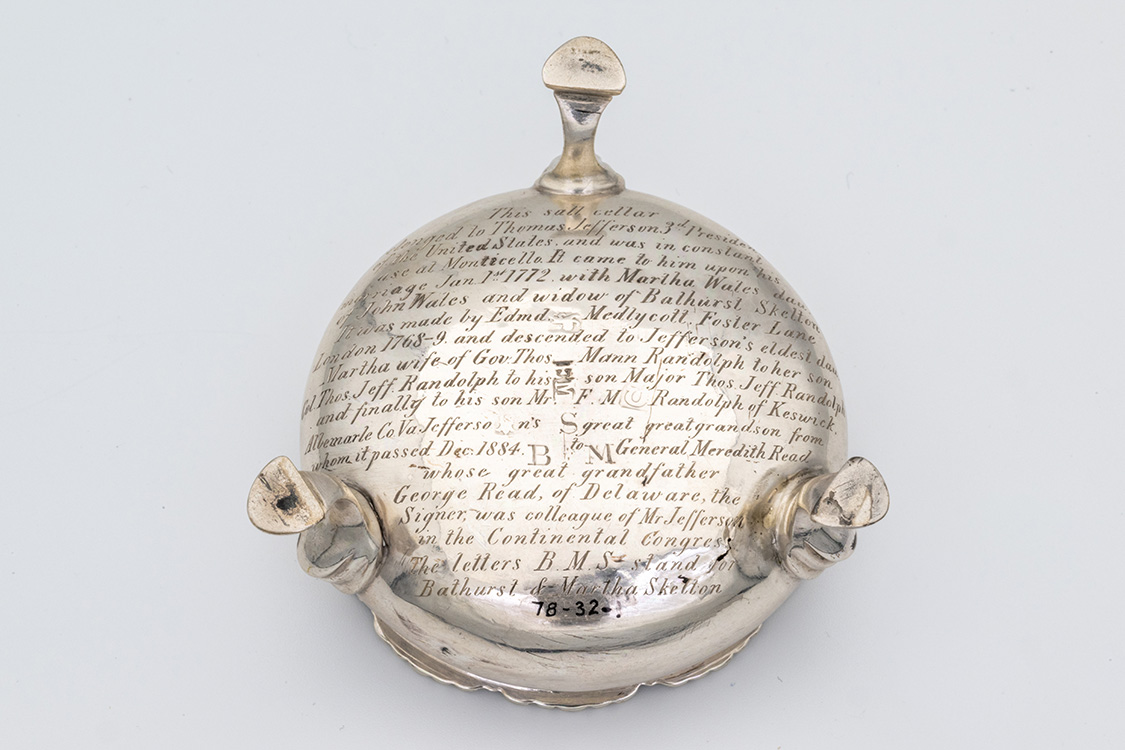 Figure 10 |
The pair of salt spoons (Figure 11) do not have any maker, date, assay, or standard marks, but share history and appear to be a set with the salt cellars made by Elizabeth Muns. The spoons have shell-shaped bowls (Figure 12) and twisted handles ending with scrolled openwork finials, which some scholars have interpreted as being in the shape of an “S” for Skelton.[15]
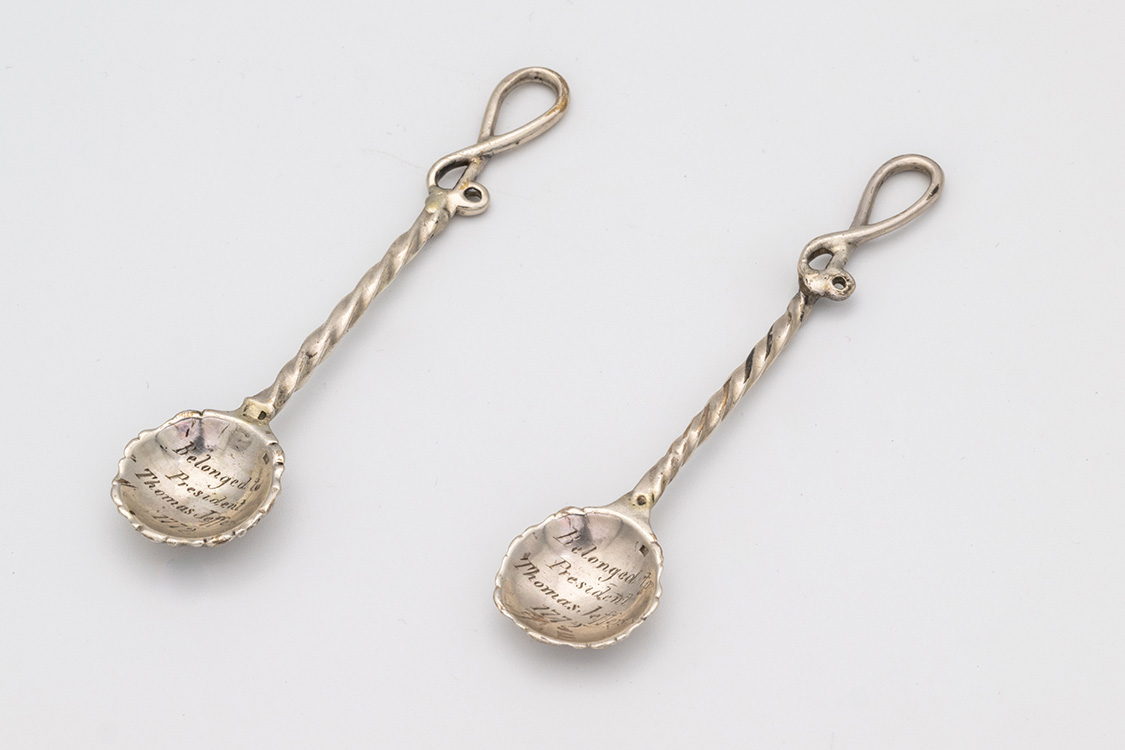 Figure 11 |
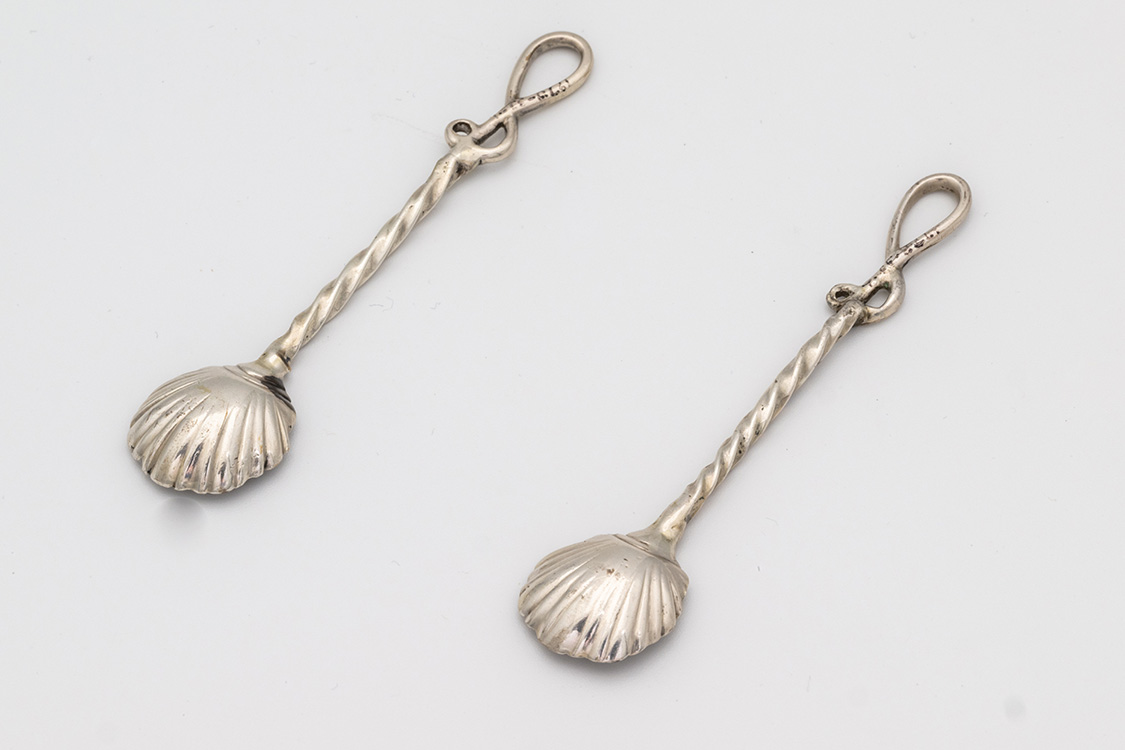 Figure 12 |
The ladle, the salt cellars, and the salt spoons were sold out of the Randolph branch of Jefferson descendants in 1884. The lengthy inscriptions on the bowls of the ladle (Figure 13) and salt cellars (see Figure 10) outline the history of ownership, misattribute the maker, define the new owner’s connections to Thomas Jefferson, and date after the silver was purchased by General Meredith Read (1837–1896). Read had “Belonged to President Thomas Jefferson 1772” inscribed in the bowls of the salt spoons (see Figure 11). Read was a career diplomat, represented America in France and Greece, and was the great-grandson of a signer of the Declaration of Independence. Through ownership and marking, Read transformed the ladle, cellars, and spoons into memory bridges for himself, linking the Jefferson objects to his family’s history through references to ancestors and genealogies, traditions of political engagement, and the Declaration of Independence.
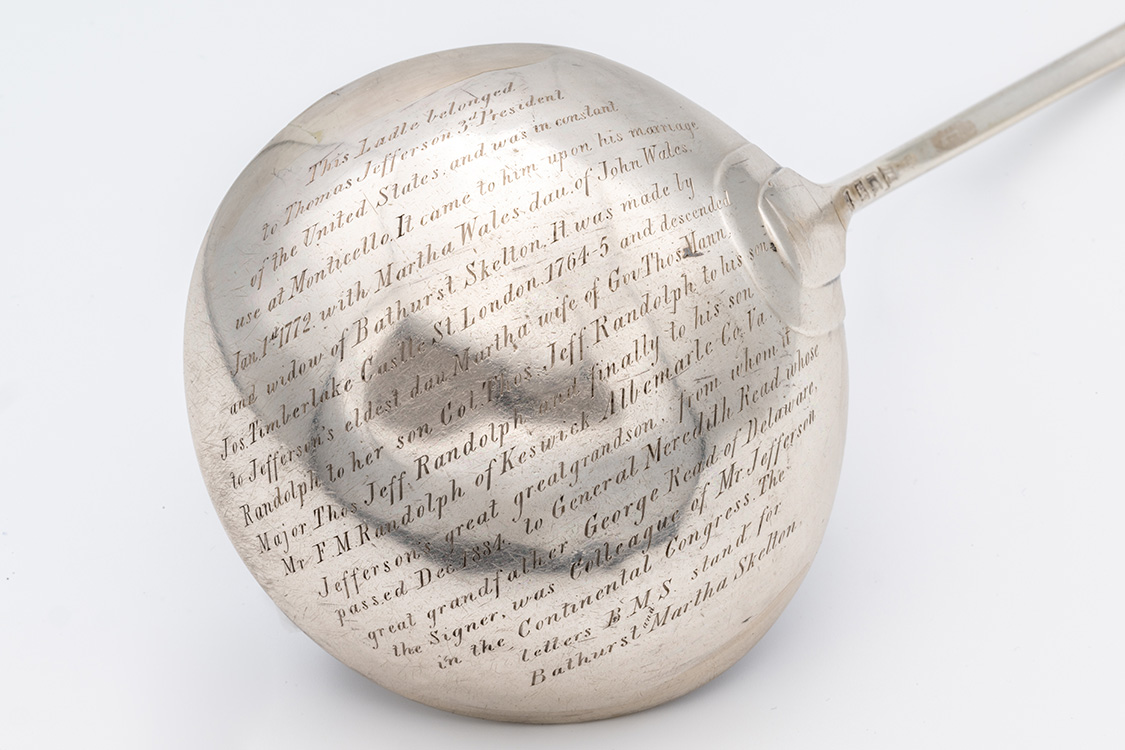 Figure 13 |
The two tablespoons with downturned spatulate handles (Figure 14) carry Elizabeth Tookey’s “E • T” maker’s mark (Figure 15). While one spoon appears patched on the handle (Figure 16), obscuring the standard, date, and assay marks, the other has the full set clearly visible, with the British lion passant, the London leopard’s head assay mark, and the year letter for 1768/9. The tops of the terminals have the same treatment of the “S/B M” and four-pointed diamond (Figure 17) as found on the teaspoons, the ladle, and the salt cellars.
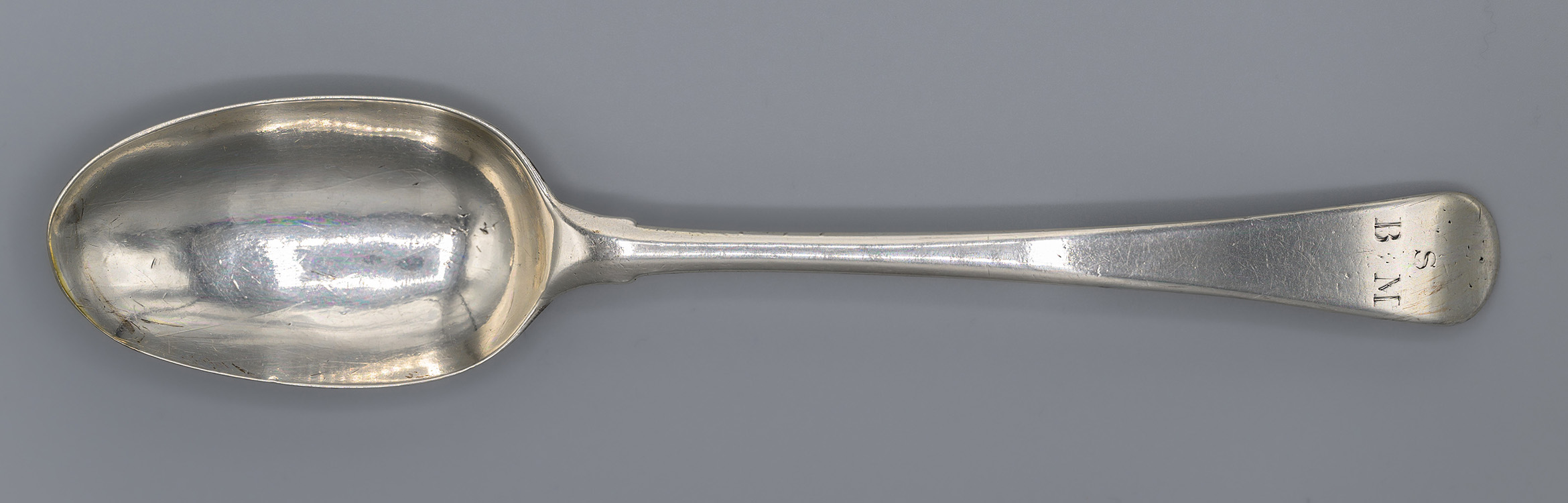 Figure 14 |
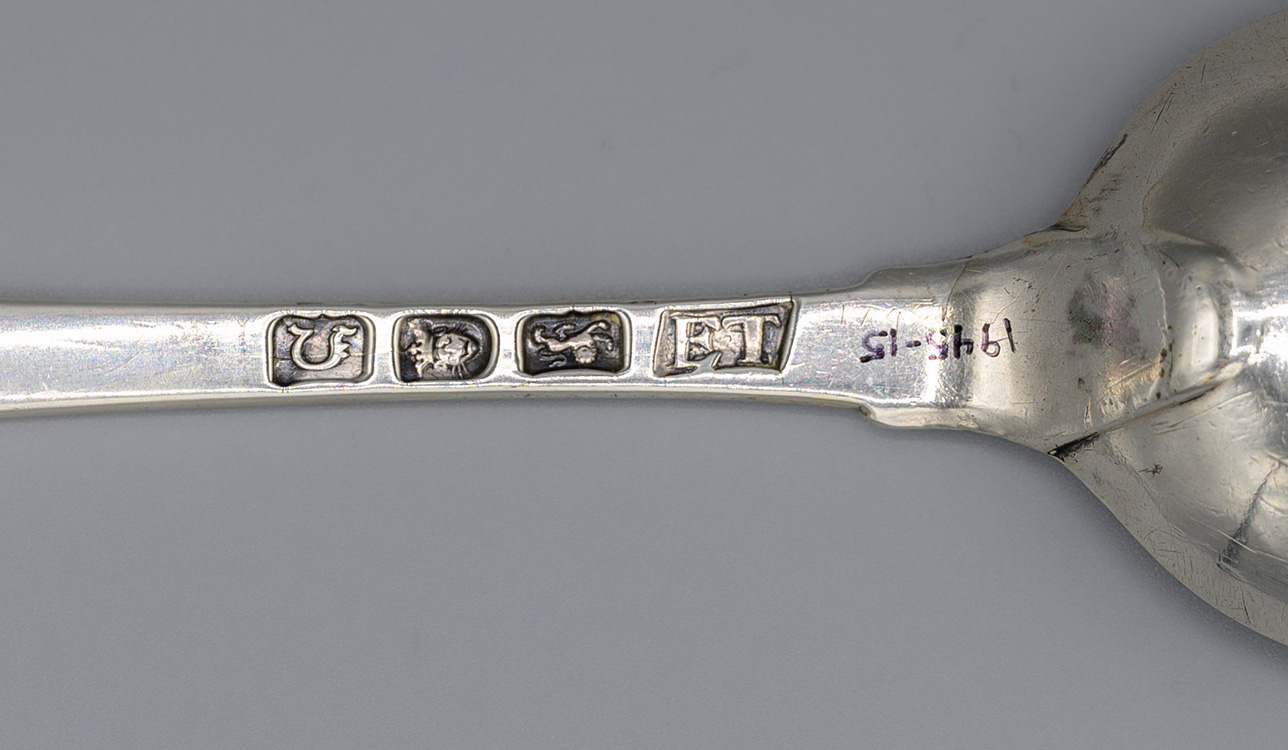 Figure 15 |
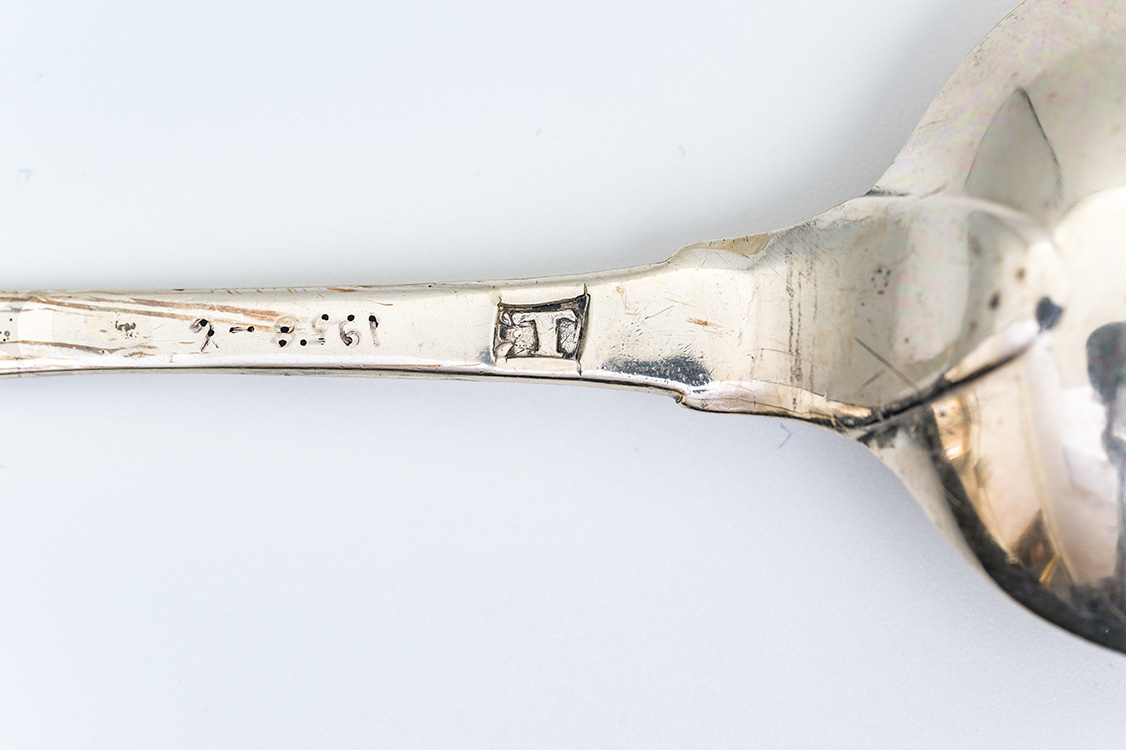 Figure 16 |
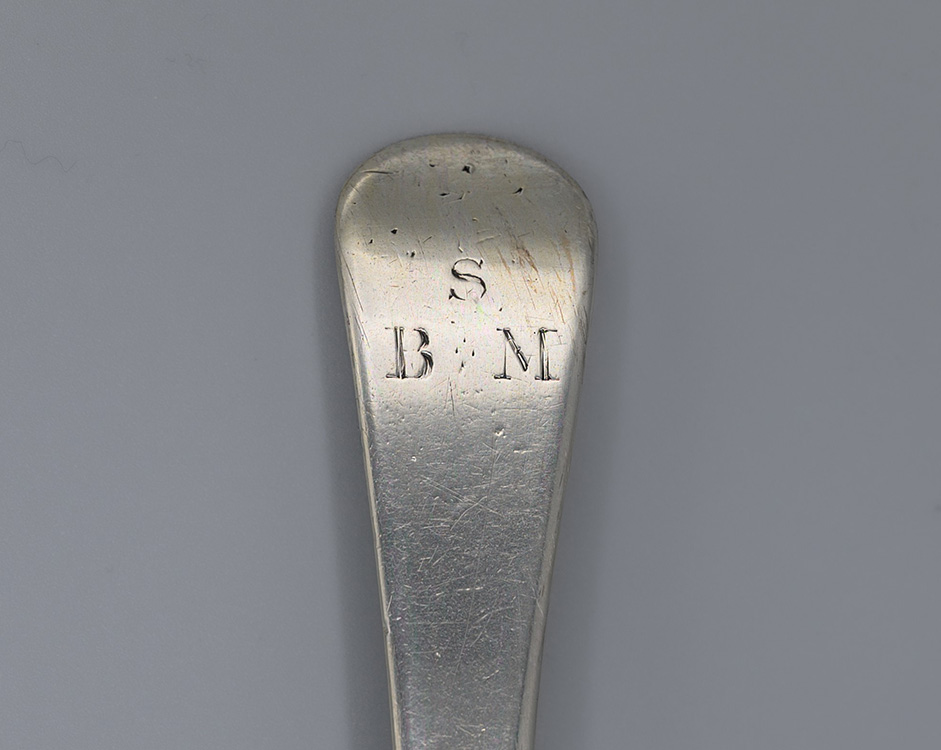 Figure 17 |
Elizabeth Tookey was a London silversmith whose earliest documented object has a year mark for 1767/68. She was married to James Tookey (who marked the ladle and the twisted handle teaspoons) and appears to have produced silver after his death in October 1767.[16] London year marks ran from 29 May through 28 May of the following year, meaning objects with the 1767 mark could have been made as late as 28 May 1768. The tablespoons marked 1768 were produced after 29 May of that year. [17]
The dates matter because they reveal and raise questions about the Skeltons’ purchasing habits. Generally, significant purchases like silver commemorate landmark events like marriage. The Skeltons wed in 1766. Using the date letters as evidence, the objects in their order were made primarily in 1768 or 1769, apart from the ladle. Did the Skeltons place their silver orders around the time of their marriage, only to have production delayed? Did they choose to celebrate a different milestone, the birth of their son in November 1767? Or did they postpone their order for another reason? We may never know.
Another clue about the Skeltons’ purchasing habits is that all the surviving silver items are English. Despite the ready availability of silver from domestic shops in Williamsburg, the Skeltons preferred things directly ordered from the metropolitan center.[18] English preference is borne out by the similarity of the engraved initials on the teaspoons, salt cellars, and tablespoons. The marks are consistent across objects made by three different silversmiths at different times.[19] This suggests the objects were elements of a single order and that the Skeltons had an agent or a factor in London who organized their purchases, selected the wares, and arranged for the consistent personalized inscriptions.[20] Further evidence that these objects were purchased directly from England appears on the Inventory of goods and chattels of the estate of Bathurst Skelton in Albemarle (see Figure 2). To settle Skelton’s estate, Thomas Jefferson compiled the list of objects Martha Jefferson brought from her first marriage to her second. Lacking a qualified appraiser in Albemarle County in 1773, Jefferson used now-missing invoices to assign values, distinguishing between English and domestic purchases by the currency he noted for the object. All of the silver pieces are given values in Sterling.[21] Careful reading of the monograms across makers combined with the documentary record indicates the Skeltons ordered their silver table wares from England while Bathurst Skelton was still alive and that they were all part of a single order. The objects probably did not arrive in Virginia until after Skelton’s death on 30 September 1768.[22]
Thomas Jefferson’s 1 January 1772 marriage to Martha Wayles Skelton immediately changed the character of Jefferson’s living spaces. Before his marriage, Jefferson kept a peripatetic lifestyle, his legal career carrying him around the colony. He spent months at a time in Williamsburg, renting rooms or staying with friends. Jefferson ordered the leveling of Monticello’s mountaintop in 1768, and construction of the first masonry structure on the new landscape began the following year. Events in 1770, including the destruction of Shadwell and his burgeoning courtship, made the establishment of a permanent residence a significantly higher priority for Jefferson.[23]
Thomas Jefferson described his early living conditions at Monticello in a February 1771 letter as “but one room, which, like the cobler’s, serves me for parlour for kitchen and hall. I may add, for bed chamber and study too. My friends sometimes take a temperate dinner with me and then retire to look for beds elsewhere.” [24] A year later, the approximately 325 square-foot single room remained the only appropriately habitable space at Monticello.
Martha Jefferson’s arrival at Monticello brought layers of refinement to her rough new household. Diners used her silver tablespoons and teaspoons at meals and seasoned their food with condiments from her cruet set and salt from either the four silver gadrooned salts or the six cut glass examples. Thomas Jefferson may have served punch from her “large China bowl” with the silver ladle. Her silver joined the agateware ceramics, damask table linens, candlesticks, and other furnishings she brought from the Skelton household (see Figure 2), transferring the material culture of genteel living from Tidewater Virginia to the Piedmont.[25]
During their almost eleven-year marriage, which ended with Martha Jefferson’s death in September 1782, the Jeffersons established a tradition of hospitality over the dining table that would continue for the rest of Thomas Jefferson’s long life. Political allies, friends, and foes gathered at the dinner table at Monticello, eating food prepared by highly skilled enslaved cooks Ursula Granger and Suck.[26] Diners ate from ceramic and pewter dishes, using a combination of silver and bone-handled utensils, all presented first on linen or damask and then, by August 1781, on new Virginia-made napkins and tablecloths.[27]
Governor of Virginia
In the 1770s, Thomas Jefferson’s political profile exploded. He began the decade serving in Virginia’s colonial House of Burgesses. He then represented Virginia in the Second Continental Congress, drafted the Declaration of Independence, and, on 1 June 1779, became Virginia’s second governor, following Patrick Henry. It was an inauspicious time to lead the commonwealth. Just weeks before Jefferson assumed office, the British conducted a successful raid in Virginia that burned Suffolk. This attack exacerbated debates and disagreements about Virginia’s participation in the American Revolution and sparked seething arguments across regions that pitted citizens of different social and economic classes against one another.
Thomas Jefferson served two consecutive one-year terms as governor. Scholars have thoroughly described and analyzed the difficulties of Jefferson’s tenure as governor and his abilities as an administrator. Allowed little authority by Virginia’s constitution, Governor Jefferson faced increasing challenges within the commonwealth as the war continued. During Jefferson’s first term, Virginia’s government moved from the colonial capital of Williamsburg to Richmond, a town with about six hundred residents. Acknowledging the growing power base developing outside of the Tidewater, legislators chose Richmond for its more central location. The choice of Richmond was also strategic. It was easier to defend than Williamsburg, and the James River, though still navigable to most ocean-going ships at Richmond, was shallower and narrower than it was farther east. But Richmond was a small town. Thus, when the government shifted there, the governor and representatives lodged in private houses, boarding houses, and taverns, and the General Assembly met in a commercial complex near the James River. Jefferson, his family, and his enslaved domestic servants lived in a rented wooden house nearby.[28]
As the war escalated, so too did Virginia’s turmoil. Many citizens refused to serve in the state militia. Others declined to support the war effort with food and supplies. Thousands of enslaved people self-liberated, taking advantage of General Sir Henry Clinton’s Philipsburg Proclamation of 30 June 1779. The Philipsburg Proclamation expanded the 1775 proclamation issued by then Royal Governor Dunmore of Virginia by offering freedom to any enslaved person across all colonies, not just Virginia, who were able to make it to British lines, whether they intended (or were able) to serve in the military or not.[29] These proclamations encouraged people to leave their slaveholders, including at least twenty-eight men, women, and children who emancipated themselves from Jefferson (Figure 18).[30] Fluctuating support for the war, supply issues, price inflation, acts of self-liberation, and riots protesting military service and taxes bedeviled Thomas Jefferson’s tenure as governor. Compounding these challenges, Virginia became the epicenter of the war in 1781, with troops under American turncoat Benedict Arnold sacking Richmond in January, forcing Governor Jefferson and his family to flee.[31]
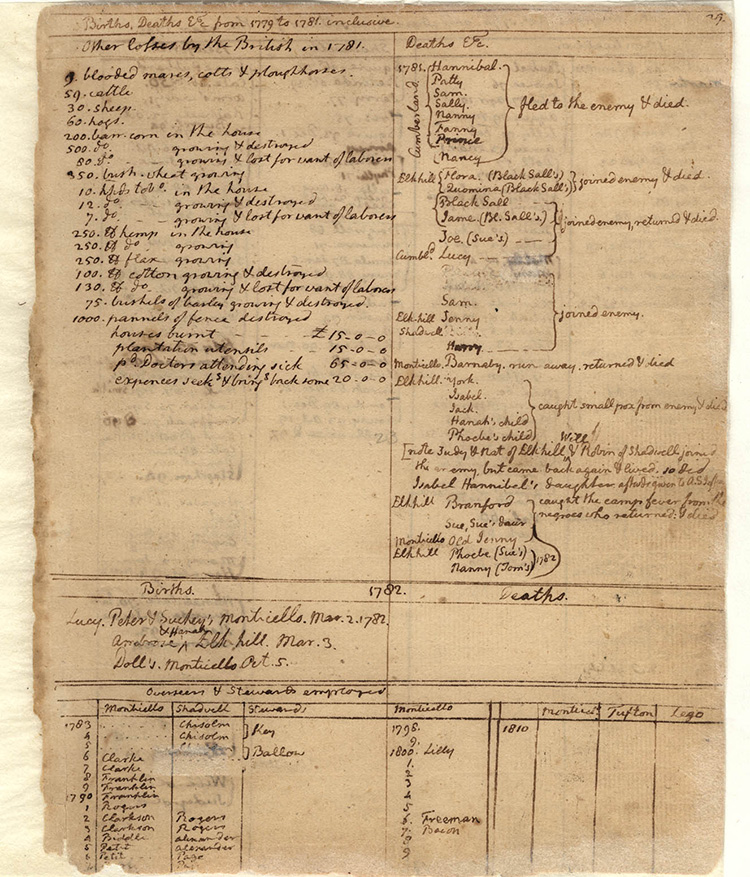 Figure 18 |
Official Silver?
In June 1779, Thomas Jefferson, the inveterate list-maker, took an inventory of the furniture in the Governor’s Palace in Williamsburg. He documented ceramics and glassware, mirrors, beds, tables, and chairs that were the property of the state, including pieces that appeared on earlier inventories of objects in the households of Royal Governors Botetourt and Fauquier. When the government moved from Williamsburg to Richmond, Jefferson itemized the furniture slated to be moved, including tables, chairs, looking glasses, chandeliers, and seven cases of ceramics and glassware used for dining and entertainment. In all, almost fifty crates traveled up the James River.[32]
In reviewing Jefferson’s careful lists of goods associated with the office of governor, a type of object is conspicuously absent: silver. Jefferson noted French plate candle sticks and snuffer stand and a pair of silver salt cellars on his 1779 inventory, but nothing else. This absence begs the question: was there official state silver? Or was the acting governor expected to use his own silver while occupying the office? Examining the inventories of the most recent royal governors in Virginia suggests an answer. Norborne Berkeley, baron de Botetourt, became the governor of Virginia in 1768. He spent hundreds of pounds in London on furniture and clothing before departing for America.[33] He died in Virginia two years later, after which a committee created a thorough inventory of Botetourt’s extensive personal estate of more than 16,500 items. The committee worked with Botetourt’s heir to settle the estate and sent two crates containing Botetourt’s personal silver, including shagreen cases of silver flatware, back to England in 1771.[34]
John Murray, the fourth Earl of Dunmore, succeeded Botetourt as Virginia’s royal governor. Conflicts with local leaders escalated in early 1775, culminating with Dunmore seizing the stores of gunpowder held in the Williamsburg powder magazine, setting off months of tense negotiations with threats of military action thick in the air. In June, Dunmore and his family abruptly fled the Governor’s Palace, taking refuge on a British warship. Dunmore attempted to maintain authority from the water but failed and returned to England about a year later.[35] Years later, he submitted claims for his personal effects abandoned in Virginia, including furniture, pictures, ceramics, glass, household utensils, his library, musical instruments, and articles of clothing. Silver does not appear on his list of abandoned property.[36] Dunmore’s silver, including a teapot in the collection of Colonial Williamsburg (Figure 19), was probably with him in Virginia and was considered valuable and portable enough to remain on his person after he left the official residence. These examples indicate that Botetourt and Dunmore both used their personal silver in their official capacities as royal governor of Virginia, perhaps setting a precedent for American governors of the commonwealth to follow.
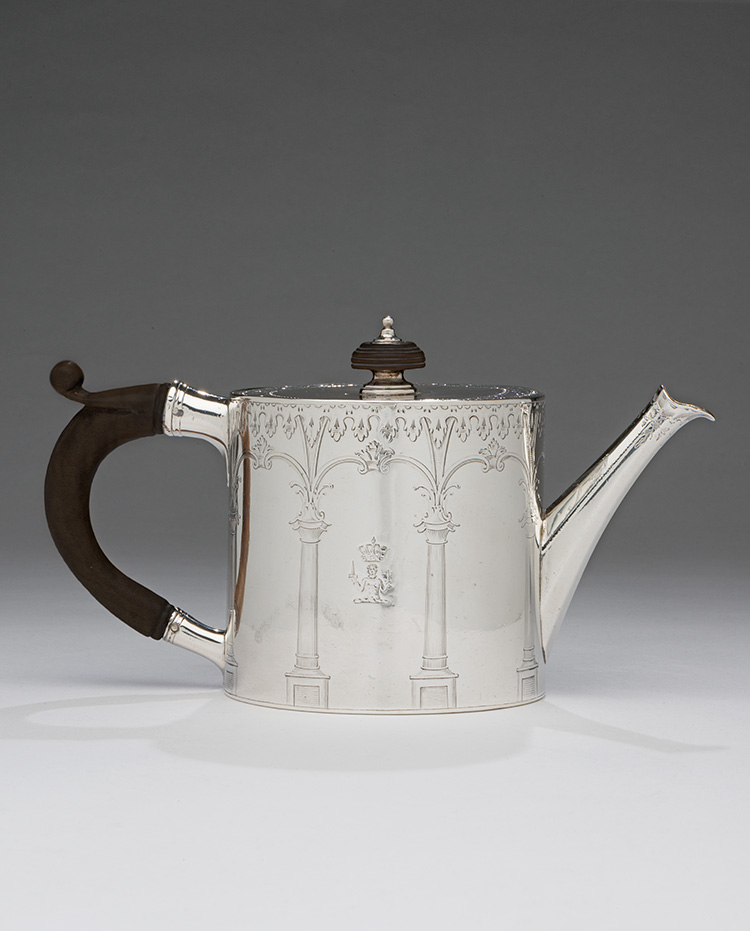 Figure 19 |
Escape Plans
As tensions between Lord Dunmore and Patriot leaders exploded in the summer of 1775, Thomas Jefferson was in Philadelphia attending the Second Continental Congress. Concerned by the uncertainty in Virginia, Thomas and Martha Jefferson developed a plan for their family to go into hiding if situations merited. Jefferson was fearful his family might become targets of political violence because of his position as an emerging Patriot leader. Although the specifics of the plan are unknown, Jefferson refers to it in a letter to his friend and relative, Francis Eppes.[37]
Years later, Thomas Jefferson, his family, and the enslaved people living with them in Richmond implemented their escape plan. In January 1781, British troops under turncoat Brigadier General Benedict Arnold invaded Richmond in a surprise attack that found the Virginia government and militia woefully unprepared.[38] Isaac Granger Jefferson was born enslaved at Monticello and was a child in the governor’s household between 1779 and 1781.[39] He retained detailed memories of the January 1781 British raids on Richmond, including the recollection that James Hemings and Robert Hemmings drove Martha Jefferson and her three daughters away the day before Arnold arrived.[40] Thomas Jefferson waited, watched troop movements, and finally called on an enslaved groom named John to prepare his horse, on which Jefferson fled Richmond.[41]
When British soldiers arrived at the governor’s rented house, they confronted one of Jefferson’s enslaved men, George Granger. Asked for Thomas Jefferson’s whereabouts, Granger replied that he was in the mountains. Next, the soldiers asked for the keys to the storage areas, and Granger handed them over. Finally, they asked for the silver. Calmly, Granger told them it had also been sent to the mountains. It had not.[42]
Instead, as Granger’s son Isaac Granger Jefferson remembered years later, his father gathered all the silver in a bedtick and hid it under a bed in the kitchen just prior to the enemy’s arrival. The British, fortunately, did not burn the house, but plundered the governor’s wine cellar, fed his corn to their horses, and divided his stores of meat between the soldiers. Isaac Jefferson recalled that the British took him and his parents, along with Jupiter and Suck, Mary Hemings, her children Daniel, Molly, and Joseph, and her nephew Wormley with them to a camp near Yorktown.[43]
Isaac Granger Jefferson’s recollections richly detail a pivotal episode in his young life. They reveal that the Jefferson family and the enslaved people who served them had an escape plan that included both people and valuables. The silver that George Granger kept from the British was Thomas and Martha Jefferson’s personal silver, including the English spoons, salts, and ladle she brought to the marriage. Martin Hemings and Jupiter, who would interact with the silver and the British again in the June 1781 events, were both active participants in the January escape. Finally, Isaac Granger Jefferson claimed that George Granger received freedom as a reward for his actions in the face of British aggression, although no manumission papers have yet been found.[44]
“British horse came to Monticello.”
The events at Richmond in January 1781 had many parallels with what happened at Monticello in June 1781: a lightning-fast British force nearly captured Thomas Jefferson; he, his family, and some members of the enslaved community enacted an escape plan; some people were left behind; and silver was at the center of the story. By the spring of 1781, the British had focused their considerable military might on Virginia. Unceasing raids and skirmishes by the British army and navy seemed unstoppable, only highlighting the disorganization, unreadiness, and unsteadiness of Virginia’s militia. Noting legislators’ fears about traveling to Richmond, Jefferson proposed that Virginia’s General Assembly should meet in a safer place. Heeding his advice, the House of Delegates voted to adjourn and reassemble in Charlottesville by 24 May.[45]
On 24 May 1781, Thomas Jefferson and some members of the General Assembly duly reconvened in Charlottesville. Governor Jefferson, Martha, their two children, and most of the enslaved people who had been with them in Richmond (minus those now with the British) rejoined the community at Monticello, accompanied by at least three senior legislators and their enslaved attendants.[46] Other legislators lodged in nearby plantations and Charlottesville’s taverns.
The situation was increasingly dire for the American Patriots. Redcoats outnumbered, outgunned, and out-horsed Virginia revolutionaries. Worse, the British controlled all waterways leading to the Atlantic Ocean while battalions of mounted British troops rode with impunity across Virginia, occupying some plantations, destroying others, and plundering supplies. On 24 May, the same day the Virginia legislature was supposed to meet in Charlottesville, British Lieutenant Colonel Banastre Tarleton left the provisioning camp at Westover Plantation and began setting his sights west (Figure 20).[47]
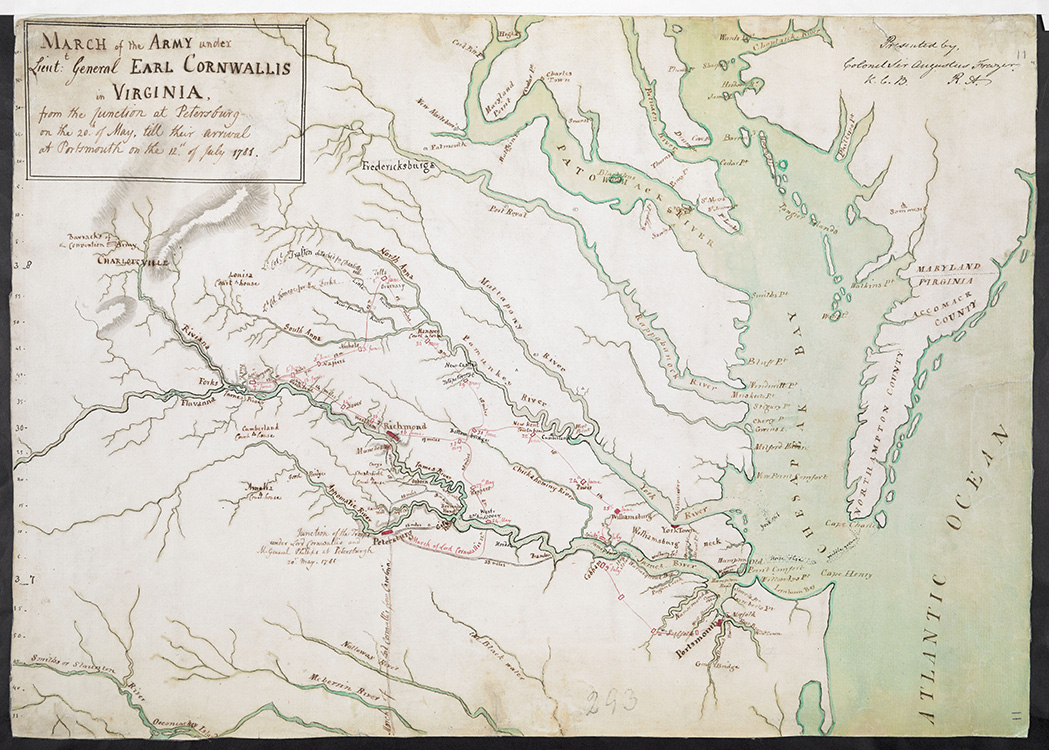 Figure 20 |
Carrying orders that included disrupting the legislature, capturing Governor Jefferson, and spreading fear and mayhem throughout the countryside, Banastre Tarleton (Figure 21) began leading his Green Dragoons, a unit of cavalry and light infantry soldiers, on a march through Virginia. Embarking from their staging point at Westover Plantation on the James River in Charles City County, Tarleton’s forces had reached an ordinary near the border between Hanover and Louisa counties by 1 June. On the evening of 3 June, Tarleton halted his men at a tavern in Louisa County, about forty miles from Charlottesville (Figure 22).[48] While they rested, Jack Jouett, a local Virginia militiaman, observed Tarleton’s unit, discerned their plans, and commenced a desperate cross-country ride overnight to warn Jefferson at Monticello and the legislators in Charlottesville.
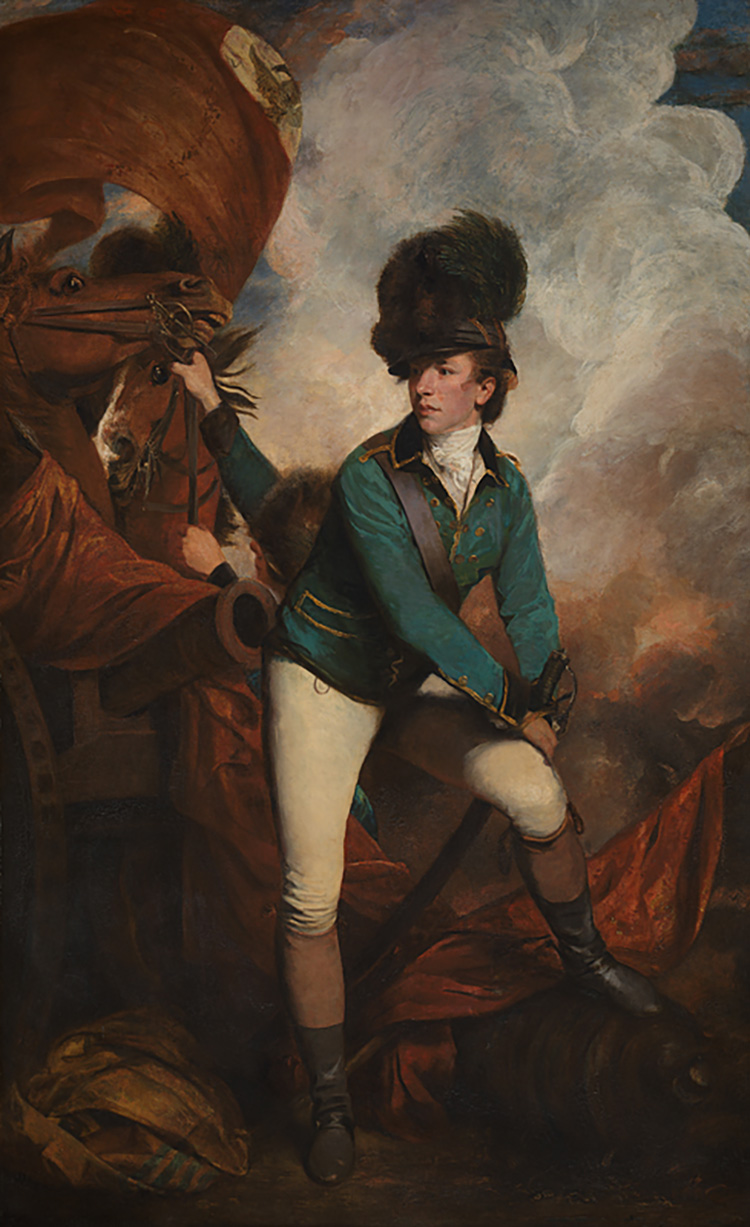 Figure 21 |
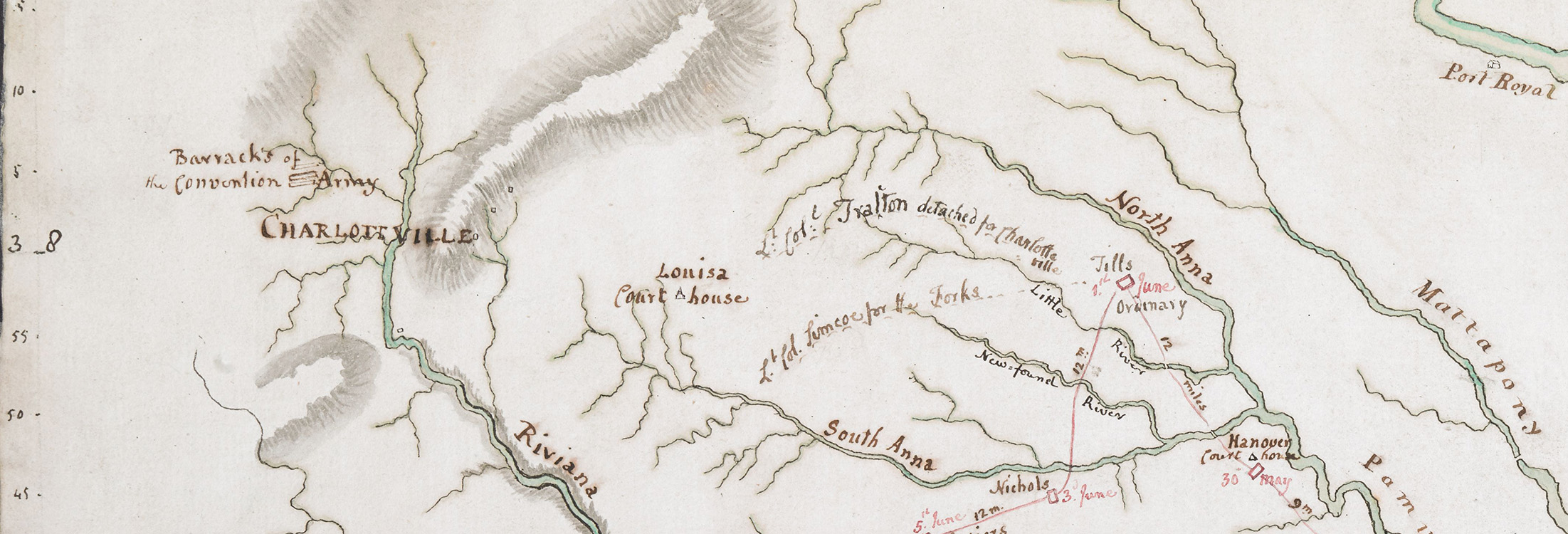 Figure 22 |
Jack Jouett arrived at Monticello before sunrise on 4 June with warning of Banastre Tarleton’s intentions and imminent arrival (Figure 23). Thomas Jefferson recorded that everyone had breakfast at Monticello before the legislators traveled down to Charlottesville and his wife and daughters left the plantation. Jefferson remained at the property, attending to “pressing arrangements,” and finally left after another American, Lieutenant Christopher Hudson, arrived at Monticello with news that British soldiers under Captain Kenneth McLeod were at the foot of the mountain.[49] Jefferson rode off, meeting his family at a friend’s plantation later in the day. The Jefferson family eventually sheltered at Poplar Forest, their plantation about ninety miles southwest of Monticello.[50]
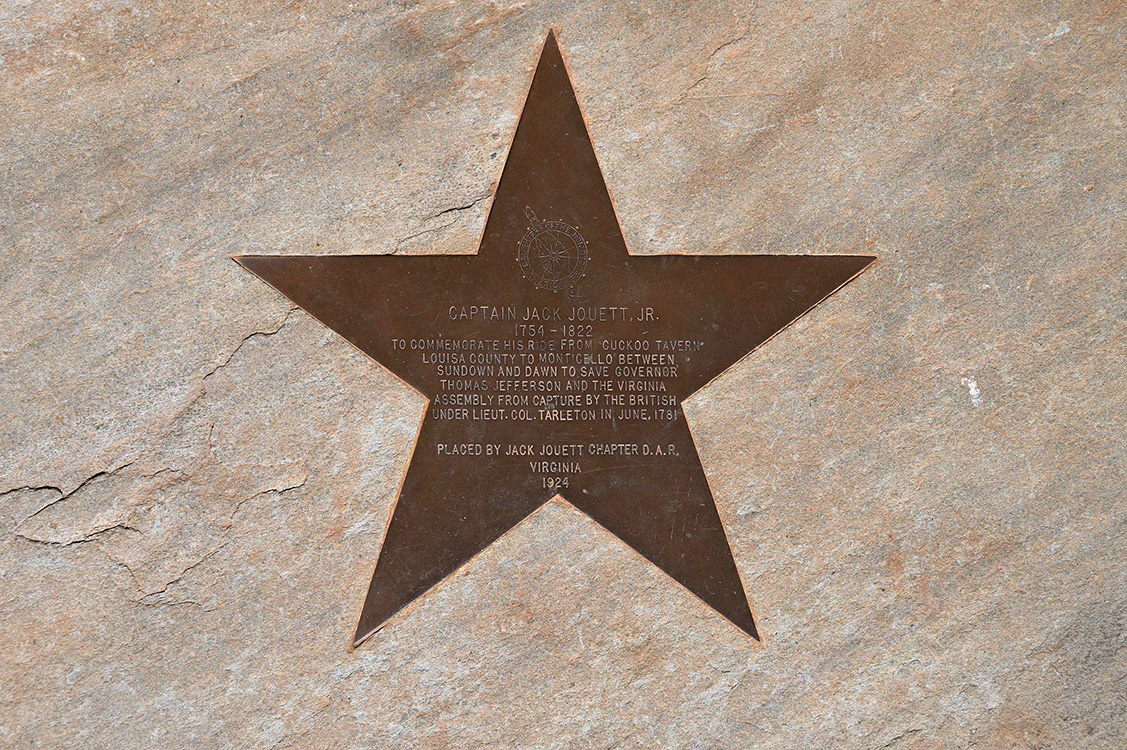 Figure 23 |
Context for the Raid
In advance of Tarleton’s June 1781 raid, the Jeffersons clearly had a strategy to evacuate Monticello quickly. Their experiences in Richmond six months earlier informed the plan and many of the same enslaved individuals who acted with such bravery in January were present at Monticello in June. As in January, Robert Hemmings and James Hemings probably packed the carriage for Martha Jefferson and her two daughters and drove them to Enniscorthy, a prearranged location, accompanied by a “young gentleman who was studying with him [Jefferson].”[51]
That morning, as the Jefferson family and their visitors finished breakfast following Jack Jouett’s arrival, Martin Hemings prepared for departure. As butler, Hemings held the authority to direct the household staff and make decisions about the clothing, papers, supplies, and personal goods to be packed for travel with the departing Jeffersons. Hemings likely directed some of the other domestic enslaved workers to organize the Jeffersons’ belongings, while he may have taken the responsibility of packing the valuables himself. Enslaved domestic laborers, possibly Betty Brown, packed clothing and personal effects for the family into a wagon for transport; Jupiter might have driven this vehicle from Monticello. Ceramics, furniture, personal papers, even some of Jefferson’s official documents as governor remained behind. According to most versions of the story, Hemings and a man named Caesar stayed at Monticello to safeguard the house and manage its contents. Hemings had been in Richmond in January 1781 and participated in the first escape, as had Jupiter, and likely Brown. Helping to alleviate the chaos of the morning, several people playing key roles in helping the Jefferson family escape had experience from the first escape. Scholars have surmised that Caesar may have been the brother of Jupiter. If so, Caesar might have learned from Jupiter what to do if Monticello were seized by the British.[52]
As in the January flight, Thomas Jefferson escaped the British with his family intact. Once again, the efforts, sacrifices, and bravery of members of the enslaved community were key to Jefferson’s success. Banastre Tarleton only stayed in Charlottesville for about eighteen hours and did not camp with his troops at Monticello. Meanwhile, Captain McLeod kept troops from torching the house and stealing or destroying everything in it. Jefferson’s experience of British clemency, while not unheard of, was unusual.
Why did Monticello escape with such minor damage in the June 1781 raid? Numbers, orders, and time partially explain it. As stated, Banastre Tarleton and Kenneth McLeod came to Monticello with specific orders to capture Jefferson. Finding him gone, they moved on. In his 1787 letter to William Gordon, Thomas Jefferson claimed that Tarleton gave McLeod “strict orders that nothing be damaged.”[53] (This aligns with Tarleton’s own description of the raid, which emphasized speed and disruption, not destruction.) No matter. Even though troops might have been under orders against plundering property, Jefferson’s neighbor, Mary Walker Lewis, had a vastly different experience with British troops ruining her plantation and killing and consuming her livestock. Lewis’s interactions with Tarleton happened just after McLeod’s troops arrived at Monticello. Benjamin Harrison, one of the legislators staying with the Jeffersons at Monticello, also had firsthand experience of the destruction often wrought by British forces in a domestic sphere. Earlier that January, his family’s James River plantation, Berkeley, was ravaged with many of his furnishings and family paintings burned (Figure 24).[54]
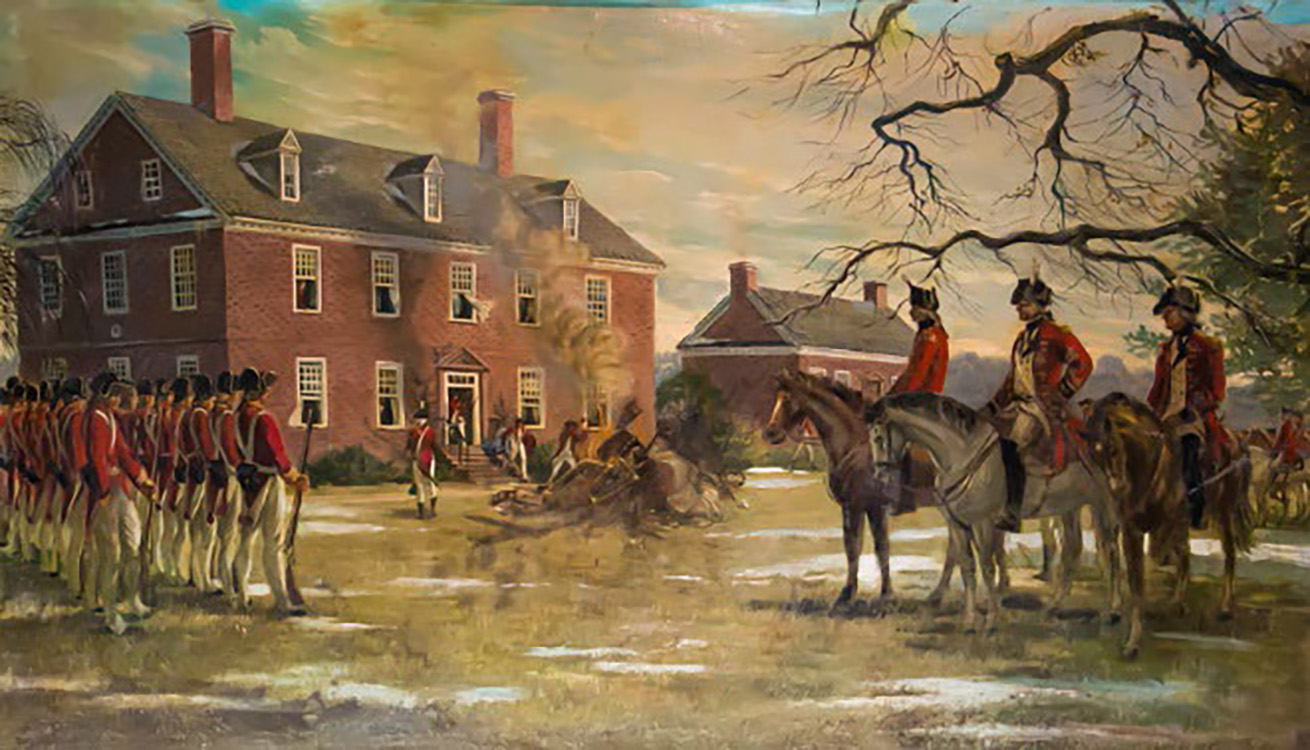 Figure 24 |
Unlike Berkeley, which had been the well-established seat of a prominent Virginia family for more than fifty years, Monticello was a construction site. The house was habitable, but unfinished, with exposed brick walls instead of finished plaster. The furnishings, mostly Virginia pieces from the Tidewater, were not of remarkable quality or execution, and any paintings that may have hung on the walls of the first Monticello are unknown to scholars today. The Jeffersons had food available for Suck to prepare as meals (as Ursula Granger and Mary Hemmings were with the British at this time), as well as some beer, cider, liquor, and wine to drink. Unlike Mary Lewis’s amply supplied plantation, neither food nor drink at Monticello was in bountiful supply since the white family had not been fully in residence during Jefferson’s governorship. In terms of symbolic destruction, the wreck of an established, genteel house full of furniture and paintings like Berkeley carried far more significance than an unfinished, under-furnished brick shell on the Virginia Piedmont. In practical terms, a well-stocked plantation like Mary Lewis’s offered more immediate benefits for an army on the move.[55]
At least one Jefferson property met a fate similar to the plantations of Mary Walker Lewis and Benjamin Harrison. Elk Hill, a profitable plantation on the James River in Goochland County that Thomas Jefferson inherited through his wife, appears on a map (Figure 25) annotated with the date 7 June and the name “Govr Jefferyson” noting the location.[56] Lieutenant General Charles Cornwallis made Elk Hill a temporary headquarters for ten days with almost seven thousand troops, writing dispatches from “Jefferson’s Camp.”[57] During the occupation, soldiers destroyed Jefferson’s tobacco and corn, killed the livestock and horses, and “carried off” enslaved people from the property, acting in a “spirit of total extermination” towards Jefferson’s property at Elk Hill.[58] Jefferson went on to describe houses “plundered of every thing which could be carried off” under Cornwallis’s occupation in Virginia and “that his table was served with plate thus pillaged from private houses can be proved by many hundred eye witnesses.”[59] Even years later, Jefferson’s anger at Cornwallis’s actions at Elk Hill and his awareness of household valuables like silver being seized during the campaign were palpable. Notably, silver was the specific example of plundered personal property Jefferson used to illustrate Cornwallis’s depravity.
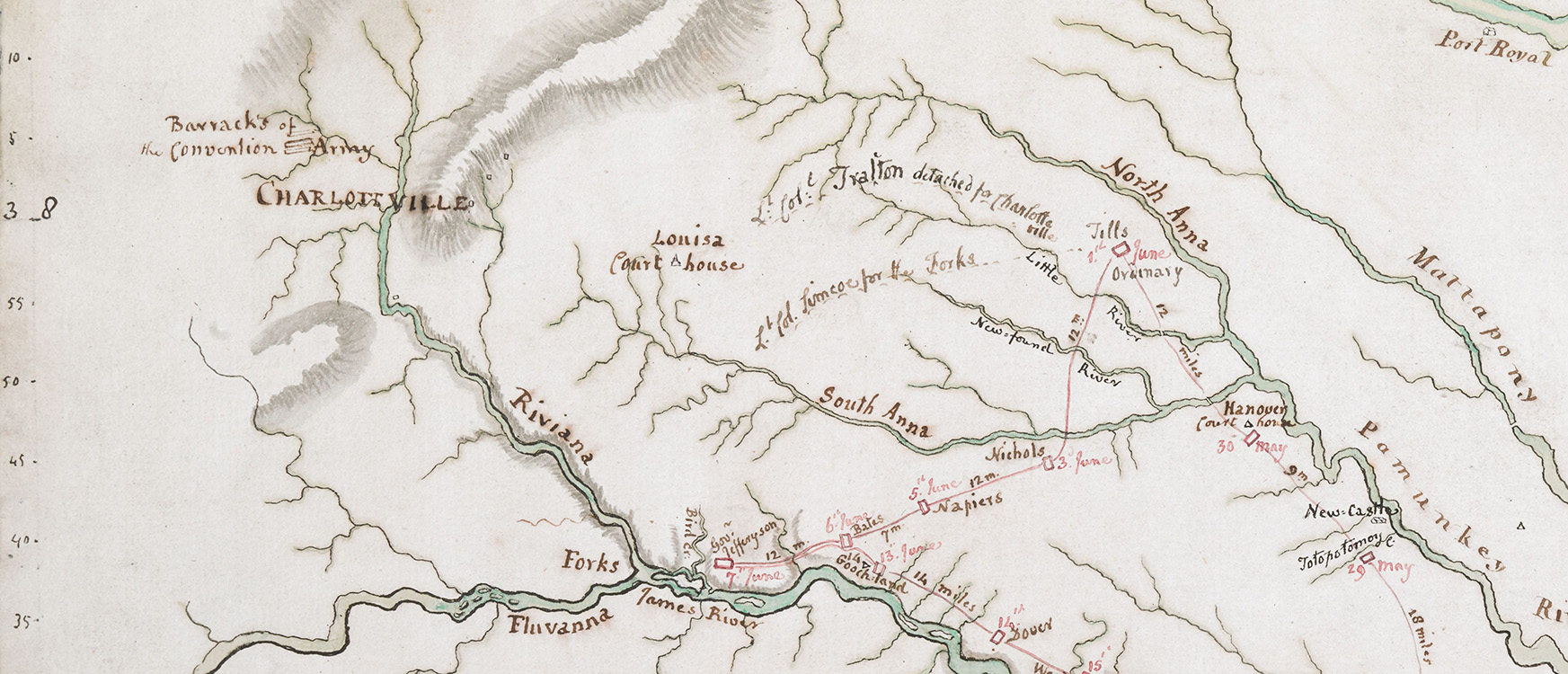 Figure 25 |
Saving the Silver
A story about the Jeffersons’ departure from Monticello and the efforts of enslaved people to preserve the family silver from seizure by British troops during the June 1781 raid has become one of the fundamental legends of the plantation. The story passed through generations of slaveholding and enslaved families, with enough similarities to confirm that everyone recalled the same event and enough differences to show how families claimed the story for themselves, establishing their own memory bridges between objects, events, places, and people in the past. The story revolves around agency, resource management, authority, and protection at Monticello after the slaveholding family has departed. Silver is at the center of it.
Three major variations of the story survive in families with connections to Monticello. The first, and best known, is the Randolph family version, published in the nineteenth century by Henry S. Randall, Jefferson’s first major biographer, and Sarah Nicholas Randolph, Jefferson’s great-granddaughter, and recorded in Thomas Jefferson Randolph’s memoirs.[60]
In Randolph family memories, tellers highlight the loyalty of the enslaved people who supported the interests of the slaveholders, emphasizing Martin Hemings’s discretion and judgement and Caesar’s dedication and sacrifice. In these versions, Hemings and Caesar remained in the house after the Jeffersons left. Each worked feverishly to pack and hide the silver away from the British. In these tellings, Hemings gathered the silver, and Caesar was responsible for putting it in a safe hiding place under the floorboards of the portico. Just as Hemings handed Caesar the last piece, it is said, the British arrived. Hemings dropped the plank into place, and Caesar, having no time to remove himself from this hiding space, was stuck there without food or water for a prolonged period. The earliest recorded version claimed eighteen hours, while later versions say Caesar was under the portico for three days and nights. Lucia Stanton noted the biblical reference to an individual spending three days and nights under duress.[61]
The Randolph version includes a dramatic scene between Martin Hemings and a nameless British soldier. Once the troops arrived, Hemings showed Captain McLeod through Monticello. McLeod subsequently made his intentions known that his soldiers were to preserve the house, its furnishings, and its occupants. A soldier challenged McLeod’s order, pointed his gun at Hemings’s chest, and asked Hemings to disclose Jefferson’s escape route. Hemings refused, gave a fierce glare and called the soldier’s bluff by responding, “Fire away, then.”[62]
A subset of the Randolph family story is the information provided to Henry Randall by Wormley Hughes. Hughes, born at Monticello in 1781, was enslaved on the plantation and given unofficial freedom at Thomas Jefferson’s death in 1826. Hughes’s wife was Isaac Granger Jefferson’s niece. Hughes told Randall about Jefferson’s chaotic departure from Monticello with the British on his heels, showing the biographer a track over Carter’s Mountain that he described as part of the escape route and noted Jefferson’s trouble keeping his horse under control. Hughes was an infant at the time of the raid in 1781 but probably learned about the events as family lore either from his mother Betty Brown, a member of the Hemings family who was present during both raids, or from his wife and her extended family.[63]
The next version comes from the Bankhead and Scott families of Alabama. Susan Scott, an enslaved domestic servant transported from Virginia to Alabama by William Stuart Bankhead in 1846, was the matriarch of the Scott family. Bankhead was Thomas Jefferson’s great-grandson. After they settled in Alabama, both families shared stories about their connections to Thomas Jefferson and Monticello with their children and grandchildren.[64]
In the 1920s, William Bankhead’s granddaughter wrote about the events of June 1781, identifying Caesar as the individual “who remained under the floor of the portico at Monticello for three days and nights without food or water while hiding his master’s silver from the British in 1781.”[65] She recalled that the Scott family were descendants of Caesar, while most scholars and Scott family members now believe that Susan Scott was Jupiter’s granddaughter.[66]
Lessie Young Clay (Figure 26) was Susan Scott’s great-granddaughter. She was interviewed with Cary Hotchkiss (another William Bankhead granddaughter) in Alabama in 1971. In the interview, Hotchkiss told of a raid at Monticello, with Jupiter now identified as the enslaved butler in charge of domestic work in the house. Although she mistakenly thought the raid happened during the War of 1812 rather than the American Revolution, her telling recalled the table set with all the silver when someone ran in warning that the British were coming. Jupiter grabbed up the tablecloth, collecting the silver, and removed it to a cellar under the front porch at Monticello. With the door closed, Jupiter became stuck in the cellar while the British came and went. Three days later, someone on the porch heard banging on the cellar door and Jupiter was finally released. Even though Hotchkiss was the primary storyteller about the silver in the 1971 interview, a younger Bankhead descendant later remembered Clay telling him about the silver.[67]
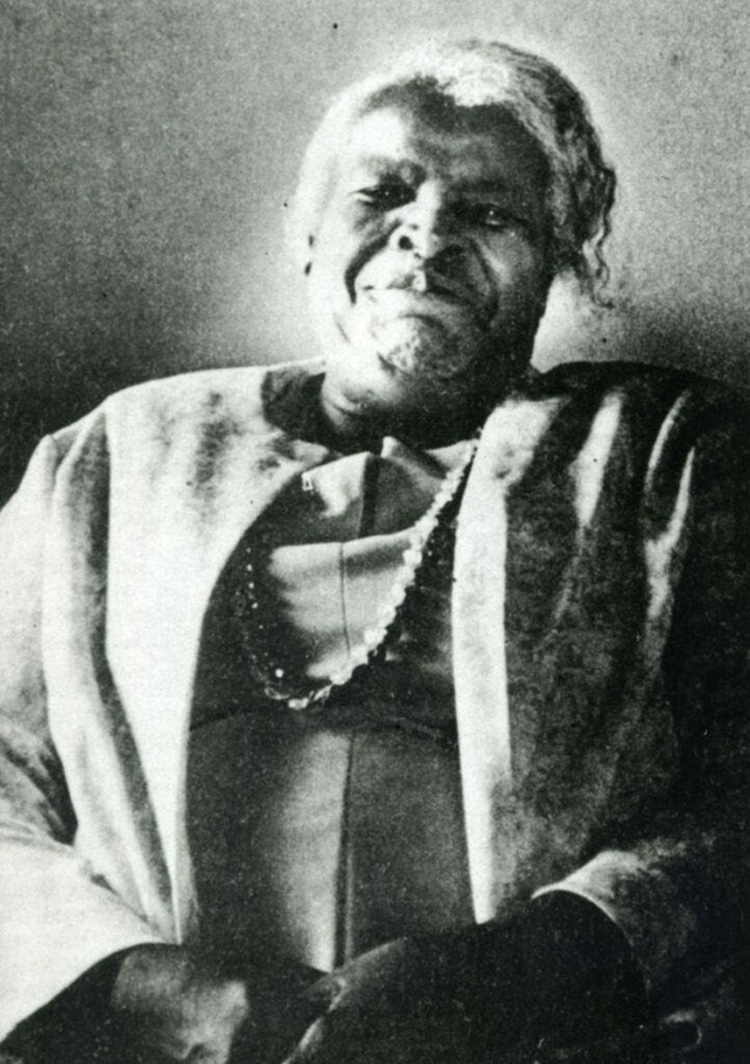 Figure 26 |
In 1996, D. D. Martin, the wife of a Bankhead descendant, remembered a similar story, that “Lessie was proud of her descent from Jupiter, that hid family silver, was it the War of 1812? . . . In a trapdoor under a porch, and hid for three days.”[68]
Recollections by descendants of the Bankhead and Scott families reveal several noteworthy distinctions. Most Bankhead-descended interviewees, who were white, told the story about an enslaved man hiding and protecting Monticello’s silver. Often, they tried to link their stories to a concrete detail by associating the silver raid with a known event, in this case the War of 1812. Even though incorrect, were the white storytellers unconsciously making this choice because they believed it would increase their authority as history keepers?[69]
On the other hand, Black interviewees from the Scott family did not focus on the silver as closely in their stories. Lessie Young Clay knew and told the silver story, but younger interviewees focused on their descent from Jupiter and/or Caesar as noteworthy people and their family’s connection to Monticello as stories worth telling. A young woman interviewed in 2019 appreciated knowing she could trace her family back to Monticello during Jefferson’s lifetime. When asked if her connection to Monticello changed her perspective on history, she responded “when they talk about Thomas Jefferson, then it’s like, I already know something. But knowing something else.”[70]
A third version of the story descended in the Fossett family. In Peter Fossett’s 1898 recollections of life at Monticello, he (Figure 27) described the June 1781 British raid. Even though Fossett was born in 1815, decades after the event, he grew up with the story being told in his family. In Fossett’s telling, his “mother’s uncle” helped Jefferson with his horse and hid them in nearby woods while the soldiers occupied Monticello. Fossett also recalled “My father’s aunt hid the silver in the potato cellar. When the soldiers came up, she was standing over the keyhole. The house was searched and nothing could be found. They came to her and with arms drawn demanded that she should tell them where the silver was.” [71] She did not. He continued by describing the soldiers shifting their attention and destructive instincts toward the wine stored in Monticello’s cellars.
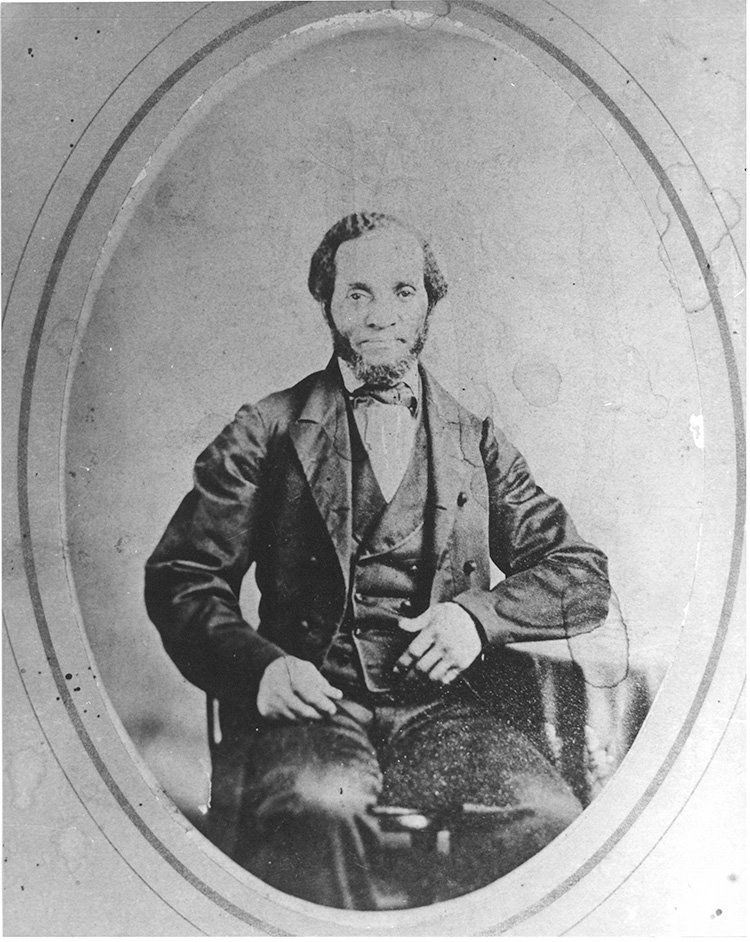 Figure 27 |
Charles Bullock’s father was enslaved with Peter Fossett after Fossett’s sale from Monticello. Bullock met and spent time with Fossett during his 1900 visit to Monticello and told a story clearly influenced by what he heard from his father and Fossett. In a 1949 letter, Bullock referred to “Peter Heming” as the plantation blacksmith. According to Bullock, “Heming” shod Jefferson’s horse backward to throw the British off the trail of his hoofprints and increase the odds of Jefferson’s successful escape. Bullock continued with the story of the British raid, inserting Tarleton’s name in place of McLeod as the commander at Monticello and describing the actions of Peter Hemings’s wife, “who had her husband place iron hooks inside the walls of the large well and thus save much of the things of value, including the gold and silver service.” [72] Peter Hemings was eleven years old in 1781. While he probably helped his older brothers during the British raid, he did not play as prominent a role in the event as Bullock gave him. Bullock conflated Hemings with someone else.
Despite the identification slippages, the Fossett tellings highlight the presence and actions of women and the use of existing places to hide valuables. A sizable number of enslaved women lived and worked at Monticello in 1781, many of them members of the Hemings family, who performed such domestic tasks as cooking, cleaning and maintaining spaces, cleaning and repairing clothing, serving as lady’s maids, and minding children. Their work kept them in the rooms of the house. These women would have known the contents of the silver collection and been familiar with available hiding spaces less obvious than boards quickly pried from the floor of a porch. Peter Fossett’s recollection maintains the tradition of British soldiers threatening an enslaved person with violence in exchange for information. As in the other tellings, the enslaved person did not flinch.
To be sure, the various tellings of the events at Monticello on 4 June 1781 share certain commonalities. Governor Thomas Jefferson was the intended target of a surprise British raid. Jefferson, his family, and the guests who spent the night of 3 June at Monticello evaded British capture. After getting the family and visitors away from the house, a group of enslaved people remained at Monticello to secure valuables, including the silver owned by the Jeffersons. When British soldiers asked for information, enslaved people did not provide it, and instead faced threats of physical violence with authoritative, defiant silences. After a short time, the British left Monticello largely undisturbed, except for some stored goods in the cellars. The silver hidden by Martin Hemings, Caesar, Jupiter, Joseph Fossett’s aunt, or Peter Heming’s [sic] wife remained in use by the Jefferson and Randolph families. Thirteen objects survive to the present day.
As the story moves through families and generations, traveling across state lines, the facts remain consistent, but the details, especially those identifying who participated in hiding the silver and who stood tall against the British, change. These differences, superficial though they seem, reveal a web of complicated and often conflicting motivations experienced by both actors and tellers. For example, while the Randolph and Bankhead families prioritize tellings that emphasize the loyalty of enslaved people and their efforts to protect their slaveholders’ property, the tellings in the Scott, Fossett, Hughes, and Granger families have different goals. Whereas the Randolphs and Bankheads might see the lengthy stay of someone under the porch without food or water as a statement of devotion, descendants of enslaved people could read it as proof of their ancestor’s physical and mental fortitude under terrible conditions.
This Revolutionary silver story offers many avenues for later tellers to assert the importance of their ancestors and connect their families to foundational events in American history. For the Randolphs and Bankheads, the story emphasized Thomas Jefferson’s importance as the governor of Virginia and his wealth in both material objects and enslaved people. For members of the Scott, Hughes, and Fossett families, the story offered proof of their ancestors’ presence, power, and authority. They shaped American history through their actions in the American Revolution. They stood up to British authority, saved Thomas Jefferson, and held valuable information about hidden assets. They were the heroes in a Revolutionary episode. All versions of the story share a strong tone of pride.
As rich and detailed as the silver story is, however, questions remain unanswered. If the British troops so narrowly missed capturing Thomas Jefferson, why did they not pursue him? We also know at least four enslaved people left Shadwell and Monticello to join the British.[73] Were others in Albemarle County tempted to try for freedom, especially when troops arrived at the plantation? In a war about independence and the fundamental rights of people to govern themselves, would anything change for the people enslaved at Monticello?
As the summer of 1781 wore on, British troops moved back east, eventually concentrating around Yorktown. Thomas Jefferson and his family returned to Monticello on 24 July, where they found the silver, papers, and other things left behind mostly intact. Members of the Granger and Hemings family who went with the British after the January raid remained in British hands. After the Americans won the culminating battle of the Revolution at Yorktown in October 1781, Jefferson received word that he could claim his enslaved people. He recorded a payment on 25 November 1781 to retrieve them.[74] Isaac Granger Jefferson remembered Thomas Jefferson sending a wagon and that “Old master was mightly pleased to see his people come back safe & sound (Although ‘All men by nature are free & equal.’) & to hear of the plate.”[75] Isaac Granger Jefferson called out the words of the Declaration of Independence as he remembered his re-enslavement. He also emphasized his slaveholder’s pleasure at regaining property – both people and plate (Figure 28).
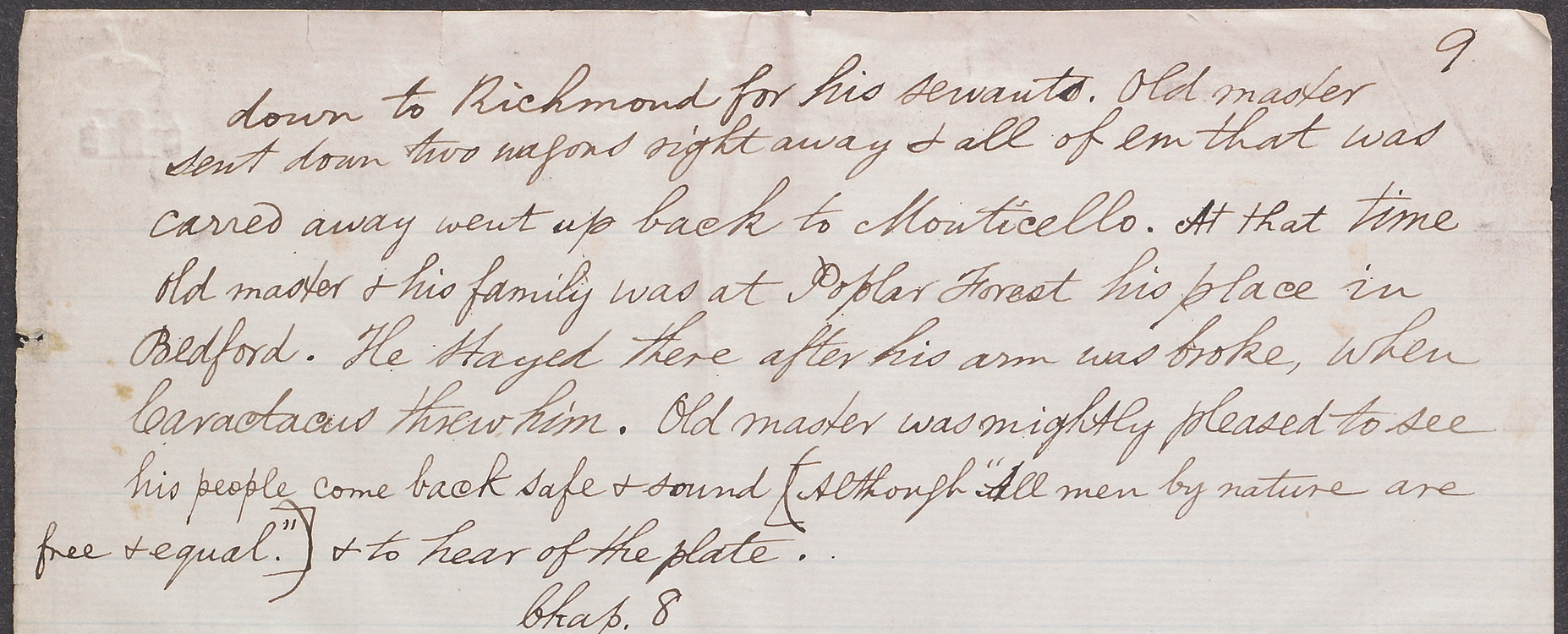 Figure 28 |
Back at Monticello, Suck and Ursula Granger again prepared food for the Jefferson family and their guests. Diners used the silver spoons and bone-handled knives and forks, but the agateware plates might have been replaced by Queensware shallow and deep plates or pewter dishes acquired during the years of Martha and Thomas Jefferson’s marriage.[76] They seasoned their dishes with condiments in the (now missing) silvertop cruet set and the salt cellars and served punch with the silver ladle. The table would have been set with the “12 dammask napkins 6 new Virginia ditto/ 4 new Virginia table cloths” that Martha Jefferson recorded at Monticello in her household account book in August 1781.[77]
White residents of Monticello continued using the Skelton silver for the rest of Jefferson’s life. After his death, Jefferson’s daughter Martha Jefferson Randolph maintained the collection, keeping it packed in a wooden chest with an inventory pasted under the lid. Her son, Thomas Jefferson Randolph, distributed the silver among his siblings after his mother’s death in 1836. Pieces of the Skelton silver moved through the generations.
Alas, accidents happened. One twisted-handle teaspoon, with English silversmith James Tookey’s mark, went missing. A worker at Monticello in the 1960s, while planting a bush near the South Wing, noticed a group of objects lying in the soil. He alerted his supervisor, who told him to get rid of them. Included in the cache was a small teaspoon with a twisted handle (Figure 29). Thankfully, the worker ignored his supervisor’s instructions and, instead of throwing the objects away, preserved them. In 2017, he and his family returned the spoon to Monticello. It was a perfect, if corroded, match to the other twisted-handle teaspoons in the collection. Thanks to the family’s generosity, one more piece of Revolutionary silver that witnessed dramatic moments of tension, fear, authority, and action is back at Monticello.
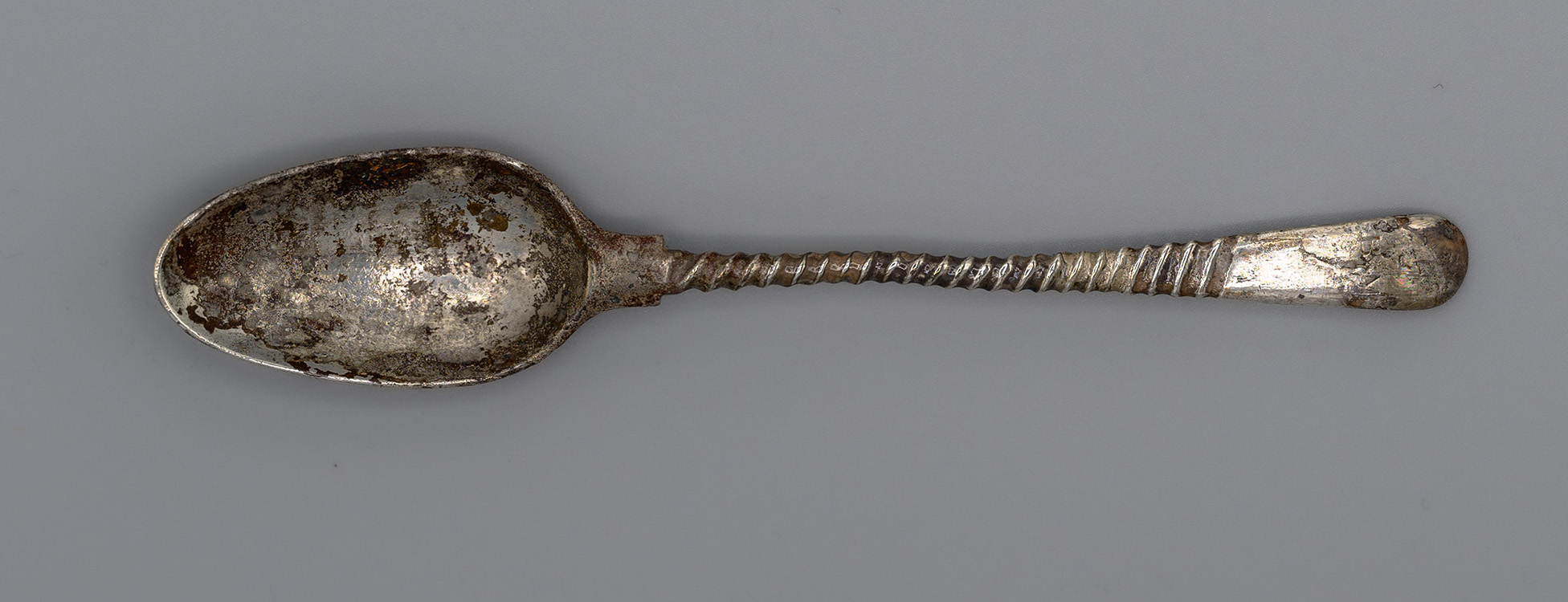 Figure 29 |
The silver objects at the center of this story have endured since James Tookey, Elizabeth Tookey, and Elizabeth Muns made them in London in the 1760s, handled, used, marked, and remembered by successive generations. As memory bridges, the silver ladle, salts, and spoons connect the events of 4 June 1781 to foundational identities of perseverance, authority, and pride. The inherited memories attached to these objects have likewise persisted through countless retellings. The published references and oral traditions around this group of English silver and the people who handled, hid, and preserved them are not a single unified story. Rather, the parallel but divergent accounts reveal how each community interpreted and celebrated the agency of their ancestors and claimed their place in the story of the American Revolution and its legacies.
Emilie Johnson is the Curator of Arts and History at the Thomas Jefferson Foundation and can be reached at [email protected].
[1] The story of the June 1781 British incursion to Monticello appears in many Thomas Jefferson biographies. This opening account comes directly from Jefferson’s own recollections of the events of both January and June 1781, which is available in “Notes and Documents Relating to the British Invasions in 1781,” Julian P. Boyd et al., eds., The Papers of Thomas Jefferson, 1 October 1780 – 24 February 1781 (Princeton: Princeton University Press, 1950–), 4: 256–278. Banastre Tarleton outlined his recollections of the raid in A History of the Campaigns of 1780 and 1781: In the Southern Provinces of North America. By Lieutenant-Colonel Tarleton … (London: Printed for T. Cadell, 1787), 295–297. Online: https://archive.org/details/historyofcampaig00tarl (accessed 9 March 2026). Michael Kranish details the events of 4 June in his work Flight from Monticello, identifying the Virginia legislators who stayed with the Jefferson family at Monticello. Michael Kranish, Flight from Monticello: Thomas Jefferson at War (Oxford, England: Oxford University Press, 2010), 269.
[2] We will further explore the conduct of British troops under Tarleton during the June 1781 raid into Albemarle County later in the article, recognizing that Jefferson’s experience was rather unusual.
[3] The intersection of historical event, material culture, memory, and oral history is a rich theoretical space to situate this work. As an example, memory is at the foundation of the original silver commission by the Skeltons, as can be discerned by the initials of the patrons “S/B M” inscribed on each piece. The “Memory” section of chapter 5 “Memory and Gift” in Edward S. Cooke, Jr., Global Objects: Toward a Connected Art History (Princeton and Oxford: Princeton University Press, 2022), 183-194 is particularly helpful. The relationships between memory, history, and oral tradition have been the focus of extensive scholarship. A foundational work about the oral tradition in the African American community is Geneviève Fabre and Robert O’Meally, eds., History and Memory in African-American Culture (New York and Oxford: Oxford University Press, 1994). Hilary Green highlights the ways Black families used oral tradition to challenge white-centric discourse around the Civil War. The African American families who preserved the silver story and its connections to the American Revolution are doing something similar through their storytelling: ensuring their ancestors’ presence, actions, and contributions are remembered and preserved. Hilary N. Green, Unforgettable Sacrifice: How Black Communities Remembered the Civil War (New York: Fordham University Press, 2025).
[4] Lucia Stanton references the notion of claiming worth and status through associated people and objects in her description of the events of January and June 1781. Lucia Stanton, Those Who Labor for My Happiness: Slavery at Jefferson’s Monticello (Charlottesville and London: University of Virginia Press, 2012), 100–102.
[5] Roger C. Aden, “Memory Bridges: Narrative Memories in Saved Objects,” Western Journal of Communication 88, no. 4 (2024): 821–39; Kenneth L. Ames, “Material Culture as Non Verbal Communication: A Historical Case Study,” Journal of American Culture 3, no. 4 (1980): 619–641; Stanton, Those Who Labor for My Happiness,106.
[6] Each of these examples will be explored later in the article. The teaspoon is 2017-9, the reworked objects are the ladle, salt cellars, and salt spoons that originally belonged to Martha and Bathurst Skelton, the story about Martin Hemings was published in Henry S. Randall, The Life of Thomas Jefferson (New York: Da Capo Press, 1972; reprint of the 1858 edition), 1:338–339, and the oral histories come from descendants of Thomas Jefferson and Jupiter who relocated (respectively by choice and by force) to Alabama.
[7] Peter Jefferson Probate Inventory, 13 October 1757, Will Book 2, 1752–1785, Albemarle County, Virginia, 41–48, Clerk’s Office, Albemarle County Courthouse, Charlottesville, Virginia.
[8] Will of Peter Jefferson, 13 July 1757, Will Book 2, 1752–1785, Albemarle County, Virginia, 32–34, Clerk’s Office, Albemarle County Courthouse, Charlottesville, Virginia. By 1769, Thomas Jefferson owned a silver coffee pot worth nearly eight pounds, which he gave to a friend who was traveling to England to pay for books “Memorandum Books, 1769,” Founders Online, National Archives, https://founders.archives.gov/documents/Jefferson/02-01-02-0003 (accessed 21 May 2026) [Original source: James A. Bear, Jr. and Lucia C. Stanton, eds., The Papers of Thomas Jefferson, Second Series, Jefferson’s Memorandum Books (Princeton: Princeton University Press, 1997), 1: 143.]
[9] “Memorandum Books, 1770,” Founders Online, National Archives, https://founders.archives.gov/documents/Jefferson/02-01-02-0004 (accessed 7 April 2026) [Original source: James A. Bear, Jr. and Lucia C. Stanton, eds., The Papers of Thomas Jefferson, Second Series, Jefferson’s Memorandum Books (Princeton: Princeton University Press, 1997), 1: 158.]
[10] Digital Archaeological Archive of Comparative Slavery (DAACS): https://daacsrc.org/homepage/query (accessed 14 January 2026).
[11] In 1767, Jefferson begins recording purchases and expenditures in his Memorandum Books; the earliest documented purchase for eating utensils is an order for “buck handle knives and forks” from his Glasgow-based factor Alexander McCaul in early 1769. “Memorandum Books, 1767,” Founders Online, National Archives, https://founders.archives.gov/documents/Jefferson/02-01-02-0001(accessed 7 April 2026) [Original source: James A. Bear, Jr., and Lucia C. Stanton, eds., The Papers of Thomas Jefferson, Second Series, Jefferson’s Memorandum Books (Princeton: Princeton University Press, 1997), 1: 16.]
[12] Charles City County Deeds and Wills, 1766–1774, 526; Thomas Jefferson, Fee Book, 1764–1790, Thomas Jefferson Collection, The Henry E. Huntington Library, San Marino, California.
[13] Beginning in the late seventeenth century, the Worshipful Company of Goldsmiths in London kept separate registers for largeworkers and smallworkers. Largeworkers made larger, hollow, and/or heavier items, while smallworkers specialized in smaller objects like spoons and saltcellars. The silver objects from the Skelton estate were all made by smallworkers. Charles James Jackson. English Goldsmiths and Their Marks: A History of the Goldsmiths and Plate Workers of England, Scotland, and Ireland, 2nd ed. (New York: Dover Publications, 1964), 200, 253; Arthur Grimwade, London Goldsmiths 1697–1837: Their Marks and Lives from the Original Registers at Goldsmiths’ Hall and Other Sources, 2nd ed. (Boston: Faber and Faber, 1982), 4–6, 126–127, 683, 736.
[14] The event of registering a mark indicates a significant life change, like the death of a husband. Many female silversmiths spent their careers producing work that bore their husbands’ mark, making it impossible to fully gauge their productivity. Elizabeth Muns registered as a smallworker in London on 5 May 1768, which might indicate the death of her husband. Grimwade, London Goldsmiths, 54–55, 604. Most scholars believe Elizabeth Muns was married to London silversmith John Muns. On silver discussion boards, some researchers have suggested that she might have been John Muns’s daughter, although most accept that she was likely Muns’s wife. Grimwade Biographies Updates: https://www.925-1000.com/forum/search.php?keywords=Muns&fid%5B0%5D=74#google_vignette (accessed 22 April 2026).
[15] Susan R. Stein, The Worlds of Thomas Jefferson at Monticello (New York: Harry N. Abrams, Inc., 1993), 314–316.
[16] Elizabeth Tookey’s mark is unregistered, but there are two possibilities to explain this. First, the London smallworkers registry records are missing between the years 1739 and 1758. If she registered during these years, the information is lost. The second possibility is that she took over her husband’s shop after his death, a phenomenon familiar in both Britain and America. James Tookey was buried on 8 October 1767. London, England, Church of England Baptisms, Marriages and Burials, 1538-1812 [database on-line]. Lehi, UT, USA: Ancestry.com Operations, Inc., 2010 (accessed 22 May 2026).
[17] Grimwade, London Goldsmiths, 4, 126–127, 683, 736.
[18] Thomas K. Ford and Thomas K. Bullock, The Silversmith in Eighteenth Century Williamsburg: An Account of His Life & Times, & of His Craft (Williamsburg, VA: Colonial Williamsburg Foundation, 2004). Online: https://archive.org/details/silversmithineig0000ford/mode/2up (accessed 7 April 2026).
[19] Using historic maps of London to locate the silversmiths’ households and shops, Elizabeth Muns lived and worked about three blocks away from the Tookeys, each shop positioned on either side of Aldersgate, near the Goldsmith’s Hall, just north of St. Paul’s Cathedral. Their proximity may have simplified the coordination of a single commission involving several London silversmiths. Tim Hitchcock, Robert Shoemaker, Sharon Howard, and Jamie McLaughlin, et al., Locating London’s Past. Online: www.locatinglondon.org version 2.0 (accessed January 2026).
[20] John Wayles, Martha Skelton’s father, was the Virginia agent for Farrell & Jones, tobacco merchants based in Bristol, England. Through this work, Wayles would have known agents in London. John M. Hemphill, “John Wayles Rates His Neighbours.” The Virginia Magazine of History and Biography 66, no. 3 (1958): 302–6. http://www.jstor.org/stable/4246456.
[21] On the inventory, Jefferson listed “1 large China bowl (bought in the country)” and “1 stone was bason and bottle (bought in the country)” and noted their values in “currency” rather than Sterling. Charles City County Deeds and Wills, 1766–1774, 526–527.
[22] Virginia Gazette, Williamsburg, 6 October 1768, 2. Online: https://research.colonialwilliamsburg.org/CWDLImages/VA_GAZET/Images/PD/1768/0164hi.jpg (accessed January 2026); Bathurst Skelton, Will of Bathurst Skelton, In Encyclopedia Virginia. Online: https://encyclopediavirginia.org/primary-documents/will-of-bathurst-skelton (accessed January 2026).
[23] Dumas Malone, Jefferson and His Time: Volume One, Jefferson the Virginian (Boston: Little, Brown, 1948), 114, 124–125.
[24] Thomas Jefferson to James Ogilvie, 20 February 1771, Founders Online, National Archives, https://founders.archives.gov/documents/Jefferson/01-01-02-0041 (accessed 7 April 2026). [Original source: Julian P. Boyd et al., eds., The Papers of Thomas Jefferson, 1760–1776 (Princeton: Princeton University Press, 1950–), 1: 62–64.]
[25] Charles City County Deeds and Wills, 1766–1774, 526; Thomas Jefferson, Fee Book, 1764–1790.
[26] Some notes on names and relationships: Suck was the wife of Jupiter, who served as Jefferson’s personal attendant, as a stone cutter, and who worked in the stables. Her name is pronounced Sook (short for Sukey or Sookey). Jupiter and Suck’s son Philip used the surname Evans, but at this time, scholars do not have documentation that his parents used it. For this reason, I have decided to refer to Jupiter and Suck with their first names throughout the article.
[27] Thomas Jefferson, Anne Cary Randolph, and Martha Wayles Skelton Jefferson, Household Accounts and Notes of Virginia Court Legal Cases, 1768–1808, Vol. 1, The Thomas Jefferson Papers at the Library of Congress, https://www.loc.gov/item/mtjbib026553/ (accessed 25 February 2026).
[28] Harry M. Ward, Harold E. Greer, and Richmond Independence Bicentennial Commission, Richmond during the Revolution, 1775–83 (Charlottesville: Published for the Richmond Independence Bicentennial Commission by the University Press of Virginia, 1977), 8, 44, 47; Isaac Jefferson, “Life of Isaac Jefferson of Petersburg, Virginia, Blacksmith” (1847), In Encyclopedia Virginia. Online: https://encyclopediavirginia.org/primary-documents/life-of-isaac-jefferson-of-petersburg-virginia-blacksmith-by-isaac-jefferson-1847 (accessed 7 April 2026).
[29] In 1775, Royal Governor Dunmore’s Proclamation offered freedom to enslaved and indentured people in Virginia who left their patriot slaveholders and joined British military forces. Philipsburg exploded the offer by removing military service as a requirement for emancipation, a decision that may have encouraged more women and their children to take a chance for freedom. Henry Clinton, “Advertisement.” Royal Gazette (New York, New York), no. 288, 3 July 1779: 3. Online: America’s Historical Newspapers. https://infoweb.newsbank.com/apps/readex/doc?p=EANX&docref=image/v2%3A1051CE9752E72C20%40EANX-1043EDD271321BE4%402371010-1043EDD2E14AFB98%402-1043EDD3B7937B3E%40Advertisement (accessed 16 June 2026). John Murray, Lord Dunmore’s Proclamation (1775), In Encyclopedia Virginia. Online: https://encyclopediavirginia.org/primary-documents/lord-dunmores-proclamation-1775 (accessed 9 March 2026).
[30] I use the notes in Jefferson’s Farm Book to calculate this number, which includes five people who left to go with the British, but who returned to Jefferson’s plantations and lived. Jefferson gave one of these young women, a twelve-year-old girl named Isabel, to his sister Anne Jefferson in February 1782. Thomas Jefferson, Farm Book, 1774–1824, page 29, [electronic edition]. Thomas Jefferson Papers: An Electronic Archive. Boston, Mass.: Massachusetts Historical Society, 2003. Online: http://www.thomasjeffersonpapers.org/ (accessed 7 April 2026); “Jefferson’s Statement of Losses to the British at His Cumberland Plantations in 1781, [27 January 1783],” Founders Online, National Archives, https://founders.archives.gov/documents/Jefferson/01-06-02-0210.
[31] Kranish, Flight from Monticello, 187–199; Michael McDonnell, “Thomas Jefferson as Governor of Virginia,” In Encyclopedia Virginia. Online: https://encyclopediavirginia.org/entries/jefferson-thomas-as-governor-of-virginia (accessed 13 January 2026).
[32] Comparison of Governor’s Palace Furnishings, 1710-1780, Colonial Williamsburg Foundation Research Report, 2003; “Inventory of Furniture in the Governor’s Palace, 16 June 1779,” Founders Online, National Archives, https://founders.archives.gov/documents/Jefferson/01-02-02-0126. [Original source: Julian P. Boyd et al., eds., The Papers of Thomas Jefferson, 1777 – 18 June 1779 (Princeton: Princeton University Press, 1950–), 2: 296–297]; Virginia Governor’s Palace, January, List of Packages Sent. -01, 1780, Manuscript/Mixed Material. Online: https://www.loc.gov/item/mtjbib000458/ (accessed 7 April 2026); Virginia Governor’s Palace, January, Invoice for Goods Sent. -01, 1780, Manuscript/Mixed Material. Online: https://www.loc.gov/item/mtjbib000460/ (accessed 7 April 2026).
[33] Graham Hood. “American or English Furniture? Some Choices in the 1760s,” in American Furniture, edited by Luke Beckerdite (Hanover, N.H.: University Press of New England, for the Chipstone Foundation, 1993).
[34] Colonial Williamsburg Foundation, An Inventory of the Contents of the Governor’s Palace Taken after the Death of Lord Botetourt: An Inventory of the Personal Estate of His Excellency, Lord Botetourt, Royal Governor of Virginia, 1768–1770 (Williamsburg, VA: Colonial Williamsburg Foundation, 1981); Department of Research, The Governor’s Palace: Historical Notes, Colonial Williamsburg Foundation Library Research Report Series- 219, ca. 1930; rev. 1990, 216–217, 224–225.Online: https://digitalcollections.colonialwilliamsburg.org/asset-management/2RERYD4OEBYO?&WS=SearchResults&Flat=FP (accessed 7 April 2026).
[35] For an overview of Dunmore’s actions in 1775, see https://www.colonialwilliamsburg.org/discover/moments-in-history/road-to-independence/dunmores-flight-and-the-seizure-of-the-governors-palace/ (accessed 10 September 2026).
[36] Department of Research, The Governor’s Palace: Historical Notes, 288–289.
[37] Ehrenpreis, and Brown, “‘This is the offering of the Ladies,’” 12–13; Thomas Jefferson to Francis Eppes, 21 November 1775, Founders Online, National Archives, https://founders.archives.gov/documents/Jefferson/01-01-02-0138. [Original source: Julian P. Boyd et al., eds., The Papers of Thomas Jefferson, 1760–1776 (Princeton: Princeton University Press, 1950–), 1: 264.]
[38] As governor, Jefferson made notes about a threatened British invasion in 1779, based on information given to him by George Washington and the governor of Maryland. He listed Virginia’s opportunities and challenges and created a task list that included recruiting soldiers and managing armaments, prisoners, and the public records and treasury. Despite thinking about plans for readiness, the January 1781 attacks seem to have caught Governor Jefferson and the rest of Virginia completely by surprise. “Notes on Threatened British Invasion, [December 1779],” Founders Online, National Archives, https://founders.archives.gov/documents/Jefferson/01-03-02-0283. [Original source: Julian P. Boyd et al., eds., The Papers of Thomas Jefferson, 18 June 1779 – 30 September 1780 (Princeton: Princeton University Press, 1950–) 3: 252–253.]
[39] There is a daguerreotype that, since the 1950s, has been identified as depicting Isaac Granger Jefferson. Recent research is reconsidering this identification.
[40] Members of the Hemings family used variations on the spelling of their surname, generally either one or two “m” s. A marriage indenture signed by Robert Hemmings indicates that he used the two “m” spelling. We do not have James Hemings’s signature in his own handwriting and assume he used the one “m” spelling. Marriage indenture, 1812, Getting Word African American History Department, Family Groups Collection, Box 3, Folder 40 (Charlottesville, VA: Thomas Jefferson Foundation).
[41] Isaac Jefferson, “Life of Isaac Jefferson.”
[42] Isaac Jefferson, “Life of Isaac Jefferson.”
[43] Isaac Jefferson, “Life of Isaac Jefferson.” Even though Isaac Granger Jefferson remembered Jupiter and Suck in the camp near Yorktown, other documents indicate they remained with Thomas Jefferson in the spring of 1781 and were not taken in the January 1781 raid. Wormley—or Wormley Hughes—was also described as someone who was taken by the British but was not; he was not born until March 1781. Hughes’s mother Betty Brown, with the Jefferson family in Richmond during the January raid, remained with the Jefferson family. (Known thanks to a notation for payment to a midwife to attend Betty Brown at the birth of Wormley Hughes recorded on 30 March 1781). She was at Monticello in June 1781 with her newborn son. “Memorandum Books, 1781,” Founders Online, National Archives, https://founders.archives.gov/documents/Jefferson/02-01-02-0015. [Original source: James A. Bear, Jr. and Lucia C. Stanton, eds., The Papers of Thomas Jefferson, Second Series, Jefferson’s Memorandum Books (Princeton: Princeton University Press, 1997), 1: 507.]
[44] Isaac Jefferson, “Life of Isaac Jefferson;” Annette Gordon -Reed, The Hemingses of Monticello: An American Family (New York: W.W. Norton & Co., 2008), 133–137; Kranish, Flight from Monticello, 187–199; Stanton, Those Who Labor, 119–120. Stanton thinks George Granger could read, noting a letter to Samuel Arnold in 1798 that says Jefferson left written directions with “Old George.”
[45] Kranish, Flight from Monticello, 232–257.
[46] Lucy Elizabeth Jefferson (30 November 1780 –15 April 1781) died before the June 1781 raid.
[47] Kranish, Flight from Monticello, 269–270. Ehrenpreis and Brown also discuss British depredations and refer to members of the Ambler-Cary-Nicholas families and their experiences with raiding British troops and Mary Walker Lewis’s interactions with Banastre Tarleton. Ehrenpreis and Brown, “‘This is the offering of the Ladies,’” 29–31.
[48] “MARCH of the ARMY under Lieutt General EARL CORNWALLIS in VIRGINIA, from the JUNCTION at Petersburg on the 20th of May, til their arrival at Portsmouth on the 12th of July 1781,” Map, Place of production not identified: producer not identified, [1781]. Norman B. Leventhal Map & Education Center. Online: https://collections.leventhalmap.org/search/commonwealth:hx11z253w (accessed 3 February 2026); Kranish, Flight from Monticello, 275–277; John Daly Burk, Skelton Jones, and Louis Hue Girardin, The History of Virginia: From Its First Settlement to the Present Day. (Petersburg, VA: Printed by M. W. Dunnavant for the Proprietors, 1804–1816), 4: 498–500.
[49] Hanging over the turbulence caused by Tarleton and his troops was the question of the governor’s succession. Who was governor of Virginia on 4 June 1781? Technically, Thomas Jefferson’s term ended on 3 June, but in the chaos, the General Assembly did not meet to elect a new governor. William Fleming functioned as interim governor until Thomas Nelson’s election on 12 June 1781. Jefferson was criticised widely at the time for leaving the government without a successor in place; that criticism continues to the present day. “I. Diary of Arnold’s Invasion and Notes on Subsequent Events in 1781: Versions of 1796?, 1805, and 1816,” Founders Online, National Archives, https://founders.archives.gov/documents/Jefferson/01-04-02-0323-0002. [Original source: Julian P. Boyd et al., eds., The Papers of Thomas Jefferson, 1 October 1780 – 24 February 1781 (Princeton: Princeton University Press, 1950–), 4: 258–268.]
[50] Significant research has been done on Jefferson’s routes to and from Poplar Forest, especially when he conducted more regular trips to the plantation starting in 1805. Given the risk of this flight and the early date, the Jefferson’s trip to Poplar Forest in 1781 was even longer and involved more detours than his later travels. The figure of “about ninety miles” reflects Jefferson’s usual routes and comes from Lucia Stanton, “The Road to Poplar Forest,” in Spring Dinner at Monticello, 12 April 1985, in Memory of Thomas Jefferson (Monticello Keepsakes 36) (Charlottesville, VA: Thomas Jefferson Foundation, 1985). In collaboration with Poplar Forest, the Daughters of the American Revolution have recently produced a historical marker and a brochure that describes the Jefferson family’s 1781 journey. Albemarle Chapter, Daughters of the American Revolution, “Thomas Jefferson’s Escape Route,” 2024. Online: https://www.poplarforest.org/wp-content/uploads/DAR-Jefferson-Escape-Route-Brochure.pdf (accessed 18 June 2026).
[51] The “young gentleman” Randall described was almost certainly William Short. Randall, The Life of Thomas Jefferson, 1: 337
[52] Randall, The Life of Thomas Jefferson, 1: 337; Lucia Stanton to Susan Kern, 27 January 2005, Getting Word African American History Department Archive, Sall(s) Family Collection, Box 1, Folder 1 (Charlottesville, VA: Thomas Jefferson Foundation).
[53] Thomas Jefferson to William Gordon, 16 July 1788, Founders Online, National Archives, https://founders.archives.gov/documents/Jefferson/01-13-02-0266. [Original source: Julian P. Boyd et al., eds., The Papers of Thomas Jefferson, March–7 October 1788 (Princeton: Princeton University Press, 1950–), 13: 362–365.]
[54] Jefferson described Tarleton’s clemency towards him, responding to a letter asking about Tarleton’s depredations. For another example of British clemency, see Diane Ehrenpreis and Nicole Brown’s article which refers to Major General Phillips’s order against damaging Colonel Theodorick Bland’s property. Many other Virginians experienced almost complete destruction of landscape, livestock, and property at the hands of British troops. Ehrenpreis and Brown, “‘This is the offering of the Ladies,’” 29–31. Michael Kranish describes the fate of Berkeley Plantation in January 1781 and wonders if the clemency Jefferson experienced from Tarleton and McLeod was a nod to the moderate treatment British prisoners of war received in the Convention Barracks camp near Charlottesville in 1779. For both references, see Kranish, Flight from Monticello, 185–186, 284.
[55] Robert Blair St. George explores the metaphoric significance of destructing houses and personal property as a symbolic stand-in for enacting violence on individuals in chapter three of Conversing by Signs, which inspired the comparison between Monticello and Berkeley. Robert Blair St. George, “Attacking Houses,” in Conversing by Signs: Poetics of Implication in Colonial New England Culture (Chapel Hill, NC: University of North Carolina Press, 1998), 205–296.
[56] “MARCH of the ARMY under Lieutt General EARL CORNWALLIS in VIRGINIA, from the JUNCTION at Petersburg on the 20th of May, til their arrival at Portsmouth on the 12th of July 1781,” Map, Place of production not identified: producer not identified, [1781]. Norman B. Leventhal Map & Education Center. Online: https://collections.leventhalmap.org/search/commonwealth:hx11z253w (accessed 3 February 2026).
[57] Kranish, Flight from Monticello, 287–288.
[58] Thomas Jefferson to William Gordon, 16 July 1788, Founders Online, National Archives, https://founders.archives.gov/documents/Jefferson/01-13-02-0266. [Original source: Julian P. Boyd et al., eds., The Papers of Thomas Jefferson, March–7 October 1788 (Princeton: Princeton University Press, 1950–), 13: 362–365.]; “Jefferson’s Statement of Losses to the British at His Cumberland Plantations in 1781, [27 January 1783],” Founders Online, National Archives, https://founders.archives.gov/documents/Jefferson/01-06-02-0210. [Original source: Julian P. Boyd et al., eds., The Papers of Thomas Jefferson, 21 May 1781–1 March 1784 (Princeton: Princeton University Press, 1950–), 6: 224–225.]; Thomas Jefferson, Farm Book, 1774–1824, 29. Original manuscript from the Coolidge Collection of Thomas Jefferson Manuscripts, Massachusetts Historical Society.
[59] Thomas Jefferson to William Gordon, 16 July 1788, Founders Online, National Archives, https://founders.archives.gov/documents/Jefferson/01-13-02-0266. [Original source: Julian P. Boyd et al., eds., The Papers of Thomas Jefferson, March–7 October 1788 (Princeton: Princeton University Press, 1950–), 13: 362–365.]
[60] Randall, Life of Thomas Jefferson, 1:338–339; Sarah N. Randolph, Domestic Life of Thomas Jefferson (Charlottesville: Published for the Thomas Jefferson Memorial Foundation by the University Press of Virginia, 1978; reprint of the 1871 edition), 55-57; Thomas Jefferson Randolph, “Reminiscences of Thomas Jefferson; Draft (for Randall),” circa 1850, tsb:106801. Albert and Shirley Small Special Collections Library, University of Virginia. Online: https://archives.lib.virginia.edu/repositories/3/digital_objects/1514 (Accessed 11 May 2026).
[61] Stanton, Those Who Labor for My Happiness, 134.
[62] Randall, Life of Thomas Jefferson, 1:338-339.
[63] Randall, Life of Thomas Jefferson, 1:69–70.
[64] “Lessie Young Clay (1907-post 1977)” in Families, available at Getting Word African American History at Monticello. Online: https://gettingword.monticello.org/people/lessie-young-clay/ (accessed 18 February 2026).
[65] Anna Hotchkiss Gillespie, Birmingham News, 18/19 February 1923. Gillespie wrote a similar account for the Monticello Association Papers, 1925, 14. Accounts of Events of 1781, 1996, Getting Word African American History Department Archive, Susan Scott and Young Family Collection, Box 1, Folder 8, (Charlottesville VA: Thomas Jefferson Foundation).
[66] “Evans & Scott” in Families, available at Getting Word African American History at Monticello. Online: https://gettingword.monticello.org/families/evans/ (accessed 18 February 2026).
[67] Cary Hotchkiss and Lessie Young Clay, interview by Martha Jane and Roger (Robert) Tweedy McWhorter, 28 March 1971, Courtland, Alabama, interview transcript, Getting Word African American History Archive, Oral History collection, GW-OH Box 1, Folder 2 (Charlottesville, VA: Thomas Jefferson Foundation); Cary (Quart) Randolph Hotchkiss and Roger McWhorter, interview by Dianne Swann-Wright and Lucia Stanton, 12 November 1996, Courtland, Alabama, interview transcript, Getting Word African American History Archive, Oral History collection, GW-OH Box 3, Folder 38 (Charlottesville, VA: Thomas Jefferson Foundation).
[68] D. D. Neal Martin, interview by Dianne Swann-Wright and Lucia Stanton, November 1996, Courtland, Alabama, interview transcript, Getting Word African American History Archive, Oral History collection, GW-OH Box 3, Folder 35 (Charlottesville, VA: Thomas Jefferson Foundation).
[69] Using oral history keepers in his own family as the example, Darwin Turner suggests that oral history measures time by events, not specific dates. Storytellers like Hotchkiss and Martin are products of historical traditions that privileged written records or third-person accounts for their “objectivity, truth, and permanence.” Darwin T. Turner, “African-American History and the Oral Tradition.” Books at Iowa 53 (November 1990): 7–12. Online: https://pubs.lib.uiowa.edu/bai/article/id/28879/ (accessed April 2026).
[70] Teresa Hampton Whiteside and Christalyn Woods, interview by Aurelia Crawford, Niya Bates, and Andrew M. Davenport, 12 August 2019, Courtland, Alabama, p. 35 interview transcript, Getting Word African American History Archive, Oral History collection, GW-OH Box 7, Folder 114 (Charlottesville, VA: Thomas Jefferson Foundation).
[71] “Once the Slave of Thomas Jefferson,” New York World, 30 January 1898, 33. Online: https://www.monticello.org/encyclopedia/recollections-of-peter-fossett (accessed 24 February 2026). Joseph Fossett was an infant in 1781. He was almost certainly with his mother, Mary Hemings Bell, with the British after the January 1781 raid in Richmond. Bell’s sister, Betty Brown, could have been the actor in Peter Fossett’s version of the story.
[72] Letter from Charles H. Bullock, Sr., 1949, Getting Word African American History Department Archive, Pearl M. Graham Collection, Box 7, Folder 84 (Charlottesville, VA: Thomas Jefferson Foundation).
[73] In the Farm Book, Jefferson recorded that Harry from Shadwell joined the enemy, Barnaby from Monticello “run away, returned & died,” and that Will and Robin from Shadwell joined the enemy but came back to the plantation and did not succumb to camp fever. Jefferson, Farm Book 1774–1824, 29. Original manuscript from the Coolidge Collection of Thomas Jefferson Manuscripts, Massachusetts Historical Society.
[74] “Memorandum Books, 1781,” Founders Online, National Archives, https://founders.archives.gov/documents/Jefferson/02-01-02-0015. [Original source: James A. Bear, Jr. and Lucia C. Stanton, eds., The Papers of Thomas Jefferson, Second Series, Jefferson’s Memorandum Books (Princeton: Princeton University Press, 1997), 1: 515.]
[75] Isaac Jefferson, “Life of Isaac Jefferson.”
[76] Martha Jefferson listed “10 Queens china dishes 29 shallow plates/19 deep ditto” in her Household Account book on 24 June 1774. On 1 July 1774, she added “11 pewter dishes 2 doz. pewter plates 6 deep ditt [ditto]/ 6 old shallow ditt 5 old dishes 12 water plates.” Jefferson, Randolph, Jefferson, Household Accounts and Notes of Virginia Court Legal Cases, 1768–1808, Vol. 1, The Thomas Jefferson Papers at the Library of Congress, https://www.loc.gov/item/mtjbib026553/ (accessed 18 June 2026).
[77] Charles City County Deeds and Wills, 1766–1774, 526; Thomas Jefferson, Fee Book, 1764–1790; Jefferson, Randolph, and Jefferson, Household Accounts and Notes of Virginia Court Legal Cases, 1768–1808, Vol. 1, The Thomas Jefferson Papers at the Library of Congress, https://www.loc.gov/item/mtjbib026553/ (accessed 25 February 2026).