
Adam Boyd was framed. More specifically, Adam Boyd, an eighteenth-century pastel portrait (Figure 1) in the collection of the Museum of Early Southern Decorative Arts (MESDA) sharing the same name as its sitter, spent much of the last fifty years enclosed within a lightly carved wooden frame.[1] Nearly half a century later, in June 2023, MESDA’s curators carefully removed Boyd’s portrait from its frame to facilitate closer study of the work during the annual Summer Institute.[2] Yet, even after the team removed this physical enclosure, both Boyds—portrait and person—still existed within rigid conceptual “frames” of their own.
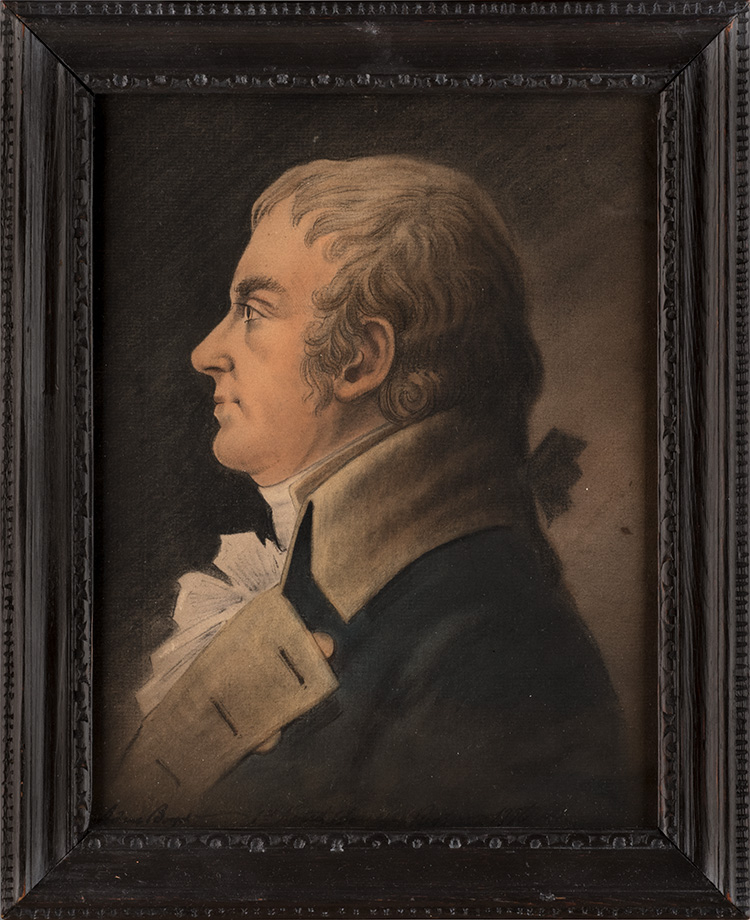 Figure 1 |
The portrait’s surface-level presentation of Boyd as a stoic military figure with ties to the American Revolution seemingly communicates a narrow representation of his personal identity. Later descriptions of the man, including Durward T. Stokes’ principal biography, also have compartmentalized his professional and lived experiences.[3] Both ideological “frames” leave us with an incomplete understanding of Boyd the person and, in turn, Boyd the portrait. Complicating these oversimplified narratives requires interrelating the sitter’s identities, and examining their shared relationship to the formation of a new nation allows viewers to construct a more complex “frame” for this early American portrait.
In each of his identities—as a newspaper publisher in Wilmington, North Carolina, prior to the American Revolution; as a chaplain in the Continental Army; and as a minister traveling along the western edge of the expanding settler-colonial enterprise—Adam Boyd was intimately familiar with and involved in the nation-building project in colonial and early federal America.[4] Applying this lens to Boyd’s pastel portrait enables us to read his interconnected identities within its military portrayal, even when they may not be immediately apparent on its surface. Ultimately, integrating a fuller analysis of Boyd’s life into our interpretations of this example of early American material culture reframes our understanding of the portrait as a tool of identity formation—not only of Boyd himself, but of the emerging nation.
— ♦♦◊♦♦ —
Adam Boyd (1738–1803) lived a varied life, one that mirrored the dynamism of American society during the same period.[5] By 1769, he had established himself as the publisher of the Cape-Fear Mercury, a Wilmington, North Carolina, newspaper. Seven years later, during the American Revolution, he enlisted in the Continental Army and became a regimental chaplain. Following his military service, he ministered in Wilmington; Augusta, Georgia; and Nashville, Tennessee.[6]
A surface-level reading of Boyd’s late eighteenth-century portrait, however, may neglect to capture this complexity. Using pastels on laid paper, which features no noticeable watermark (Figure 2), the once-known artist presented Boyd’s likeness in profile, styling the sitter in a military uniform.[7] An inscription (Figure 3) in the lower left corner of the portrait reads, “Adam Boyd—1st North Carolina Regt.—1776,” identifying Boyd with a Revolutionary-era Continental Army regiment. Indeed, Boyd served in several capacities during the war, culminating in his official role as “Chaplain in [the] 2d N. Carolina battalion.”[8] As a member of the fledgling American military, Boyd actively participated in the construction of the nation. In a 1780 letter, written to solicit advice and fiscal assistance from a government official, Boyd articulated such commitment to the emerging country alongside his dedication to his fellow soldiers: “for I think it my duty, as a servant of the states, to do every service in my power; but for that corps it is more especially my duty to exert myself in everything.”[9]
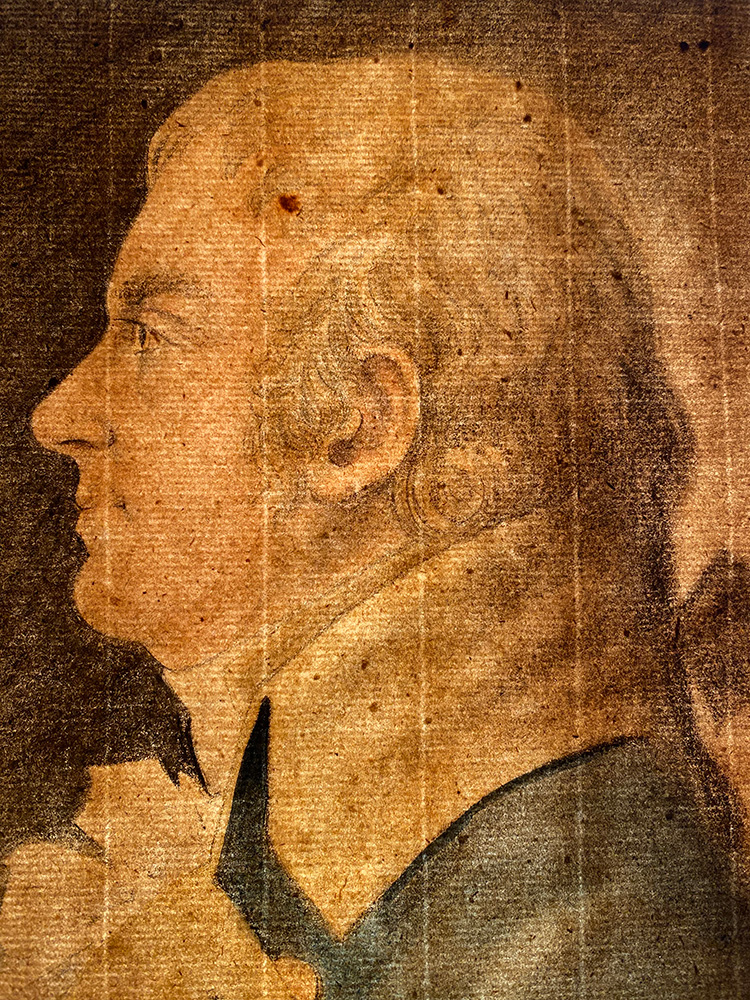 Figure 2 |
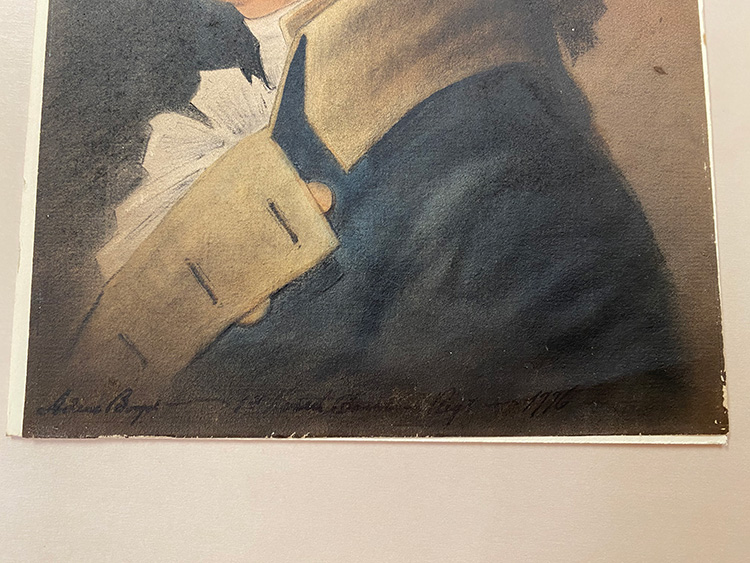 Figure 3 |
More broadly, the overall neoclassical presentation of the sitter reveals a certain posturing of the national project within Boyd’s portrait. In early American artworks—and especially within the genre of eighteenth- and early nineteenth-century profile portraiture—such neoclassical references often cultivated parallels between the ancient Roman Republic and the nascent American one, effectively conveying select messages about this new nation.[10] Boyd’s portrait may encapsulate the enduring legacy of such intentional messaging. The date included in its inscription has traditionally provided the basis for MESDA’s attribution of 1776 as the portrait’s production date. Recent examination of the costume, however, suggests that the pastel was likely produced later, possibly around 1790–1795.[11] If so, the subsequent choice to portray Boyd as a military figure and link him to this historic year may reflect how he—or how those around him—perceived his personal character and national contributions. From profile to inscription, Boyd’s military identity—and its inherent connection to nation building—was painted onto the very surface of his portrait.
Participation in the formation of a national polity characterized Boyd’s life beyond his military service, revealing how his publishing and ministerial identities may also be embedded within his portrait. In his work as a newspaper publisher, Boyd was equally involved in the development of the emerging nation by contributing to the construction of its ideological foundations. At least one of his contemporaries considered this to be an inalienable characteristic of the printing trade. In his 1810 two-volume text, The History of Printing in America, Isaiah Thomas described the distinctive importance of this “art, which is the preserver of all arts” to the American nation: “We [Americans] are able to convey to posterity a correct account of the manner in which we have grown up to be an independent people. . . .”[12] According to Thomas, eighteenth-century Americans used the practice of printing to establish a particular understanding of the nation’s origins, which then was communicated to future generations. More recently, scholars like Joseph M. Adelman have demonstrated how early American printers selectively curated the news and information they disseminated publicly through their papers, reflecting the printers’ personal politics, priorities, and perceptions.[13] Likewise, Boyd’s biographer Stokes hypothesized that Boyd exercised that same editorial authority over his own paper, the Cape-Fear Mercury.[14] In extant copies of Boyd’s Mercury, his contributions to this shaping of the early American ideological landscape are perhaps most evident in published materials that were sympathetic to the revolutionary position.
Visually, Boyd directly linked his paper to American identity and independence. Sometime between 11 May 1774 (Figure 4) and 28 July 1775 (Figure 5), he removed the British royal crest from his paper’s masthead, signaling a shift in his political alignment.[15] The intellectual content he (re)produced through the Mercury likewise reflected his support for the new national endeavor. For example, in his 28 July 1775 issue, Boyd published a “Circular Letter to the Committees of South-Carolina” that contained a scathing condemnation of British governance in the American colonies: “In this conspicuous and ever-memorable year, America has been abused, and Britain has disgraced herself, in an unexampled manner.”[16] Such portrayals provided an ideological justification for the nascent nation, presenting the power imbalance between Britain and the colonies as untenable.
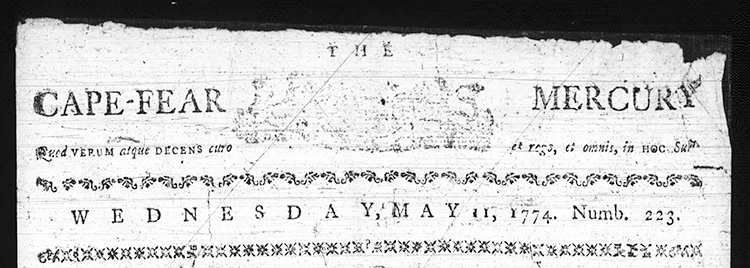 Figure 4 |
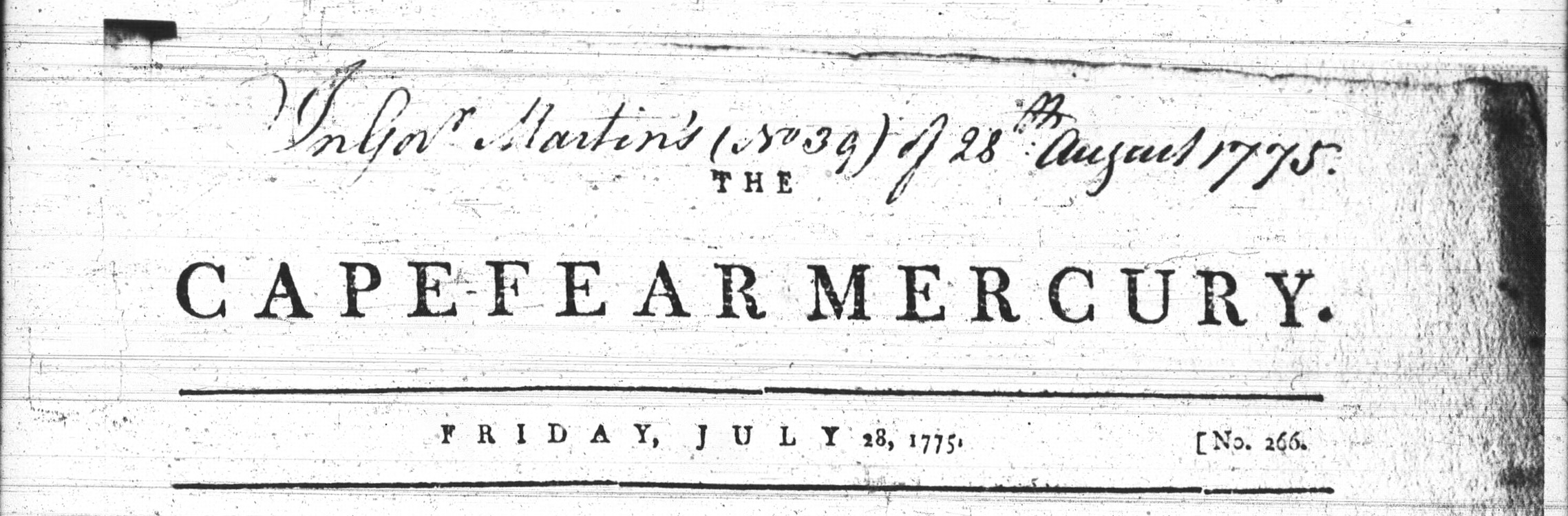 Figure 5 |
Several of the proto-revolutionary messages that Boyd featured in the Mercury expanded this perception by equating the colonists’ experiences under British governance to those of an enslaved community.[17] For example, the same “Circular Letter” continued its criticism of the British government’s “iniquity” by accusing the institution of being “fixed in the pursuit of their plan to enslave America,” while claiming that the American colonists “promise to arrest the hand of tyranny, and to save even Britannia from shackles.”[18] By circulating these analogies in his paper, Boyd helped to position the central concept behind the American project as freedom’s triumph over oppression.
At the same time, however, Boyd filled the Cape-Fear Mercury with information that perpetuated American systems of enslavement, particularly by publishing advertisements seeking the recapture of self-emancipated individuals.[19] Across the twelve regular issues of the Mercury that are extant today, Boyd profited from advertisements placed to re-enslave at least ten self-emancipated persons: William, Richmond, Jerry, Frank, Will, George, Sylvia, Jamey, Valentine, and Cuffee.[20] As scholars like Charmaine A. Nelson and Sue Shon have argued, newspaper advertisements for self-emancipated individuals effectively functioned as portraiture in eighteenth- and nineteenth-century America, often providing the only recorded representations of their personal identities.[21] The Mercury’s ad detailing William’s self-emancipation, for instance, included a description of his age, height, physical appearance, national origin, personality traits, language skills, and professional expertise (Figure 6).[22] Such “verbal” portraits reinforced America’s systems of enslavement by equipping the public with information that could identify—and potentially re-enslave—the self-emancipated individual(s) portrayed.[23] As the distributor of this weaponized information, Boyd framed enslavement practices as a normative component of early American society and facilitated their continuation.
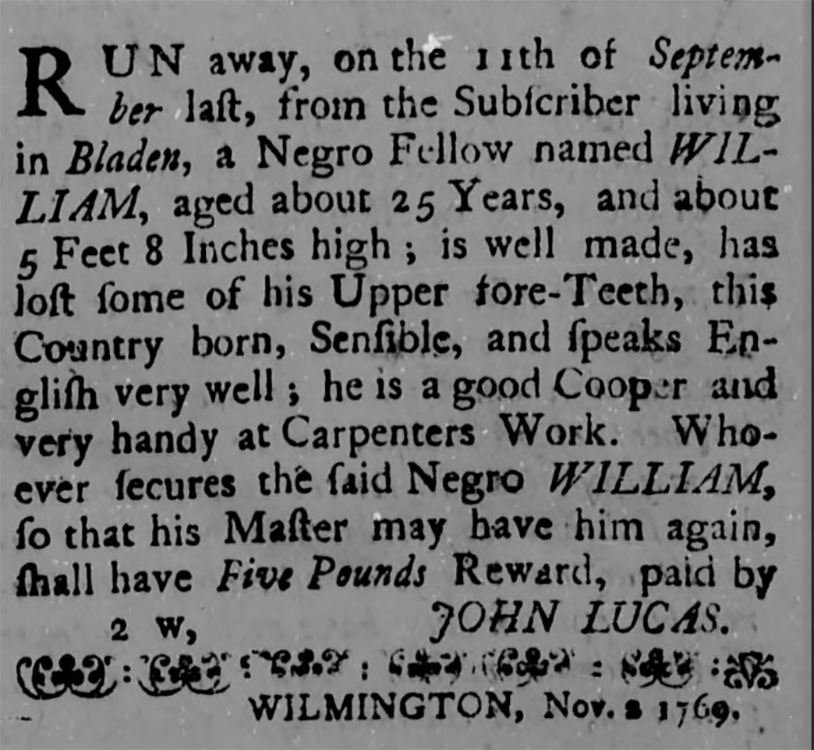
Figure 6
Like the articles and news stories in the Mercury that positioned America as the enemy of oppression, the publication of advertisements for self-emancipated individuals promoted a particular understanding of the national project. Taken together, these materials encapsulated America’s founding ideologies, which demanded freedom for some while enforcing unfreedom for many. Boyd, as publisher of the Cape-Fear Mercury, helped to cement these priorities within the burgeoning national consciousness by making them available for public consumption—seemingly without recognizing their inherent contradictions. For example, the front page of the Mercury’s 25 August 1775 issue (Figure 7) promoted the American colonists’ “desire to maintain the rights and privileges of Englishmen, but not to be their slaves,” while the final page of the same issue (Figure 8) reprinted an advertisement to re-enslave Cuffee as a carpenter.[24]
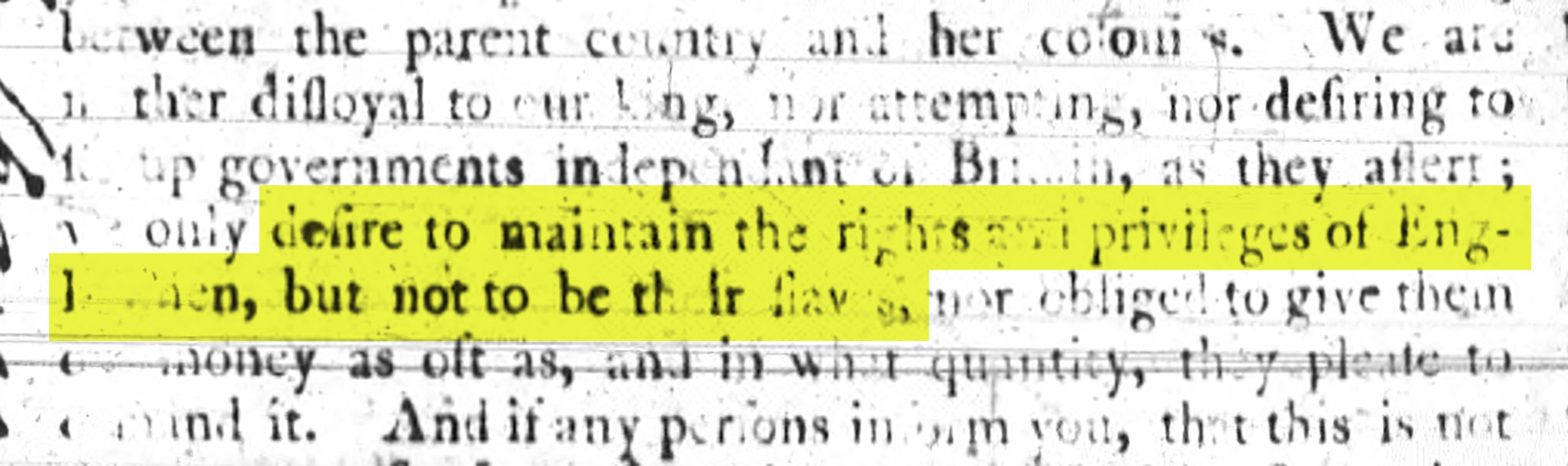 Figure 7 |
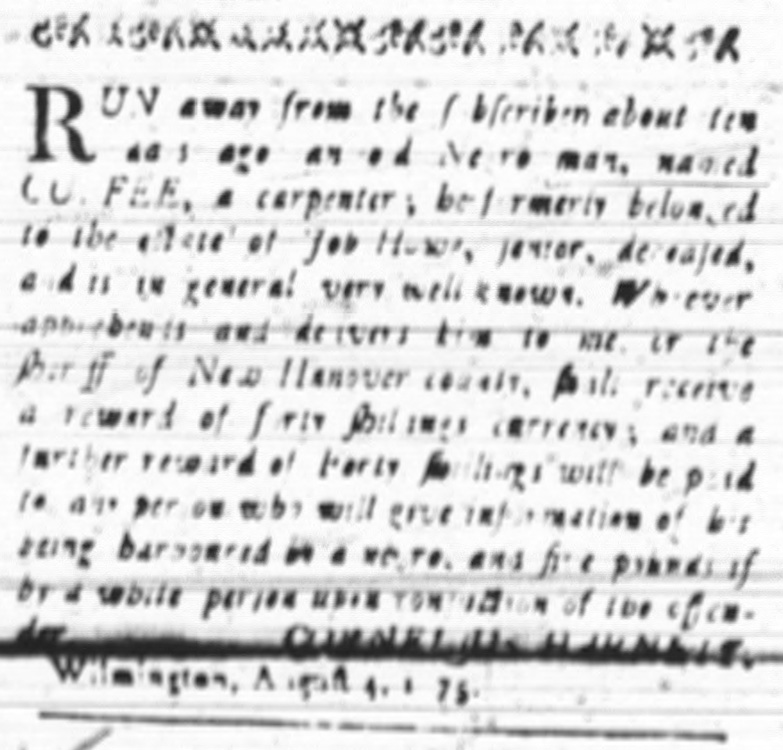 Figure 8 |
Boyd’s active engagement with the ideological formation of an American nation extended beyond his paper and even independence. In fact, in the country’s first decades, his ministerial roles across the American South evinced a distinct continuation of his nation-building efforts.[25] Other eighteenth- and early nineteenth-century figures similarly established links between religion and national development.[26] One of Boyd’s near contemporaries, Reverend Charles Coffin, succinctly summarized the connection in 1833: “Never was there any other country settled, since Canaan itself, so much for the sacred purposes of religion, as our own.”[27] Scholars like Christine Leigh Heyrman also argue that the relationship between religion and the young nation was reciprocal: the evolution of one influenced the direction of the other.[28] Several of Boyd’s ministerial activities revealed his own apparent cultivation of this interdependent bond, as he worked to frame the nation’s political future and imagined legacy in his role as a religious leader.
While living and working as a reverend in Augusta, Georgia, Boyd involved himself in local endeavors to shape national politics.[29] In 1795, for example, his name was attached to a resolution recently ratified at a town meeting.[30] Printed in the Augusta Chronicle, the proceedings concluded by exhorting then-President George Washington not to sign what the petitioners believed to be an imbalanced treaty with Britain.[31] The document clearly communicated the signatories’—and, by extension, Boyd’s—discontent with the proposed piece of legislation; “disgusted” with its contents, they argued that establishing such an unequal arrangement would “appear astonishing” to anyone familiar with the recent history of the American Revolution, especially “in the same age, with the same King and Nation, and in the name of the people who had profusely shed their blood to support [independence].”[32] By signing such sentiments, Boyd entwined his ministerial identity with activities in his own community that sought to influence the country’s political progression.
Even after Boyd relocated to Nashville, Tennessee, around the turn of the century, he continued to blend ministerial functions with nation-building through the public posturing of America’s legacy.[33] His 1800 sermon eulogizing Washington evinces this fusion, broadcasting Boyd’s vision of the newly independent nation as a leader on the global stage.[34] Designed to memorialize the larger-than-life heroism of Washington—bolstering the already-circulating legends about this early American figure—Boyd’s discourse combined religious sentiments with civic messages to position the fledgling country as “a reflector of light—A phenomenon—an era in politics [it was] now to produce.”[35] To support his claim of American exceptionalism, the author emphasized the apparent unity behind the national project: “In this hour of alarm, the states arose from East to West, animated with the same spirit, and all of the same mind, the same judgement.”[36] Reporting on the event, a later article in the Tennessee Gazette commended Boyd for this sermon that “proved how much he loved his friend—how much remained of his Patriotic Virtues!,” indicating that the minister’s political messaging had a wider resonance.[37] Boyd used his ministerial capacity to publicly imagine a national legacy that was both miraculous and unified, further contributing to America’s ongoing ideological development by effectively mythologizing its foundations.
— ♦♦◊♦♦ —
Within this fuller contextual frame, Boyd’s portrayal as a military figure can now be positioned as part of a continuum of interconnected pursuits. Understanding his attempts to influence America’s emergence and growth—concretely in the military and ideologically in both his publishing and ministerial activities—allows us to interpret Boyd’s representation in this two-hundred-year-old object with greater nuance. This search for a common thread between the sitter’s identities has emphasized how they did not exist in isolation, but instead occasionally overlapped. For example, Boyd’s roles as publisher and religious leader converged within specific materials printed in the Cape-Fear Mercury, including a letter addressed to North Carolinian Presbyterian ministers and congregants that attempted to persuade them against supporting Britain ahead of the American Revolution.[38] His military and religious identities aligned most clearly in his role as chaplain within the Continental Army, and again in his sermon commemorating “our general” Washington, “who was the life of the revolution.”[39] Finally, Boyd’s capacity to collect and share information may have connected his publishing practice to his military service.[40]
When reframed in this way, Boyd’s pastel reveals the layers of identity formation that his eighteenth-century portrait embodies. On the surface, the portrait carefully crafts the sitter’s physical identity. Yet, by situating the object within this nation-building frame—and thereby integrating each of Boyd’s roles—we can extend its work of identity construction far beyond the sitter. As we do, a particular projection of national identity emerges from the blended strokes and soft hues of Boyd’s portrait. Alison D. Howard and Donna R. Hoffman have argued that early American art—including portraiture—functioned as accessible tools with the power to forge a collective image of American identity.[41] By memorializing an individual whose personal identity and professional experiences so closely corresponded to the physical emergence and ideological cultivation of the country, Boyd’s portrait communicates deliberate messages about the young nation’s origins, priorities, and mythologies, ultimately influencing perceptions of American history for more than two centuries. Hopefully, it will not take quite as long to find a new physical frame for Adam Boyd, as well (Figure 9).
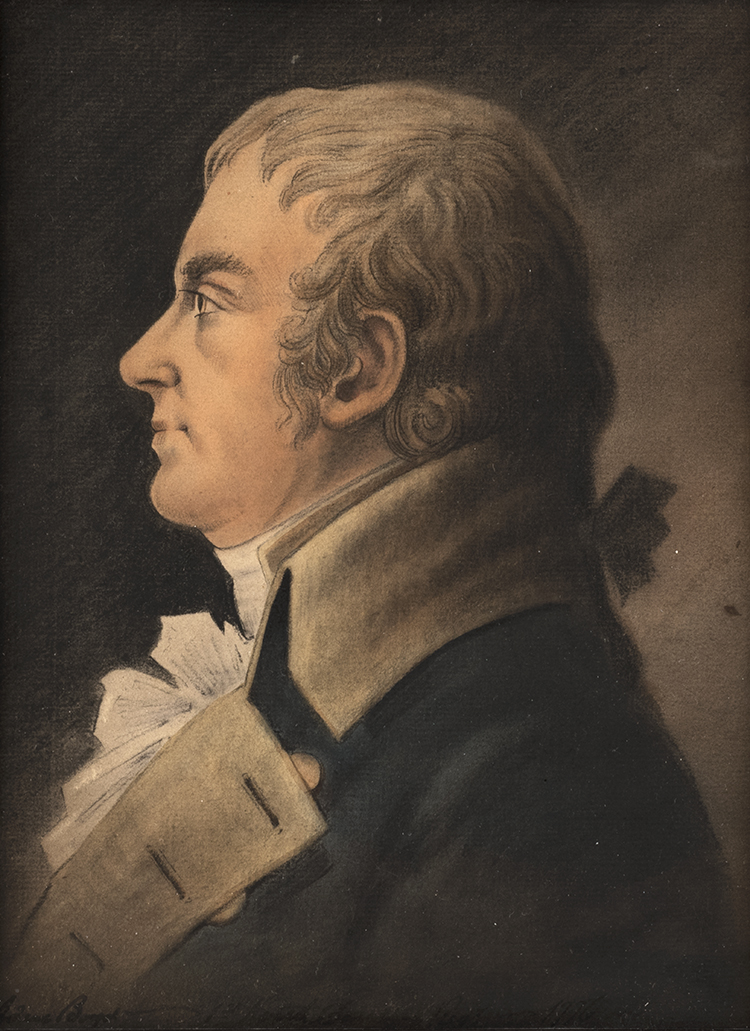 Figure 9 |
Mackenzie Strong is the Curatorial Assistant for Decorative Arts & Design at the Cincinnati Art Museum. She can be reached at [email protected].
The author wishes to thank the following individuals for their generous contributions to this research: Kim May (Director of MESDA Research and Managing Editor, MESDA Journal), A. Nicholas Powers (Curator of Collections, Museum of the Shenandoah Valley), Lea Lane (Curator of the MESDA Collection & Director of MESDA Summer Institute), and Amy Dehan (Curator of Decorative Arts & Design, Cincinnati Art Museum). The author is grateful for their time, feedback, and support throughout this project.
[1] Acquisition Check-Off Sheet, 8 April 1977, Collection File, Acc. 2913, Museum of Early Southern Decorative Arts (hereafter cited as MESDA).
[2] I was first introduced to Adam Boyd in my research project for MESDA’s 46th Summer Institute program in 2023, and I am indebted to Lea C. Lane and Dr. Daniel Ackermann for their assistance and expertise throughout the project. This research inspired the current endeavor to (again) reframe Adam Boyd. For the project’s final presentation script, see: Mackenzie Strong, “Reframing Adam Boyd: Lived Experience and Representation in an Eighteenth-Century Portrait,” 1–20, Collection File, Acc. 2913, MESDA. A recording of the presentation is also available: YouTube, Old Salem Museum & Gardens, “Mackenzie Strong: Reframing Adam Boyd.” Online: https://www.youtube.com/watch?v=14JxSq23iMs&list=PLRGH9r5zILN_KQUuqVAqAY9X-Fvx-e7fz&index=7 (accessed 30 March 2026).
[3] Durward T. Stokes, “Adam Boyd, Publisher, Preacher, and Patriot,” The North Carolina Historical Review 49, no. 1 (January 1972): 1–21. Online: https://www.jstor.org/stable/23529001 (accessed 30 March 2026).
[4] There seems to be some conjecture amongst scholars regarding the best way to define Boyd’s role in his Wilmington printing office. Stokes and Clarence S. Brigham have suggested Boyd acted as the publisher of the Cape-Fear Mercury, while Joseph M. Adelman and Isaiah Thomas apparently have been comfortable including Boyd in discussions of eighteenth-century printers. For the purposes of this research, I elected to refer to Boyd as “publisher” for transparency, but future research may yield more insights. For additional information, see: Joseph M. Adelman, Revolutionary Networks: The Business and Politics of Printing the News, 1763–1789 (Baltimore, MD: Johns Hopkins University Press, 2019), 40 (chap. 1, “Printers and Atlantic Information Networks”), Kindle; Clarence S. Brigham, History and Bibliography of American Newspapers, 1690–1820 (Worcester, MA: American Antiquarian Society, 1947), 2: 778–779. Online: https://archive.org/details/historybibliogra0002clar/page/n5/mode/2up (accessed 30 March 2026); Stokes, “Adam Boyd,” 4–11; and Isaiah Thomas, The History of Printing in America (Worcester, MA: From the press of Isaiah Thomas, Jun., Isaac Sturtevant, Printer, 1810), 2: 152. Online: https://archive.org/details/historyofprintin02inthom/page/151/mode/1up (accessed 30 March 2026).
[5] For a thorough biography of Boyd, see Stokes, “Adam Boyd,” 1–21.
[6] Strong, “Reframing Adam Boyd,” 4–5, 9–12. For another summary of Boyd’s experiences, see: MESDA, “Adam Boyd.” Online: https://mesda.org/item/collections/adam-boyd/2340/ (accessed 30 March 2026).
[7] Strong, “Reframing Adam Boyd,” 2–3; MESDA, “Adam Boyd.” Thanks to the MESDA Summer Institute staff for facilitating the use of a light table during the original research project. Although current scholarship has not yet identified the artist who created Boyd’s portrait—nor the location in which it was painted—a comment in an 1800 letter from Boyd might yield future research. While based in Nashville, Tennessee, Boyd wrote: “I have sent some little pieces of mine to Mr. Wilkings with design that Mrs. Toomer [Boyd’s stepdaughter] should have a copy if she desired it. Perhaps they may assist her meditations.” For a full transcript of the letter, see: The North Carolina Society Daughters of the Revolution, The North Carolina Booklet, vol. 15 no. 1 (Raleigh: Commercial Printing Company, 1915), 118–121. Online: https://babel.hathitrust.org/cgi/pt?id=nyp.33433081772075&seq=7 (accessed 18 September 2026).
[8] Adam Boyd, 16 May 1778, “Oath of allegiance to the United States by Adam Boyd.” Walter Clark, ed., The State Records of North Carolina (Winston, NC: M. I. & J. C. Stewart, Printers to the State, 1896), 13: 418–419. Documenting the American South, University Library, The University of North Carolina at Chapel Hill, https://docsouth.unc.edu/csr/index.php//document/csr13-0481 (accessed 15 September 2026). For an overview of Boyd’s military roles, see: Stokes, “Adam Boyd,” 12–14; Strong, “Reframing Adam Boyd,” 9–10.
[9] Adam Boyd, 3 June 1780, “Letter from Adam Boyd to Abner Nash.” Walter Clark, ed., The State Records of North Carolina (Winston, NC: M. I. & J. C. Stewart, Printers to the State, 1896), 14: 834. Documenting the American South, University Library, The University of North Carolina at Chapel Hill, https://docsouth.unc.edu/csr/index.php/document/csr14-0792 (accessed 15 September 2026).
[10] Ellen G. Miles, Saint-Mémin and the Neoclassical Profile Portrait in America (Washington, D.C.: National Portrait Gallery and the Smithsonian Institution Press, 1994), 47. Online: https://archive.org/details/saintmeminneocla0000mile/page/n5/mode/2up (accessed 30 March 2026); Alison D. Howard and Donna R. Hoffman, “A Picture Is Worth a Thousand Words: Building American National Identity Through Art,” Perspectives on Political Science 42, no. 3 (July–September 2013): 147.
[11] During initial research for the 2023 Summer Institute, print expertise from Katie McKinney (Margaret Beck Pritchard Assistant Curator of Maps and Prints, The Colonial Williamsburg Foundation) and costume expertise from Neal Hurst (Curator of Textiles and Historic Dress, The Colonial Williamsburg Foundation) suggested a possible later date. Hurst specifically noted that the stand-and-fall collar of Boyd’s uniform likely indicated a later production date. In correspondence related to this 2026 project, Hurst proposed the 1790–1795 date range based on extant examples of 1790s military uniforms and contemporaneous representations of uniforms dated to 1776. I am grateful to both scholars for their assistance and guidance. See also: Strong, “Reframing Adam Boyd,” 4.
[12] Isaiah Thomas, The History of Printing in America (Worcester, MA: From the press of Isaiah Thomas, Jun., Isaac Sturtevant, Printer, 1810), 1: 203, 10. Online: https://archive.org/details/historyofprintin_01inthom/page/n7/mode/2up (accessed 30 March 2026).
[13] Adelman, Revolutionary Networks, 5–6 (introduction).
[14] Stokes, “Adam Boyd,” 8. Brigham has catalogued a helpful biography of the Cape-Fear Mercury. According to the historian, the Mercury was published weekly, likely beginning on October 13, 1769; it ran consistently until 1774/1775, and then Boyd revived the paper for several months until he began his military service in 1776. For more information, see: Brigham, History and Bibliography, 778–779.
[15] Cape-Fear Mercury, Wilmington, North Carolina, 11 May 1774, 1. From North Carolina State Archives, presented online by the North Carolina Digital Heritage Center, https://newspapers.digitalnc.org/lccn/sn83025834/1774-05-11/ed-1/seq-1/ (accessed 30 March 2026); Cape-Fear Mercury, Wilmington, North Carolina, 28 July 1775, 1. From North Carolina State Archives, presented online by the North Carolina Digital Heritage Center, https://newspapers.digitalnc.org/lccn/sn83025834/1775-07-28/ed-1/seq-1/ (accessed 30 March 2026). This shift in Boyd’s political leanings is also noticeable in the content he produced within the Mercury. For an example of his earlier apparent allegiance to Britain, see: Cape-Fear Mercury, Wilmington, North Carolina, 24 November 1769. From North Carolina State Archives, presented online by the North Carolina Digital Heritage Center, https://newspapers.digitalnc.org/lccn/sn83025834/1769-11-24/ed-1/seq-1/ (accessed 30 March 2026).
[16] “A Circular Letter,” Cape-Fear Mercury, Wilmington, North Carolina, 28 July 1775, 1. From North Carolina State Archives, presented online by the North Carolina Digital Heritage Center, https://newspapers.digitalnc.org/lccn/sn83025834/1775-07-28/ed-1/seq-1/ (accessed 30 March 2026).
[17] “A Circular Letter,” Cape-Fear Mercury, 28 July 1775, 1; “In Provincial Congress,” Cape-Fear Mercury, Wilmington, North Carolina, 11 August 1775, 4. From North Carolina State Archives, presented online by the North Carolina Digital Heritage Center, https://newspapers.digitalnc.org/lccn/sn83025834/1775-08-11/ed-1/seq-4/ (accessed 30 March 2026); “An Address,” Cape-Fear Mercury, Wilmington, North Carolina, 25 August 1775, 1–2. From North Carolina State Archives, presented online by the North Carolina Digital Heritage Center, https://newspapers.digitalnc.org/lccn/sn83025834/1775-08-25/ed-1/seq-1/ (accessed 30 March 2026).
[18] “A Circular Letter,” Cape-Fear Mercury, 28 July 1775, 1.
[19] Boyd also personally benefited from and participated in enslavement. For further details about how Boyd’s family was supported in part by the labor of enslaved people “inherited” from his wife Mary Ivy DeRosset Boyd’s first marriage, see: Stokes, “Adam Boyd,” 12; Strong, “Reframing Adam Boyd,” 7–8. For advertisements linking Boyd to the hiring, selling, and purchasing of enslaved people, see: Adam Boyd, “[To] be hired,” Cape-Fear Mercury, Wilmington, North Carolina, 8 December 1769, 4. From North Carolina State Archives, presented online by the North Carolina Digital Heritage Center, https://newspapers.digitalnc.org/lccn/sn83025834/1769-12-08/ed-1/seq-4/ (accessed 30 March 2026); A. Boyd, “To be sold for cash” and “WANTED,” Cape-Fear Mercury, Wilmington, North Carolina, 29 December 1773, 1–2. From North Carolina State Archives, presented online by the North Carolina Digital Heritage Center, https://newspapers.digitalnc.org/lccn/sn83025834/1773-12-29/ed-1/seq-1/ (accessed 30 March 2026).
[20] Cape-Fear Mercury, 24 November 1769, 4; Cape-Fear Mercury, 8 December 1769, 4; Cape-Fear Mercury, Wilmington, North Carolina, 13 January 1773, 1. From North Carolina State Archives, presented online by the North Carolina Digital Heritage Center, https://newspapers.digitalnc.org/lccn/sn83025834/1773-01-13/ed-1/seq-1/ (accessed 30 March 2026); Cape-Fear Mercury, Wilmington, North Carolina, 7 August 1775, 4. From North Carolina State Archives, presented online by the North Carolina Digital Heritage Center, https://newspapers.digitalnc.org/lccn/sn83025834/1775-08-07/ed-1/seq-4/ (accessed 30 March 2026); Cape-Fear Mercury, 25 August 1775, 4.
[21] Charmaine A. Nelson, Keynote Lecture: “Considering Slavery and Portraiture,” delivered at the Historic Deerfield Public Colloquium, “Reawakening Materials: American Art, Empire, and Material Histories in Historic Deerfield’s Collection,” 7–8 November 2024; Sue Shon, “Runaway Slave Portraiture, Aesthetic Culture, and the Emergence of Racial Sense,” Media-N: The Journal of the New Media Caucus 18, no. 1 (Spring 2022): 7–10. Illinois Open Publishing Network, https://iopn.library.illinois.edu/journals/median/article/view/850 (accessed 30 March 2026).
[22] Cape-Fear Mercury, 24 November 1769, 4.
[23] Shon, “Runaway Slave Portraiture,” 7.
[24] Cape-Fear Mercury, 25 August 1775, 1, 4.
[25] For a review of Boyd’s ministerial engagements after the American Revolution, see: Stokes, “Adam Boyd,” 16–21.
[26] James H. Hutson, Religion and the Founding of the American Republic (Washington, D.C.: Library of Congress, 1998), 108–109, 113. Online: https://babel.hathitrust.org/cgi/pt?id=mdp.39015041910244&seq=23 (accessed 30 March 2026).
[27] Reverend Charles Coffin, 22 July 1833, “Letter XXIII.” William B. Sprague, Lectures on Revivals of Religion (New York: Daniel Appleton, 1833), 399. Online: https://archive.org/details/lecturesonreviva00spraguoft/page/n436/mode/1up (accessed 30 March 2026).
[28] Christine Leigh Heyrman, Southern Cross: The Beginnings of the Bible Belt (New York: Alfred A. Knopf, 1997), 21–22 (prologue), Kindle.
[29] An article in the Augusta Chronicle places Boyd as the minister of a local church at the beginning of 1795. For reference, see: J. Meriwether, “Board of Trustees,” Augusta Chronicle, Georgia, 24 January 1795, 3. Online: https://www.genealogybank.com/doc/newspapers/image/v2%3A1252FEAF2D2D3A44%40GB3NEWS-1270F66177F5BA7F%402376694-1270F6617ABDE318%402-177329BF732D8885%40%255BSavannah%253B%2BCol.%2BDorsey%253B%2BSteuben%253B%2BNew%2BYork%255D%257C%255BAustrians%253B%2BCampaign%253B%2BHolland%253B%2BLimbourg%253B%2BCologne%255D%257CAdvertisement?h=6&fname=adam&lname=boyd&fullname=&rgfromDate=1780&rgtoDate=1803&formDate=&formDateFlex=exact&dateType=range&kwinc=&kwexc=&sid=hefzuzeepkequmsrxffuzdppestfitjt_ip-10-166-46-145_1774896479757# (accessed 30 March 2026). Stokes has suggested that Boyd was ministering in Georgia as early as 1786, and in Augusta between 1790 and 1799; see: Stokes, “Adam Boyd,” 17–18.
[30] “Town Meeting,” Augusta Chronicle, Georgia, 5 September 1795, 2. Online: https://www.genealogybank.com/doc/newspapers/image/v2%3A1252FEAF2D2D3A44%40GB3NEWS-1270F6A668BDDF83%402376918-1270F6A66B8990EB%401-12E1A53883D1A940%40Town%2BMeeting?h=7&fname=adam&lname=boyd&fullname=&rgfromDate=1780&rgtoDate=1803&formDate=&formDateFlex=exact&dateType=range&kwinc=&kwexc=&sid=hefzuzeepkequmsrxffuzdppestfitjt_ip-10-166-46-145_1774896479757 (accessed 30 March 2026).
[31] “Town Meeting,” Augusta Chronicle, 5 September 1795, 2.
[32] “Town Meeting,” Augusta Chronicle, 5 September 1795, 2.
[33] Stokes, “Adam Boyd,” 20–21.
[34] Adam Boyd, A discourse, sacred to the memory of George Washington, the father of his country (Nashville, TN: Printed [by John M’Laughlin?] for the author, 1800). Eighteenth Century Collections Online: Print Edition. For a summary of Boyd’s experiences in Nashville, see: Stokes, “Adam Boyd,” 20–21.
[35] Boyd, A discourse, 8.
[36] Boyd, A discourse, 10.
[37] Tennessee Gazette, Nashville, Tennessee, 25 February 1800, 3. Online: https://www.genealogybank.com/doc/newspapers/image/v2%3A120FA649DE8643BD%40GB3NEWS-121CAEE9DF14AA40%402378552-121CAEE9F09DE088%402-121CAEEA2BCBF5B8%40Matrimony%2BNotice?h=9&fname=&lname=boyd&fullname=&kwinc=&kwexc=&rgfromDate=1799&rgtoDate=1800&formDate=&formDateFlex=exact&dateType=range&processingtime=&addedFrom=&addedTo=&sid=kctotbauheztlerzjfddkpecwikibddc_ip-10-166-46-117_1774898240299 (accessed 30 March 2026).
[38] “An Address,” Cape-Fear Mercury, 25 August 1775, 1–2. Stokes has further connected Boyd’s identities by suggesting that he may have had clerical training and experience by the time he emerged in the historical record in Wilmington, where he eventually initiated his publishing career. And, according to Adelman, religious subjects were consistently a popular feature of early American newspapers. For more information, see: Stokes, “Adam Boyd,” 3–4; Adelman, Revolutionary Networks, 40 (chap. 1, “Printers and Atlantic Information Networks”).
[39] Boyd, A discourse, 11, 20.
[40] Stokes has outlined the various ways that Boyd attempted to expand his military role, specifically citing one wartime letter in which Boyd seemingly functioned as intelligence liaison. For Stokes’ analysis, see: Stokes, “Adam Boyd,” 12–14. For Boyd’s letter, see: Adam Boyd, 20 August 1781, “Letter from Adam Boyd to Thomas Burke.” Walter Clark, ed., The State Records of North Carolina (Goldsboro, NC: Nash Brothers, 1899), 16: 1200. Documenting the American South, University Library, The University of North Carolina at Chapel Hill, https://docsouth.unc.edu/csr/index.php/document/csr16-0703 (accessed 15 September 2026). Adelman also has emphasized a similar knowledge-gathering role as essential to early American newspaper printers’ practices; see: Adelman, Revolutionary Networks, 4–6 (introduction).
[41] Howard and Hoffman, “A Picture Is Worth a Thousand Words,” 142–145, 150.